The Supernote Nomad

Do you, like my sister-in-law, make a distinction between listening to books and “real reading”? Real reading, so this interpretation goes, occurs when your eyes scan words. Some people go so far as to say that it only counts as real reading when you are touching paper pages. No Kindles allowed. Speaking for myself, I am happy to say that I read books to which I only listened.

I’m thinking about this because I’m writing this while sitting on an airplane flying home from a vacation. When I say I’m writing, I mean that I am engaged in what might be called “real writing” in the same sense that my sister-in-law refers to “real reading.” That is, I am using a pen and writing in longhand. But much like reading a Kindle, I’m not using ink or paper. I’m using a device called a Supernote Nomad. I like it a lot. In fact, I like it so much that I’m trying explain to myself why. Why is it better, at least to me, than using pen and ink? And why is it better than a keyboard? Well, for one thing, it’s a shiny new gadget, and I love shiny new gadgets. So there’s that. I could still be in the new gadget honeymoon phase. But the Nomad holds all my writing in one convenient location. No notebooks or loose leaves spilling about. The feeling of the stylus moving against the “page” is very comfortable. And when I’m ready to transfer something I wrote to the computer, it has handwriting recognition, saving me the trouble of re-typing anything.
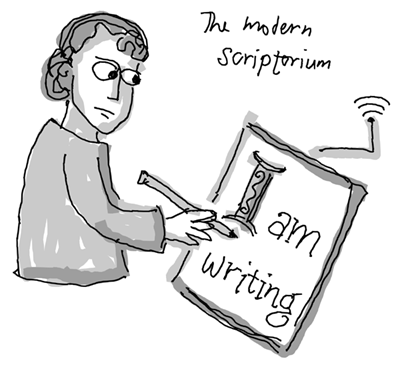
Drawn on a Nomad

I’m reminded of when I first bought an electric piano years ago (a Yamaha Clavinova). I wanted it to have the full complement of keys, feel as natural as possible, and otherwise be very minimal and clean. It was the same with this device. It’s small, simple, comfortable, and dedicated to a single task. I ask myself: why not just type into the keyboard of a small laptop or iPad? This thing is compact. I have it on my lap right now as we go through turbulence before landing at Logan Airport in Boston. But quite apart from its compact form, I like the fact that this device is dedicated to one task. With an iPad or a laptop, there is always the lurking danger of Distraction By Internet. That’s simply not possible with this device. And also by virtue of being dedicated to a single task, it feels more private. I share my iPad with others, but not this. What I write here stays here. Unless of course I choose to export it to the wide world, which I now do, if only to sing the praises of the Supernote Nomad.

Ultimately, using a pen takes my writing to a different place than typing does. I enjoy it and so it keeps me at the task longer. That is surely a very idiosyncratic thing. But if you, like me, enjoy the feel of writing in longhand and the convenience of a digital notebook, you should give this thing a try. It’s a keeper.

Happy Maps and Hedonic Cartography

Driving north on Massachusetts Route 3 today, I noticed traffic was starting to back up. How serious is this slowdown? Waze informed me that traffic was getting worse and offered to re-route me. A quick peek at the map showed clotted red roads ahead. I took the suggested route change. Thanks Waze!

Have you ever wondered where all that traffic data comes from? In the old days, some poor slob would be leaning out of a helicopter with binoculars, checking on the Tobin Bridge or whatever. But those days are over. Now, dear reader, the traffic data comes from you. Or from your phone, to be specific. That phone is telling the world where you are and how fast you’re moving, and this information can be aggregated into a beautiful map.

Your phone knows an awful lot about you. In addition to where you are, it knows who you’re talking to, what you’re listening to, what you’re searching for. Throw in a wearable, like an Apple Watch, and it knows even more: temperature, heart rate, respiratory rate. Let’s imagine it also knew how happy you were at any given time. It seems to me not unreasonable that this will soon be a thing: continuous automatic mood detection. It would be really interesting to look at maps of aggregated happiness values. Then we could have happy maps the same way we have traffic maps now. Imagine looking at the Happiness Layer on Google Maps. Want to feel better? Just steer into the area crowded with yellow bubbles.

Some of the results might be obvious. It’s pretty clear that parks make people happier than parking lots. But it would be fascinating to see when the hours of peak happiness are for a park. Why are some parks happier than others? When do crowds make people more happy and when do they make them less happy? How strong is the correlation between wealthy areas and happy areas? I like the idea of getting a notification that my neighborhood is “more happy than usual” tonight.

If we measure changes in happiness, we can see what areas are associated with large improvements in happiness (as opposed to just being places where happy people go). I’ll make an app called Happy Feet. Where should you walk if you want to improve your mood? If you follow the happiness gradient uphill or downhill, where will you end up?

Image by Midjourney

So far I’m describing this in terms of location-based happiness. But we can look for all kinds of correlations. What music makes people happiest? What food? What gifts? Data science and artificial intelligence are going to give us ways to sift through huge amounts of data looking for interesting connections. This whole notion may seem creepy and invasive, but consider how valuable it will be to advertisers, and thus how inevitable it is. You use Google every day, but its premise is kind of dystopian: several times an hour, tell a giant corporation exactly what you desire at this moment. If it wasn’t so damn useful, you’d never do it.

So that’s my prediction for a thing that’s on the way: happy maps. I can’t tell you how to be happy, but I can tell you where to go stand to be next to happy people. Of course, that might just make you miserable. Your smileage may vary.

Attention Hygiene and the Snooze Feed

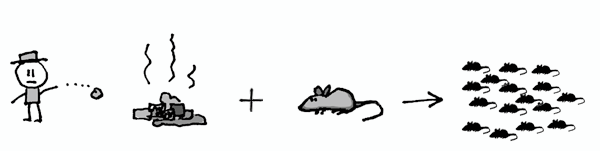
You are the mayor of a town with a serious rat problem. The municipal rat catcher comes by with his report: “I killed a thousand rats this month.” “Well done!” you say, and you write him a check. But this goes on month after month for years. Sometimes more rats, sometimes fewer. One day you think, shouldn’t we be coming to the end of the rats soon? At that moment, you are enlightened: You’re not in the rat extermination business. You’re in the rat FARMING business. Farmers don’t run out of wheat. They help it grow, they harvest it, then they start over again. Until you eliminate the conditions that let rats thrive, you’re just another farmer harvesting regular crops of rats. Chastened by this realization, you look around your town with fresh eyes.

It’s a rat paradise! Piles of food left out to rot, uncovered garbage, and a rat catcher who is more than happy to be fully employed month after month. Only when you clean the place up does the rat population finally start to go down for good.

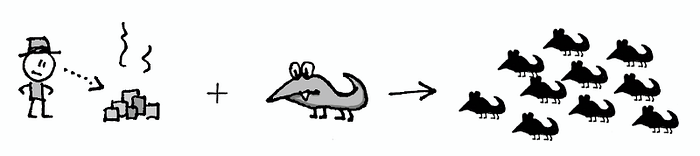
Eventually you move on from your job in Ratburg. You are now the mayor of Facebookville, and you have a serious meme problem. Toxic fake news memes are running rampant, biting your citizens. You pay meme debunkers to come in every month and spray them with facts and explainers. Mr. Snopes, the municipal debunker, assures you that he is making good progress. “We killed a thousand memes this month!” But one day, as you ponder the meme food chain, it hits you. You’re a freaking MEME FARMER!

Here’s how it works. Humans excrete attention through their eyeballs. Memes feast on it, and then multiply into toxic blooms of fake news. It doesn’t pay to intervene by debunking individual memes. More will keep pouring in. You can never get ahead of the meme population until you control the steaming heaps of waste attention that pollute your streets. You thank Mr. Snopes for his valiant but ultimately misguided work. The real work lies elsewhere.

Advertisers have rewarded Facebook for consolidating all this thinly spread and divergent attention into one convenient pile. They eat their fill and leave behind a filthy mess. Until we address this problem of attention hygiene, fake news will only proliferate. Every time you take the click bait, you delight the meme, the troll who created him, and the debunker who lives for the tiny noiseless take-downs that currently pass for progress. Your untended attention is a menace to society.

So what does attention hygiene look like?

Do a social media fast every other day. Consider not forwarding or re-tweeting that stupid thing the stupid politician did. Know your triggers and steer clear of them. See a headline about a maddening NRA ad? Don’t click! You know nothing good will come of it. Importantly, even the institutions are starting to acknowledge the problem and respond. Facebook has introduced a snooze button that will let you temporarily unfollow a person, page, or group for 30 days. Call it the Snooze Feed.

We’re getting better at this. Eventually we’ll have clean streets and good attention sewers. But for now we’re still in the filthy old London typhoid ‘n cholera stage. Boil your newsfeed, and please, don’t sneeze into your browser!

Note: this post originally appeared on Medium. I’m repatriating it over here on starchamber.com.