When I was in grad school, my friend Larry Alder and I had a special term for when you truly understood something. Everyone knows that, armed with a little knowledge, you can sometimes wing it. Fake it. Multiple choice test? You’ll do okay. Of course, if you put in the time memorizing lists of facts, you can do better. You’ll probably even get a good grade in the class. But do you REALLY understand it? Really? This can be brutally important for some topics.

Let’s say you’re being grilled on a subject like, oh I don’t know, the area-Mach relation in a supersonic converging-diverging rocket nozzle. Of course you already know that
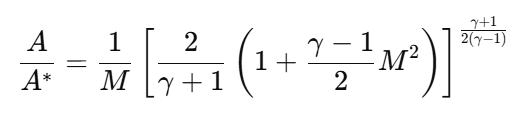
because duh, right?
Then again, that’s just a string of fancy letters and numbers. What assumptions does it depend on? Can you re-derive it on the whiteboard right now? Do you see how it’s implied by the conservation of mass flow? Do you understand the physical implication of the specific heat ratio? Can you explain it to me like it’s two in the morning, I’m going crazy, and I have to finish this godforsaken problem set before I go to sleep?
Because that’s how it was with me and Larry. We were in the same classes and we often helped each other with tough problems. There were times when one of us (probably me) would say “Well, I get the right answer, but I can’t explain why.” That’s KNOWING the answer. And there were other times when one of us (probably Larry) would say “What do you want to know? I can explain this a few different ways.” That’s OWNING the answer. That’s when you see how it slots snugly into the grid of everything else you know. How it’s not just interesting THAT it’s true, because of course it simply MUST be true.
I don’t claim that I owned many topics (including my old nemesis, the converging-diverging nozzle). But it was a useful distinction. I sometimes think of it like this: Tell me something you know. Now tell me something that will get you laid. The first of these is flashy knowledge, insubstantial. Ooh! Big boy knows some Greek letters! The second of these, well, that’s worth something. It’s hard to get to and it’s hard to fake.
This whole concept has been on my brain a lot recently because of Crepusculus. I’m sure you remember that Crepusculus is the festival that falls on the day of the earliest sunset (which is December 9th at my latitude). Without getting into it too much, the earliest sunset happens earlier than the shortest day (December 21st), because of something with the very grand name of Equation of Time. The Equation of Time, in turn, depends on two major factors: the elliptical nature of the Earth’s orbit (eccentricity) and the tilt of the Earth’s axis (obliquity). I’m not pretending to explain any of this here, but I will tell you that the eccentricity part is easy to understand and explain. But the obliquity part… I just couldn’t SEE it. I knew the equation, I read the explanations on various web pages, but I didn’t OWN it in a satisfying way. So that was the challenge I set for myself this year.

I’m happy to say I succeeded, at least to my own satisfaction. I wrote a bunch of MATLAB code and made some fun models. If you want to follow the technical discussion, you can follow along with the piece that I put on my work blog: The Perils of Obliquity. And as a bonus, I vibe-coded a JavaScript web app you can run here: Obliquity.
The main thing I wanted to ruminate on here was this crucial difference between the name dropping that passes for knowledge and the thorough embrace by which we push machines through the sky.
 Rambles Blog at Star Chamber