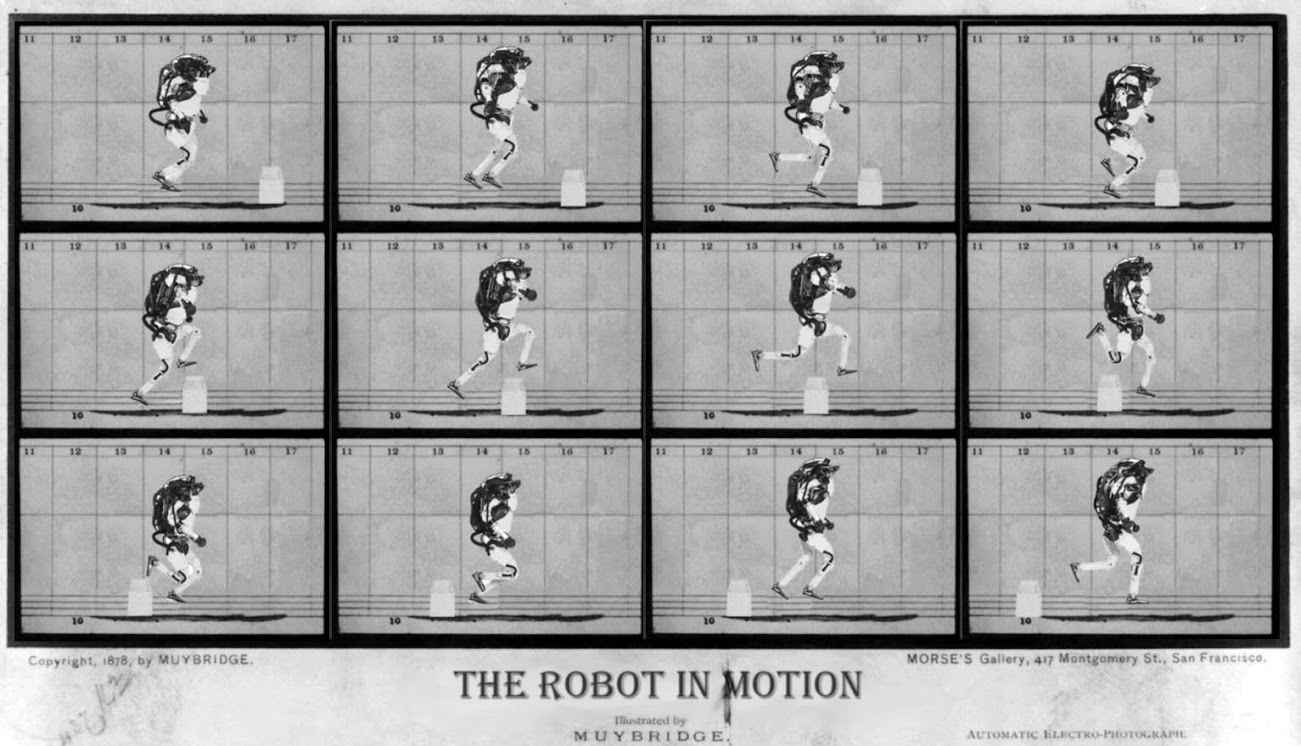
You know the story: One night over whiskey, Leland Stanford and Eadweard Muybridge were having an argument about the Atlas robot from Boston Dynamics. The question: does Atlas always have one foot on the ground while he’s moving?
The primitive photographic technology of the time had no way of telling if the robotic wonder was ever truly airborne. But Muybridge kept at it, and eventually came up with this.
I am going to found an organization called MetaMensa. Admission is based on your IQTQ. That’s your Intelligence Quotient Test Quotient. It measures how good you are at taking IQ tests relative to how good you could possibly be at taking IQ tests. So if you get 8 out of 10 questions correct, then you have an IQTQ of 80. You must have a positive IQTQ to join MetaMensa. There’s some controversy regarding how well IQ tests do measuring your intelligence. But MetaMensa sidesteps all that: we have a rock-solid way to test your IQTQ. By the way, we make no claims about the relationship of the IQTQ to your intelligence. Just to your ability to take IQ tests.
If you multiply your IQTQ by your age and divide by 100, you will get your IQTQ Age Factor (IQTQAF), a number that is equal to or less than your age. What this value (measured in years) signifies isn’t yet clear, but the arithmetic is not difficult to perform. People with an IQTQAF greater than their age are immediately disqualified from MetaMensa, because somewhere their math has gone badly wrong, and that’s not the sort of person we want parading around as the sort of person who parades around as someone who they believe is believed to be smart because of how they score on a culturally biased and academically bankrupt test of perceived but not actual intelligence. Not by a long shot.
At the MetaMensa Gift Shop we sell t-shirts that say “Say what you will about my intelligence, but I’m very good at taking IQ tests.” On the back it says “I joined MetaMensa and among other things I got this t-shirt. It’s not lousy. ‘Lousy’ actually means ‘full of lice’, and this t-shirt does not fit that description. At least not at the time it was purchased. And by the way, it’s just a myth that highly intelligent people are pedantic assholes.” We also sell novelty pants that say “These are actual smarty-pants.” They’re novelty pants because they’re not actually smart.
MetaMensa holds monthly dinners in which the seating is strictly stratified by IQTQ scores. If you have an odd IQTQ score, you are required to sit next to someone with an even IQTQ score. That way, you can see how the other half lives.
So have you got what it takes to join MetaMensa? Look in the mirror and ask yourself this question: “Do I have $35 for the admission fee?” If the answer is yes, then the answer is yes. You’re our kind of person.
See these? These are Sonos speakers, and they used to sit in my kitchen and living room. But I’m done with them now. I’d offer them to you, but they’re worthless. Incapable of functioning. They will never sing again.
I’m replacing these speakers with the latest model from Sonos. But usually when I upgrade, I can pass along my old hardware. I can give you my old television or DVD player or whatever. But when I looked at these old units sitting on the floor of my basement, they had a particularly forlorn look. They’re good for nothing but scrap.
We don’t expect things to last forever. We’re used to the value of things decreasing steadily over time. But my speakers experienced a step function, going from useful to useless as quickly as if they’d been dropped into a blender. Increasingly, hardware is only as good as its software, and increasingly that software is a cloud-only service provided at the whim of a far off firm.
Here’s what happened.
I bought the speakers ten years ago, and they served me well. But recently Sonos offered me a good deal on new equipment — a 30% discount on brand new speakers if I would just get rid of my old ones. I could see where this was headed. Old hardware is a pain to support, and Sonos wants to be rid of these old boxes. They were offering me a carrot to upgrade now. But I had no doubt that behind their back they also carried a stick. At some point they will unilaterally withdraw support. I took the offer. Once I got my new speakers, Sonos headquarters sent a bullet down the wire that euthanized the old ones. They let me know, in no uncertain terms, that they would never work again for my account or anyone else’s.
I like my new speakers. I’m glad I upgaded. But Sonos, it occurred to me, has a lot more leverage over my inclination to upgrade than, say, the company that made my DVD player.
Soon enough, software will enter and enliven every object under the sun. Door knobs and dishwashers, toothbrushes and table tops, eyeglasses and egg cartons, mirrors and refrigerator magnets. They will all acquire amazing new skills. But if for some reason the software is voided, the objects must die. And it’s difficult to opt out. Software-enabled hardware is truly better. But you need to stay up-to-date, which means you need to be a customer in good standing with a healthy, trustworthy company. Otherwise your device will become a doorstop. You own the object, but you don’t own the soul. It’s an animal that you rent. It can die. It can turn on you. Mostly it will be a good deal, but it can go away at any time. Get used to it!
My wife drives a Ford Fusion hybrid. It’s packed with plenty of software, but she’s never updated it. As far as I can tell, that’s not something that Ford ever planned for. This is a snapshot from a simpler world. I drive a Tesla, and it gives you a sense of where the industry (not to mention the world) is headed. The car receives regular over-the-air updates. It’s great to have the car’s functionality constantly updated. But if the company went out of business, I can imagine the car becoming a large and expensive brick. I don’t mean to pick on Ford or Tesla. It’s just an example, along with Sonos, of the coming world. Live by the wire, die by the wire.
I like Twitter. It’s my favorite way to fill the found minutes that pile up during the day. I’m waiting in the lunch line. I’m brewing coffee. The movie hasn’t started yet. But then a certain third-grader was elected president of my country, and since then I’ve noticed that a surfeit of Twitter is making me ill.
I don’t go out of my way to follow politically-oriented people on Twitter, but these days you just can’t get away from politics. Some fresh outrage presses itself on the fretful populace and people can’t help but tweet about it. And then I can’t help but read about it. And then I get mad, and I follow links and I read analyses and opinion pieces and still more warm suckling Twitter (beware of anything that suggests itself as a solution to the problems it creates). I get more mad. I trade valuable time for stomach acid… and so it might take me an hour to calm down from the outrage of the hour, and by then of course a new one is just beginning to squat on the nation.
And to what end, my Twitter indulgence? Am I a better informed citizen, ready to make a difference? Am I more engaged or just more enraged? In general I don’t advocate avoiding the news or hiding from unpleasant information. But Twitter is full of talented writers with infective invective. With sharable swearable bons mots. Reading it too often is sickly sweet. Sipping from a pitcher of bottomless bile. Picking a fight with the news cycle. It doesn’t end well.
I knew I needed to stop, or at least cut down. And yet, there I am again, in line with a few minutes to kill. I want to reach for Twitter. Because even as it enrages, it always entertains. It really does. This is a classic addictive behavior. When I want to reach for the cigarettes, for what should I reach instead?
That’s when I thought of Dickens.
If you can check the disposition of the Donald every fifteen minutes, you can just as easily check on Oliver Twist. Wherever Twitter is with me, so is there Kindle. Mercifully, it turns out, you can read a novel in the same stolen moments, and it doesn’t sicken your soul. I tried it, and it worked! I still check Twitter, and I still like it. I just don’t read it nearly as often as I used to. I’m calmer, and now I’ve moved on from Oliver to David Copperfield. Clever chap, that Charles Dickens.
So if you should find yourself, like me, dipping into the poison well too often, consider something novel.
Notice that when he finally breaks through the clouds (at around 2:08) he is BELOW the steep valley walls just on either side. GPS is nice, but especially when it works.
I live in Massachusetts, and big storms here are often referred to as Nor’easters. Why? Because they are associated with northeasterly winds that blow in from the sea ahead of the storm. These winds are so severe that they can blow the letters TH right out of the word NORTHEASTER, leaving behind nothing but a limp apostrophe dangling from the ceiling.
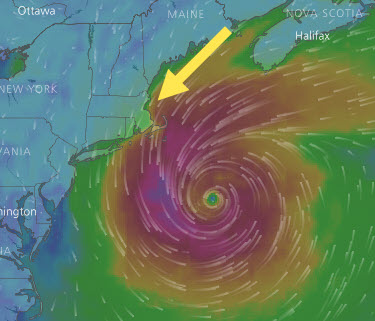
I’ve recently fallen in love with Windy.com, a weather site that vividly animates winds. It’s particularly gripping during hurricane season, and this hurricane season has made for some eye-popping imagery. Hurricane Jose (officially it’s just a tropical storm now, but I’m not saying that to Jose) is currently rumbling off our shores, and the picture from Windy really illustrates the Nor’easter phenomenon. Look.
The air is being sucked down the low-pressure drain of Jose’s eye, dragging over Massachusetts’ soggy sleeves along the way. A lovely painting of a terrifying creature.
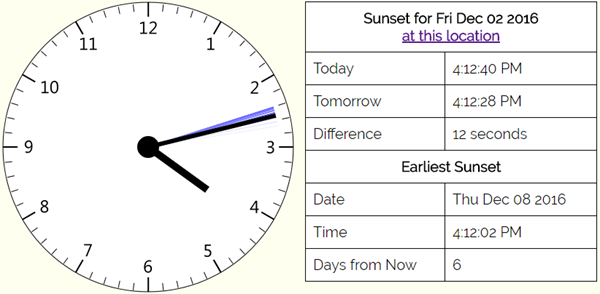
Happy Crepusculus! Tonight is the earliest sunset of the year: 4:12:02 PM. At least it is for me and everybody else at my latitude. This image, taken last week, shows the exact moment of every sunset for the week preceding and following today’s early sunset.
Almost every sunset falls between 4:12 and 4:13. It’s like the sun is standing still! We should give this season a special name to honor this remarkable observation. We’ll call it Sun-Still. No, how about Sun-No-Go? No. How about something fancy and Latin sounding, something derived from sun (sol) and standing still (sistere): solsistere. Sol-sister? Okay fine, let’s just shorten that to solstice. I’m sure everyone will figure out what it means.
If you already know about the solstice but are surprised that it’s happening as early as December 8th, I should point out that this is merely the earliest sunset. The latest sunrise is in January, leaving the shortest day on December 21st where it belongs. If it seems surprising that the earliest sunset and the latest sunrise don’t coincide, you can blame the earth’s slightly elliptical orbit around the sun.
In the meantime, I’m more than happy to celebrate the slow retreat of sunset. Today may not be the actual solstice, but it’s worth observing for its own merits, so I’ve given it the name Crepusculus (more Latin: twilight = crepusculum).








 Rambles Blog at Star Chamber