Trading Places in the Podcast News

This is your Podcast Recommendation Post. I have a half hour commute every morning and evening, and I almost always listen to books on Audible. But between books, I usually plow through a bunch of podcasts. For a while I was listening to the History of Rome podcast, which I thoroughly enjoyed. But since the Roman Empire ended, so too did the podcast. So here’s your first tip: history podcaster Mike Duncan is back at it with Revolutions, “a weekly podcast series examining great political revolutions.”

The second tip also has a Roman connection: you should be listening to 99% Invisible with host Roman Mars. I just did a ten-show binge, and they were all good and getting better. As a product of the 1980s, I especially liked the show he did with the Planet Folks on Trading Places, the Dan Aykroyd/Eddie Murphy movie. If you don’t have time to listen to the podcast, here’s a written version of the basic story: What Actually Happens At The End Of ‘Trading Places’?

It’s really staggering how many good podcasts there are.

What the good drones are up to

We know what bad drones can do, but what about the good ones? Sensefly is a company that can map a disaster site with a few hand-held robot planes. Their latest PR move is to map the Matterhorn with the same technology. It’s pretty remarkable. Watch the video.

You see this and you realize it’s is being done by a small company with limited funds. Soon, these things, and other robots like them, are going to be everywhere. I imagine they’ll be putting aerial survey pilots out of business just as soon as the FAA sorts out how to manage drones and people in the same airspace.

And while these guys map the earth, the underwater drones will be spanning the seven seas. Get ready for a data tsunami.

LED lighting for cities

I’ve started to notice significant numbers of LED streetlights around my town. This makes me happy for a few reasons: the lights use less energy, they last longer, the color is more pleasant, and they dump less light overboard into the sky.

berlin

I was thinking of this when I saw a picture of Berlin taken at night. After all these years, you can still see the divide between the east and west. It’s nothing like North and South Korea, but still, what’s going on? Different kinds of lights originated with different governments long ago, and the difference persists. The orange lights in the east are sodium vapor streetlights (Natriumdampflampen!) whereas on the west they had the whitish mercury vapor lamps (Quecksilberdampflampen!).

It got me wondering what the US will look like five years from now as you fly across it at night. Perhaps the sickly orange grid (we like those sodium vapor lights too) will be replaced by a muted soft white lattice.

It’s easy to latch onto one version of a story and forget about it for a few years. For a long time LED lightbulbs and solar power were the fanciful dreams of tree huggers. While it’s true that they’re not going to free us from petroleum anytime soon, they are both making huge advances. Here is an encouraging report from Greentech Media: Four Charts That Prove the Future of Clean Energy Is Arriving. Once these technologies become good business choices on their own merits (that is, unsubsidized), they will blossom quickly.

Behold the Amplituhedron

Have you read about this amplituhedron thing? Here’s an article that describes it: Physicists Discover Geometry Underlying Particle Physics.

You’ll be happy to know that the related improvements to twistor theory vastly simplifty the Britto–Cachazo–Feng–Witten recursion involved in the scattering process. In fact, I suspect you’ll never look at Britto–Cachazo–Feng–Witten recursion the same way again.

What I like about this is that it sounds so much like the crackpot science of mumbling weirdos. Or even better, the whole article reads like the loopy faux-physics back story in science fiction movies. You know, when the geeky scientist guy explains to the protagonist why the time machine works or the faster than light toaster or whatever.

doc-brown

I mean, this is from the first line of the article: We have “discovered a jewel-like geometric object that dramatically simplifies calculations of particle interactions and challenges the notion that space and time are fundamental components of reality.”

A coruscating jewel at the heart of space-time. Thousands of hours of supercomputer time reduced to a scrap of paper. The foundations of physics buckling and reshaping before our eyes.

Yeah right. Sounds like H.P. Lovecraft to me.

You read this, and you think, oh wait, these people are credible? Institute for Advanced Studies, Harvard, Oxford?

Sometimes a little math does the trick. Sometimes truth is as good as fiction. In 1931, while Einstein and his wife were visiting Caltech, they took a trip to the Mount Wilson Observatory. As Einstein admired the gigantic device, his wife Elsa got the last word.

Like a child at play, [Einstein] scrambled about the framework, to the consternation of his hosts. Nearby was Einstein’s wife, Elsa. Told that the giant reflector was used to determine the universe’s shape, she reportedly replied, “Well, my husband does that on the back of an old envelope.”

(from National Geographic)

A Sunset Clock

About this time every year I start to get obsessed with the sunset. Since we’re close to the equinox, the sunlight is disappearing at the fastest rate we’ll see all year. This fact alone separates me from the people who talk about autumn as their favorite season. Beautiful colors, apples and pumpkins, crisp temperatures, and clear blue skies. Sure. I won’t say those things aren’t nice. But the darkness creeps in like a mist. It smiles an oily smile as it unfolds umbrellas and spreads out blankets, because it knows with celestial mechanical precision that nothing but December can dislodge it. And December is on vacation. December is somewhere far away, drinking margaritas and playing poker with Santa Claus.

Anyway: sunsets.

I wanted to boost my Javascript skills, and I wanted to learn about Github, so I wrote a little program to show how fast the sunsets were ebbing noonward.

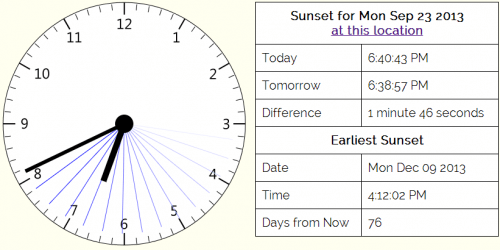
Here it is: http://www.starchamber.com/sunset/

sunset-clock

It uses browser geo-location to figure out where you are. If it succeeds, it can calculate sunset times accurately. It shows you today’s sunset and tomorrow’s so you get a sense of how fast things are changing. As a bonus, a stylized clock face shows two weeks’ worth of sunset times in blue. Finally, it shows you how long until the earliest sunset. At my latitude, that’s December 9th, a mere 80 days away! At your latitude, it may well be different. And I should mention that this page is possible because of Preston Hunt’s excellent SunriseSunset Javascript class. I had been working with some old Naval Observatory code, but it was miserable work cleaning it up. Preston came along and saved the day.

And if you want to help me fix it or report a bug, here is the Github repository: https://github.com/gulley/Sunset-Visualization

Fork away!

LATE-BREAKING NEWS: I want to pass on my grateful acknowledgment of help from David Wey and Josh Natanson who, sure enough, did fork and improve my code on Github. Y’know, there’s something to this collaboration business. It’s a real rush when somebody magically reaches out and helps you fix something that you created. Thanks guys!

America’s Cup 2013

Have you seen any of the qualifying races for the America’s Cup? It’s worth watching.

The official America’s Cup racing starts this weekend, but the Vuitton Cup (which selects the challenger for the big race) just wrapped up. The new boats are just incredible. They are giant catamarans with immense rigid sails (airplane wings, really) and hydrofoil keels that pop them out of the water. And they fly. They’re moving at top speeds of over 50 miles per hour. They can sustain speeds of over 40 knots even as they come around a mark. As one of the commentators remarked, this leads to a new situation for sailors: high g-forces on the job.

But one of the most exciting things about the experience of watching the race has nothing to do with the boats themselves. It has to do with the way the race is presented on TV. Sailboat racing is a difficult sport to follow partly because so much that happens is hard to visualize. There’s no race track. Skippers can move on divergent paths for long periods, making it hard at times to even know who’s in the lead.

The augmented reality of overlaid computer graphics adds a lot of extra information, as this video from IEEE Spectrum makes clear: the speed of each boat, their tracks over the water, the wind direction, tidal currents, course boundaries, and more.

It’s easy to guess that, if people go for this kind of coverage in a big way, it will be applied to other sports. We already have the virtual “first down” line in football games. Imagine predictive baseball graphics showing you where that ball is going to drop in the outfield as the fielder runs it down. Or maybe other heretofore boring sports will get sexed up with augmentative graphics. Bowling with superimposed strike points, or curling with virtual dancing brooms. The mind boggles. Stay tuned!

Bonus coverage: here’s the Tech Crunch version of the story.

Presidential trivia in the news

Presidential trivia time. Can you name a president who was not a US citizen when he were born? Spoiler alert for Birthers: it’s not Barack Obama.

Ready? Martin Van Buren was the first president to be born after the United States became a country. So any of the presidents from Washington to Jackson began their lives as subjects of the Crown. If you’re keeping score, that includes Jefferson, Madison, Monroe, and a brace of Adams.

Is that a trick question or not? I’m not sure, but I like it. But even more do I like my next question. It is my favorite presidential trivia question: Can you name a president that was not a US citizen when he died?

mystery-pres

Ready? Coming along just one president after Van Buren is John Tyler. Tyler, a Virginian, was known as His Accidency because he filled the office after William Henry Harrison’s speedy demise. By the time of the Civil War, he had long since retired from political life. Nevertheless, he joined the Confederacy and was elected as a representative to the Confederate House. He died in 1862, which means that his death occurred after he had renounced his status as a US citizen. QED. Tyler’s death went officially unmourned in Washington. Last question: Can you name another president whose death was unmourned?

Ready? Carter, Clinton, Obama, and a brace of Bushes are unmourned because they are as yet undead.

Now that’s a trick question.

John Tyler came to mind recently because he made the news the other day. Incredibly, and despite the fact that he was born 221 years ago, two of his grandsons are still alive. That’s right. Two grandchildren of a US president who took the oath of office in 1841 are eating Cheerios and watching the Daily Show.

Now you know. If you don’t use that one at your next cocktail party, don’t blame me.

Tactile computing

Quartz had a nice piece last week on computer-mediated interaction with three-dimensional objects. I’ve seen work done by the Tangible Media Group at the MIT Media Lab, and it always seemed more gimmicky than anything else. But the guy featured on Quartz, Oliver Kreylos at UC Davis, is doing some remarkable work. The one that really impressed me was the interactive sandbox where he uses a Microsoft Kinect to figure out where the surface of the sand is, and then he uses video to paint a contour map down onto the sand. Build a mountain range and he’ll calculate the map.

The video is worth watching. You get a sense for how much insight people can derive from an interactive surface like this, and the approach is a nice mix of high-tech and low-tech.

When you virtualize something into the digital ether, it vanishes in some important sense. Think of a library of CDs disappearing into MP3s on a hard drive. You gain convenience, but you lose the tactile persistence of physical objects. The music that you own becomes more forgettable. In the last few years, I’ve moved from CDs and even MP3s to a music subscription program (MOG) that comes in by WiFi to wireless speakers around the house. It’s terrifically convenient. But my wife was complaining that she liked the old CD player better. “How can you say that” I said, “when you can listen to any CD in the world with this thing?” But in truth, I understand. She liked having the physical CDs sitting around. They reminded her what she liked and what she wanted to listen to.

Here is the problem: You’re sitting around and you think, what do I want to listen to? So you go to your music service and stare at a search box. You could play anything. But you have to THINK of it first. And that’s expensive.

We could just keep the CDs sitting around as big physical reminders, but why not use something smaller? It occurred to me that we might use chips, blank poker chips, as physical reminders of the various digital artifacts we own. Here is a collection of music chips that my wife made. You see them in bowl and you pick one up. And then you think, “Why yes, I would like to listen to some Joe Jackson.”

chips

I’m trying this with music, but this approach would work with any digital artifact: a movie, a program, a book, Stick a little bar code on it, and the computer could help you act on it. The sensible interface of the future will have more PUI (physical user interface) to mix with the GUI.

Printing helicopter parts

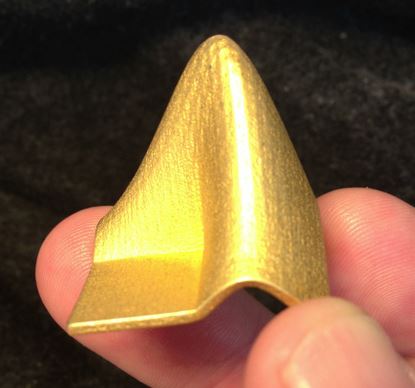
I am a 3D printing enthusiast, but I admit that a family only needs so many small plastic Yoda heads. The idea that everybody will own a 3D printer and use it to make useful stuff for their house seems pretty silly when you see what people are making with their low-end devices. I can’t think of the last time I had an urgent need for a plastic shower curtain ring or any other similarly small plasticky household thingy. But I have started using Shapeways as a service both to buy other people’s designs (check out this origami crane skeleton) and to print stuff of my own, like this metal shape.

membrane

By reading the Shapeways blog, I’ve started to understand how 3D printers can be genuinely useful for normal people. They claim that some of the best selling pieces on their site are for robot quadcopters. Hobbyists are buying these helicopters and then tricking them out with highly customized parts.

So this is the scenario that makes sense to me: if a product is designed with 3D printing in mind, then it is, by definition, ready to be fixed and improved by 3D printing. All the parts can be made available on the web as 3D plans ready to print. When needed, they would be ordered from a shop like Shapeways. The turnaround time of 1 to 2 weeks isn’t fast, but it is vastly cheaper than buying your own machine. What’s true for hobbyist toys now will be true for many things in the future. I can see a selling point for a product being that you have access to 3D plans for all parts.

And look at this video of the Shapeways operation. It’s amazing how tightly they pack the print volumes with lots and lots of pieces. These machines are cumbersome and slow; it’s the only way to get low prices and fast turnaround.

Did we really go to the moon?

Yes. Yes we did.

Still, there are two big reasons to think it might have been faked. The perennial one is that it just seems crazy to imagine that humans can actually fly to the moon. It did then, and it does now. But with each passing year, it seems especially nutty that the primitive humans of the 1960s could have managed it. Years ago it occurred to me that, for some people, the moon landing will be viewed much like the Egyptian pyramids: a deeply strange and inscrutable human folly that seems somehow impossible given the available technology. Could it really have happened? I wrote an imaginary documentary on this site: Mysteries of the Ancients: Primitive Man on the Moon.

Dr. Squidhammer believes that an early explorer named Leif Armstrong not only visited, but may have even started a colony on the Moon, a colony called “Greencheese” in the hope of encouraging early settlers to come to the then-barren Moon. But how?

moon

Steve points out of very entertaining video by a gentleman named SG Collins on the subject of a faked moon landing. Collins does something very clever here, something that we should think about more often when dealing with cranks and conspiracy theorists. The people who say it was all a hoax tend to focus on negative evidence: (spurious) reasons it couldn’t be real because of shadows and and lighting and so on. Instead, Collins looks at positive evidence that faking is hard. What would it have taken to actually pull off the hoax in 1969? As he puts it, while we did have the technology to go to the moon in 1969, we did not have the technology to fake it. Have you ever looked at the simulations they did for the news back then?

That situation is now reversed. We seem to have lost the ability to go to the moon, whereas we could fake a landing without breaking a sweat. Because we are now so used to movie magic, we are credulous about what movie magic could have done 44 years ago.

Watch it. It’s a good video.