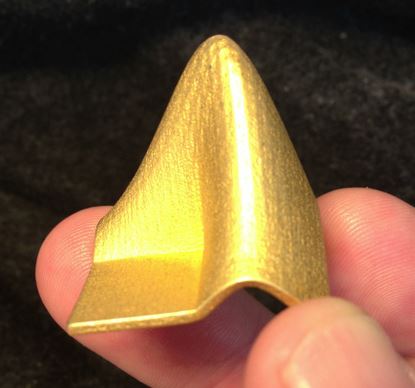
I am a 3D printing enthusiast, but I admit that a family only needs so many small plastic Yoda heads. The idea that everybody will own a 3D printer and use it to make useful stuff for their house seems pretty silly when you see what people are making with their low-end devices. I can’t think of the last time I had an urgent need for a plastic shower curtain ring or any other similarly small plasticky household thingy. But I have started using Shapeways as a service both to buy other people’s designs (check out this origami crane skeleton) and to print stuff of my own, like this metal shape.
By reading the Shapeways blog, I’ve started to understand how 3D printers can be genuinely useful for normal people. They claim that some of the best selling pieces on their site are for robot quadcopters. Hobbyists are buying these helicopters and then tricking them out with highly customized parts.
So this is the scenario that makes sense to me: if a product is designed with 3D printing in mind, then it is, by definition, ready to be fixed and improved by 3D printing. All the parts can be made available on the web as 3D plans ready to print. When needed, they would be ordered from a shop like Shapeways. The turnaround time of 1 to 2 weeks isn’t fast, but it is vastly cheaper than buying your own machine. What’s true for hobbyist toys now will be true for many things in the future. I can see a selling point for a product being that you have access to 3D plans for all parts.
And look at this video of the Shapeways operation. It’s amazing how tightly they pack the print volumes with lots and lots of pieces. These machines are cumbersome and slow; it’s the only way to get low prices and fast turnaround.
Still, there are two big reasons to think it might have been faked. The perennial one is that it just seems crazy to imagine that humans can actually fly to the moon. It did then, and it does now. But with each passing year, it seems especially nutty that the primitive humans of the 1960s could have managed it. Years ago it occurred to me that, for some people, the moon landing will be viewed much like the Egyptian pyramids: a deeply strange and inscrutable human folly that seems somehow impossible given the available technology. Could it really have happened? I wrote an imaginary documentary on this site: Mysteries of the Ancients: Primitive Man on the Moon.
Dr. Squidhammer believes that an early explorer named Leif Armstrong not only visited, but may have even started a colony on the Moon, a colony called “Greencheese” in the hope of encouraging early settlers to come to the then-barren Moon. But how?
Steve points out of very entertaining video by a gentleman named SG Collins on the subject of a faked moon landing. Collins does something very clever here, something that we should think about more often when dealing with cranks and conspiracy theorists. The people who say it was all a hoax tend to focus on negative evidence: (spurious) reasons it couldn’t be real because of shadows and and lighting and so on. Instead, Collins looks at positive evidence that faking is hard. What would it have taken to actually pull off the hoax in 1969? As he puts it, while we did have the technology to go to the moon in 1969, we did not have the technology to fake it. Have you ever looked at the simulations they did for the news back then?
That situation is now reversed. We seem to have lost the ability to go to the moon, whereas we could fake a landing without breaking a sweat. Because we are now so used to movie magic, we are credulous about what movie magic could have done 44 years ago.
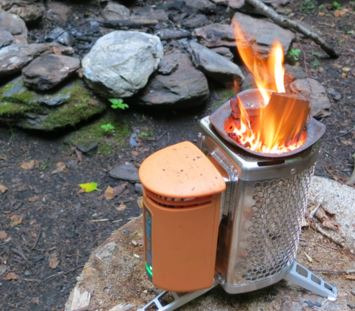
I went camping with my daughter this weekend. I don’t go camping very often these days, so when I do it’s fun to take the opportunity to buy a little gear from REI. This time I got myself a BioLite stove.
Most camping stoves use gasoline. You have a bottle of gasoline and there’s this little tube that runs over to an open flame. They’re designed to be safe of course, but I always feel like I’m tinkering with a bomb. Camp stoves make me nervous. Not to mention the fact that you have to carry around heavy bottles of fuel that might leak and turn your backpack into biohazard or a Hindenburg-like ball of flame. The BioLite, though admittedly on the heavy side, lets you replace the bottled white gasoline with the sticks you find around your campsite.
It has a thermo-electric element that runs an electric fan. This fan pumps air into the burn chamber the same way that the blacksmith uses bellows to superheat his coals. And VOOM! those sticks burn like mad! No problem at all to boil water or cook. You just need to keep feeding in the twigs. The fact that the fuel is so low tech does away with my immolation anxiety. It also gives you a convenient way to start a fire if you have access to a fire pit. Finally, assuming naturally occurring fuel is present, it takes away the “range anxiety” of worrying about how many nights your fuel will last.
The BioLite represents all that is great about the marriage of high-tech and common sense. I recommend it.
President Obama has finally put climate change on the national agenda. Some say he’s attempting too much, and some say he’s attempting too little. I say that, however you slice it, some effort is better than no effort. It’s important to acknowledge when you’re moving in the right direction. That doesn’t dispel the gloomier parts of the picture, but good news is good news and we should take it where we can find it.
Here, for example, is a list of Cleantech Milestones Worth Celebrating as compiled by Greentech Media. You read these things, and you have to wonder: Is it real, or is it hype? But I am seeing some of these things with my own eyes. I’m a believer. I use LED lightbulbs in my house. Friends of mine have installed solar panels on their roofs. I know several people with electric cars. Something is actually happening.
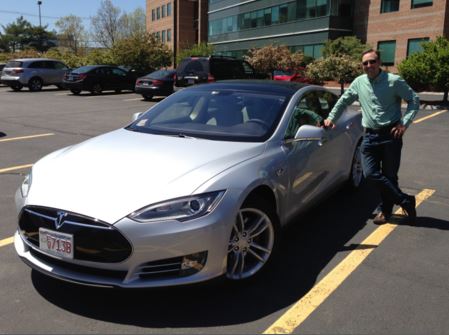
My friend Seth recently bought a Tesla. It’s a nice car! The Tesla story is a good example of how hard it is to change things in the real world. Tesla wants to sell you a car directly, which is to say, without using a car dealership. It turns out that in most states this is illegal. And why is it illegal? It’s illegal for ancient historical reasons that no longer make sense except for one thing: there are now entrenched interests, car dealers, who will bitterly oppose any change to the old laws. In North Carolina they are even passing new laws to prevent Tesla from selling you a car. Consider how ludicrous the argument is: the noble car dealers are protecting you, the helpless consumer, from the claws of the manufacturers.
It’s the most depressing kind of self-interested protectionism masquerading as a public service. I wish Tesla luck. In the spirit of green tech, I suppose we shouldn’t talk about tilting at windmills. Perhaps instead we should speak of windmills tilting at oil rigs.
Anyone who has ever noticed Minnesota’s little protuberance has to wonder at some point: why on earth would they have drawn the border like that?
The northern border of the lower 48 is flat flat flat along the 49th parallel from Washington State to western Minnesota, and then there’s this thing. If you look closely, the mystery is compounded by the fact that the special included region is uninhabited park land on the far side of a lake.
Is there something valuable there? Gold? Copper? A precious trove of old National Geographics?
The answer is a charming example of fossilized happenstance. The diplomats who negotiated the northwest border of the US had an imperfect knowledge of the region based on this imperfect map. This excellent video from C.G.P. Grey explains all…
Watch much NASA TV? If you’re even a little bit of a space geek, you’re probably aware that the word “nominal” is used by spaceflight teams as a way of saying “as expected.” Which is fair enough, but like a lot of geek language, it gets fetishized under the guise of somehow being “precise.” Never confirm with a mere “yes” when you can use “affirmative” or “roger that, will comply.” I like rolling around in jargon as much as the next fanboy, but it generally adds syllables and not illumination. Still, fun is fun.
The curious thing is that the word nominal is used in the space business in a way that is unlike all the standard definitions. The space-centric context of nominal is so odd that it is called out as a final special case. The Oxford online dictionary defines the fourth American form as: (chiefly in the context of space travel) functioning normally or acceptably. I’m guessing it started out long ago as a way of saying a flight parameter is following the named (declared and expected) path. Apparently this usage goes all the way back to the NACA/Langley days. And from there it grew and grew.
Spaceflight is booming these days, so we’re hearing lots of nominals. So many, in fact, that the podcasters over at Spacevidcast.com made a wonderful compilation. They counted the number of times that SpaceX and Orbital Sciences use the word in recent launch coverage videos. The result? SpaceX put in a plucky performance with 31 nominals (one every 23 seconds), but Orbital Sciences trounced them with an astounding 93 nominals by the time the vehicle was in orbit. That’s one nominal every 7 seconds. Is that super-nominal? Meta-nominal? Or perhaps just phe-nominal?
You’ll want to zoom to the 4:48 mark in the program.
At some point, it became so absurd that I felt like I was listening to this instead:
Just down the road from me, along Brattle Street on the way into Harvard Square, stands the Dexter Pratt House. Its minor claim to lasting fame is that old Dexter Pratt was the local blacksmith, and one fine day in 1840 as he labored under a nearby chestnut tree, who should walk by but Henry Wadsworth Longfellow. Inspiration smote the poet, and he set down these words.
Under the spreading chestnut tree
The village smithy stands…
The words remain, and so does the house. But the chestnut is gone. In fact, all the American chestnuts, almost without exception, are gone, having been wiped out by a devastating chestnut blight in the first have of the last century. My father, growing up in Crozet, Virginia, remembers watching the line of dying chestnuts march across the mountains. At the time of the blight, chestnuts made up as much as a third of the great forests of the east. Imagine seeing them all struck down in the span of a few years. By a freakin’ fungus.
The American chestnut isn’t quite extinct, but it’s on the doorstep. Other related chestnut species, notably the Chinese chestnut, don’t have the same blight susceptibility, and for years specialists have interbred the species trying to create an American chestnut with blight resistance. They have succeeded in making resistant hybrids, but none of these has anything like the majestic size of the old American breed.
Carl Zimmer, writing on the National Geographic website, has a good summary of more recent work done to save the tree: Resurrecting A Forest
Rather than using heavy-handed hybrid breeding, new genetic tools make it possible to move genes one at a time from species to species. This is allowing biologists to make a chestnut that is almost entirely native chestnut but with with just enough secret sauce to ward off the fungus. The odds are getting better and better that we (or our children) will see mighty chestnuts once again. But what story will we tell ourselves about it? Zimmer does a good job of capturing this puzzle.
If, a century from now, Powell’s chestnuts tower once again over the eastern United States, how will we think of those forests? Will we think of them as nature restored to its former glory, ecosystems thriving once more? Or will we think of them as unnatural, the product of human tinkering? Or both? Given the past century of struggle to save the chestnut, the choice here is not natural versus unnatural. It’s chestnuts versus no chestnuts. “It’s not going to fix itself,” says Powell.
As Longfellow might have written:
Under the genetically modified chestnut hybrid
The village cyborg stands…
I live in Watertown, Massachusetts. That’s where the finale played out in our recent unpleasantness here in the Boston area. My house is just across the Charles River from where the big shootout occurred. About a mile and a half, as the Google flies. It happened a little less than a mile from where my daughter goes to school. Bang! Bang! Bang!
Sounds like I was pretty close to all the excitement, eh? In fact I was more than 3000 miles away. We were on a family vacation to Ireland, so my first hint that something was wrong was when I happened to walk past a TV in the fitness center at the Camden Court Hotel in Dublin. Amid sounds of confusion, the text crawled across the bottom of the screen: Boston Marathon. I hurried back to the room. One of the things I quickly realized was that I had no desire to turn on the TV. At that moment, all I wanted was web access. There’s so little actual information in TV news, particularly when you’re arriving late to a breaking story. Mostly it serves up the same disturbing images over and over. I knew from experience that Twitter, boston.com, and Wikipedia would be my best sources. And so they proved to be.
My wife and I spent the next hour glued to our iPhones, calling out fresh details to each other, fielding emails and texts from concerned family and friends. Then we tried to settle back into vacation mode. It was, of course, strange to fly across the Atlantic only to find Boston at the top of the international news. We started to avoid the “Where are you from?” question because it was such a bummer as a conversation starter. “Sad, so sad. Shame, such a shame.” But even stranger news lay ahead.
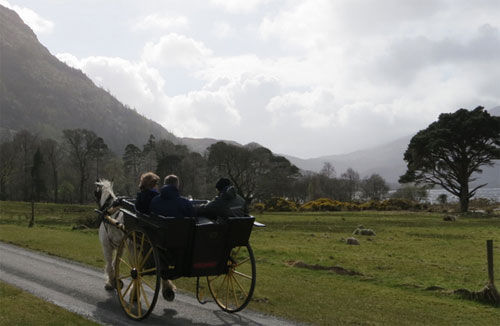
Three days later, in the Earl’s Court House hotel in Killarney, I learned that my little home town was the scene of a showdown with the police. Because of the time zone difference, on Friday morning I was reading in real time the first Twitter reports of the ripping blast on Laurel Street, the pop-pop-popping gunfire, the acrid hanging smoke, the vanished bomber. An unhinged bomb-laden terrorist was last seen about a mile from my house, and … and oh look! It’s time for us to go on a carefree ride in a horse-drawn jaunting car by Muckross Lake.
Unbalanced people with deadly weapons and murderous intent are bad. We don’t like those people at all. But here is a very important question: those people, do they look like me? I sure hope they don’t, because that makes this whole hating process so much easier.
Much has been written about this lately, but the crimes of New Town and the crimes of Boston are so close in time and place that it’s hard to avoid. When faced with domestic terror we are able to say, “things like this will happen from time to time.” Shrug. What can you do about crazy people? No countermeasure is likely to make a difference. But terror at the hands of the Other is an abomination for which no countermeasure is too great.
Can’t we find some middle path between these responses? “Keep calm and carry on” is surely the best advice. Things like this will happen from time to time, and we can’t let the immune response be more damaging than the infection.
Being abroad during this storm gave me two gifts. The first was being safe with my family far away from a dangerous event. The second was the experience of being the Other as it unfolded. When you travel abroad, you are apart, the Other. How shall the Other be treated? Countries defined by ethnicity and cultural uniformity are charming, much more charming than the United States. All noise and chaos, America lacks this aligning charm. But this chaos is our saving grace. Shaped by ideas rather than ethnicity, we can embrace the Other as our own. If we are frightened into forsaking the Other, we will have the worst of both worlds. No embrace. No charm. Only a harvest of bitterness.
In 1913, Igor Stravinsky’s ballet The Rite of Spring premiered to such a hostile reception that forty members of the audience were ejected for first fighting with one another and then flinging things at the orchestra. Radiolab did a nice program on this famous performance, if you’d like to learn more about it.
What was all the fuss about? Some say it was Nijinsky’s bizarro choreography, and some say that bad luck happened to bring in an especially belligerent crowd. But most say it was the music. The shockingly dissonant music. Music that was a violent assault on the unready ears of an earlier age. Just how bad was this music? It sure seems tame enough now. But this animation by Stephen Malinowski can give you a heightened sense of the wild and rich tapestry Stravinsky assembled.
There’s a great story about how Diaghilev, the ballet’s producer, was first listening to Stravinsky play the pounding chords that ultimately sparked the tumult on opening night. Stravinsky recalled:
He was a little bit surprised to see this repetition of the chord so many times. He asked me only one thing: Will it last a very long time? And I said: till the end, my dear.
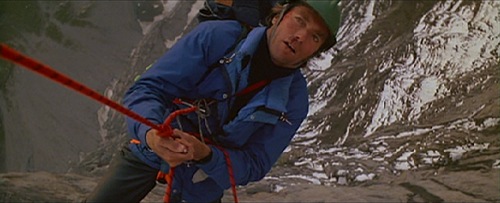
My friend Greg told me about a curious technology-related problem he had last week. While reading a climbing magazine, it occurred to him that it would be fun to watch the old Clint Eastwood film The Eiger Sanction.
Now let’s turn back the clock a few years. You can smoke in bars. The village blacksmith is nearby in case your horse throws a shoe. And (here is the important part) there’s a Blockbuster video store on every corner. In this sepia-toned world, Greg would run to the nearest Blockbuster and rent his movie. Problem solved. But since the passing of that era, here’s what happened. Greg started using Netflix. No more trips to the video store. Hooray! But after a time, he decided he didn’t like the DVD-by-mail option (too slow) or the stream-by-net option (not enough selection). So he stopped using Netflix. But while he was trying Netflix, so was Everybody Else. The world turned its back, and poof! The cigarette machines, the payphones, the blacksmiths, the Blockbusters, they all vanished.
Fast forward to the present, and Greg can’t figure out how to rent a movie. He’s stranded in the modern age, dangling like Clint between the departed past and a future that’s not quite here.
Have you had an experience like this?
I did a few years ago when my cell phone died and I really needed to make a phone call. Have you ever looked for a working payphone? If you walk into a liquor store and ask where the nearest payphone is, you will be treated as if you just rolled in a cat box.
Greg’s tale of First World woe doesn’t stop with Clint. In addition to being a talented software developer, Greg is also a talented musician (who just released a new album). His band performed live on the radio last week (WICN). Before the show, his proud wife texted the news to a bunch of friends. Several replied with words to this effect: “I can’t find a radio in my house! What should I do?” She may as well have been telling them to saddle up the old gray mare.
Now I know, and Greg knows, that there are ways to listen to the radio over the net. But some people don’t. Some of those folks sat in their cold cars because that’s the only radio they could find. It’s a neat illustration of what we might call “kicking away the ladder.” That awkward moment when you can’t quite touch the past or the future. And it may explain why Mad Men is so popular. The men were men, the women were women, and the telephones were massive Western Electric 500s made from shatter-proof plastic and mastodon bones.
By God, I need a bourbon. They still make that, right?



 Rambles Blog at Star Chamber
.jpg)