A trip to Ireland

In April, I’m headed to Ireland on a family vacation. Where should I go? How should I prepare?

I’m availing myself of gamification. This Sporcle quiz is good for learning the 32 counties: Can you name the counties of Ireland? Apparently everybody always forgets about poor old County Longford.

Audible is helping me with my James Joyce classics: Dubliners and Ulysses. I’m not surprised, but it’s still cool to see the various Google Maps-based resources for following Leopold Bloom around Dublin, especially Walking Ulysses from Boston College.

Anybody want to recommend a good book on Irish history?

We’re renting a car, so I’m facing the prospect of shifting with my left hand, sitting on the right, driving on the left. Preparatory to this, I’m using Google Earth and Google Maps to get a feel for the roads I’ll be on. I’m told that the roads are so narrow that most of the time it hardly matters, but to me this seems worse, since you’ll come up on someone and have to remember by to veer quickly to the left, not right. So that should be fun. It would be nice to use the iPhone to help with maps, but I’m not sure if using the international data roaming is worthwhile. Are there temporary plans that make it worth doing?

I should point out that, although I sound completely clueless, I am already relying on the best possible travel resource. My wife researches and plans the trip, and I say “Where are we going today?”


Fertilizers and biomass

Whenever I see harvest pictures like this, I always think about mass redistribution.

harvest

That is, this corn is transported to my plate from, let’s say, Iowa. And more corn like it keeps coming every year, harvest after harvest. Every year Iowa gets shaved a little thinner, its sweet abundance getting hacked off and carted away to the four corners of the hungry corn-eating globe. Won’t Iowa eventually be scraped down to a barren parking lot? That corn was originally little seeds in the ground. What did the corn eat so that I can eat it? Is there enough corn food to keep the party going?

There’s plenty of Iowa to go around, but still, something is getting sent away. What is it? The good news is that water and carbon, two of the heaviest parts of the crop, come straight from the sky in the form of rain and carbon dioxide. But there are some other things that are sucked out of the soil and not replaced. What are they?

Fertilizer bags tell the story. Each bag is labeled with three numbers, say 20-5-10. These three numbers correspond to the amount of nitrogen, phosphate, and potash (potassium) in the mix. Fertilizer is, and is carefully designed to be, Gatorade for soil. It replaces what the soil sweats away every harvest. Stop fertilizing and your farm productivity would crash. You might think that nitrogen, also being abundant in the atmosphere, would be easy enough for plants to suck from the sky like carbon dioxide. But sadly no plants (without some bacterial help) have ever figured out this trick, so humans have to spend fantastic amounts of energy putting atmospheric nitrogen into a “fixed” form that the plants can eat. Potassium is easy enough to come by, but it turns out that our phosphate supplies are petering out.

I know, it’s yet another alarmist peak-this or peak-that story. But we shouldn’t really be surprised by the Peak Phosphorus story. The earth’s population is so large that we have to keep a very big food-making machine running at top speed all the time. It can’t break down, and every year we have to make it run faster still. A lot of things have to work just right; there’s always going to be a weakest link. As long as we have adequate energy, we’ll have fixed nitrogen for our plants. But phosphates need energy and phosphate rocks, and if we’re not careful we can run right through our supplies. Science News has a recent article on this: Salvage Job.

Sensing an opportunity for profit, farmers sought more fertilizer to nourish their fields. But high oil prices had increased the cost of processing phosphate rock, which provides a key ingredient in fertilizer. With rising demand and tight supply, phosphate rock prices leaped from about $45 per metric ton to $80, then $135, then $367 — a roughly 700 percent spike in just one year.

All those bags of fertilizer have to come from somewhere…

On failure

Many years ago, while browsing at Wordsworth Bookstore in Cambridge (long since shuttered, which gives you an idea of how many years ago) I came across The Education of a Speculator by Victor Niederhoffer. The book fascinated me in a horrifying kind of way because the author of this autobiography was so unbelievably, so nauseatingly arrogant. Harvard graduate, five-time U.S. champion squash player, absurdly wealthy Wall Street speculator. The hubris was so over the top that I wished bad things would happen to him.

Bad things did happen to him.

In 1997 Victor Niederhoffer had a spectacular fall from financial grace. The market turned against him and he was crushed. His business closed, he mortgaged his house and sold his antique silver collection. I cried tiny tears.

But really, this only made him more interesting. It certainly made him more sympathetic. Love him or hate him, this is a guy with some stories to tell. Over on Slate, Kathryn Schulz has interviewed him, and sure enough, he’s a great talker: Hoodoos, Hedge Funds, and Alibis: Victor Niederhoffer on Being Wrong.

It got me thinking about success, failure, and heroes. What does failure really teach us? We can admire the ones who make good decisions and prosper. But our heroes? Our heroes are the ones who make bad decisions and get away with it. For this we lionize them, not for their wisdom or their prowess but for their luck. For the fact that the gods smiled on them even as others were swallowed whole. This is the spark we long to touch. To be beautiful without effort. To sin and be loved.

In the end, life is just one damn thing after another, and we put our own purpose to the chaos, threading improbable stories through the wreckage. Pretending that causality is more than just the funny places where the holes line up and the sunlight filters through.

I’ve always had a distaste for the cautionary “don’t do what I did” tales of the penitent felon or the recovering drug-addled rock star. “Look here!” I want to say. “I’m reading your damn book because you did what you did.” But I am drawn to these lurid stories as much as the next person. It’s the nature of pornography. The rock star in remission says “Kids, don’t take the drugs that I took.” But he’s really saying, “Take these drugs and maybe you too will write a best-selling memoir!”

Mister, we paid you to take those drugs. You would have failed us not to brag about it. But please don’t be pious in your reform. Your contrition on the far side of debauchery is the song of a siren. It serves you, but it does not serve your audience. Guns always sell best after a massacre.

The robot that discovered a sonnet

From the Boston Globe last week, I learned about the marvelous Pentametron, the robot poet of Twitter. Here’s how it works. The Pentametron is a program written by the artist Ranjit Bhatnagar (a.k.a. @moonmilk). It screens Twitter for tweets that happen to match the familiar five foot pattern of iambic pentameter. Then it pairs tweets that happen to rhyme. The happenstance is twofold, and the couplets that result are remarkably charming.

The Globe article reminds us that this poetic form has a noble tradition, going back to the Dada and Surrealist movements. Art is where you find it, and it depends as much on the attitude of the observer as anything else. But there’s something especially sweet in these fleeting telegraphic messages from the real world, caught in a butterfly net and pinned wing to wing. Try this one:

I always give the pizza guy a tip.
I’m ready for a REAL relationship!

The @pentametron Twitter account has a constantly updated list of couplets. Here’s one from tonight.

Here comes the story of the Hurricane
In…absolute…excruciating…pain

To this poetic bricolage, I decided to add another layer. Here are some of @moonmilk’s couplets with images I found via Google image search. I entered the exact text of each line and grabbed one of the top images.

Who has a charger for the iPhone 5?
French Bulldogs are the cutest dogs alive

I don’t remember ever learning this…
That hesitation right before a kiss.

Im losing everyone and everything
I wonder what tomorrows gonna bring.

Winter exit strategies

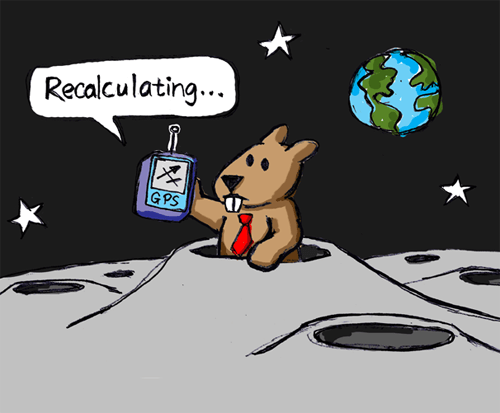
“How far can you drive into a one mile tunnel?” goes an old riddle. Answer: Only half a mile. After that, you’re starting to drive out again. Mr. Groundhog rides shotgun on our cross-quarter day between winter and spring. From his vantage, he’s supposed to tell us something of the subjective experience of the winter that remains. But we know what he’s really telling us. Whether or not there’s weather or not, the the winter tide is slack and now must ebb. And ebb she will.

The data are annoying

I love the Language Log: smart people having entertaining discussions about how words work. The nice thing about the site is that the discussions are often observational and non-prescriptive. The writers are naturalists, not prudes. They wander through the living world with a butterfly net and a notebook. Language is a thing that happens, the Académie française notwithstanding. Language rises and merges in mesmerizing patterns.

The prissy righteousness of rule-o-philes makes me crazy. Grammatical taxidermy can put a moose head on the wall, but it misses the moose. So I was glad to see this article point out that language fetishism slows down communication and makes us stupid:

“The data are”: How fetishism makes us stupid

Show me the moose! And remember, if you can’t datum, join ’em.

—-

ERRATA:

1. The word ERRATA appearing in this post appears in error as there is only one entry in the list of errata. It should be replaced with the word ERRATUM.

2. As there are now, in fact, two items on the list of errata, the first erratum is in error and the spelling should stand.

3. There is no third erratum. Please stop.

Shaving energy at home

There are a number of things that make saving energy difficult. One is that people who can afford to be comfortable don’t like to be uncomfortable. Another is that people often have no idea what really drives energy use in their home. Turning off a few lights really doesn’t compensate for the fact that your new digital video recorder stays busy 24 hours a day.

If you want to help people save energy at home, make it convenient and comfortable to curtail wasted energy. We spend an awful lot of energy heating air and water. If you want to be comfortable, you can’t avoid doing a fair amount of this. But I’ve always thought it’s a particular shame that we pay to heat water for showers and shaving and then we immediately send it down the drain and out of the house. Sure enough, there are people who think about graywater heat recovery, but that’s still (relatively) capital-intensive and far from mainstream.

So what are some ways to simply use less water and still be comfortable? Low flow faucets and shower heads are good. But here’s a brilliant idea that I came across on Indiegogo the other day: the Bonsai shaving tool. I don’t know if they’ll meet their fundraising goal, but I love the idea. Men tend to leave hot water running while they’re shaving. Every last one of them realizes this is wasteful, but the alternative is just too inconvenient. This Bonsai widget is a shaving mug that keeps the razor clean by shooting a jet of water through it. No need to have an open faucet.

http://www.indiegogo.com/project/291276/widget

Clever and Bright Green!

On seasonal crepuscularity and pseudo-saint Seculus

Because I am sensitive to the waning of the sunlight in the winter, I am always happy to welcome its return. Most years I use this space to call out the day of the year on which the sun sets the earliest. This usually happens around December 9 at my latitude. If you’re wondering why it doesn’t happen on the shortest day (the solstice, December 21st), I tried to explain it carefully last year.

I’ve always felt this day, being special, should have a special name, but I could never come up with anything I liked. So I was amused to see that someone else with strong feelings on the subject has proposed just such a name. A Dr. Richard Wilk, in a letter to the Philadelphia Inquirer (philly.com), proposes that we call the day Seculus, where the name suggests that it has nothing to do with religion. What do you think? I’m game. I like the notion of Seculus as a god who refuses to believe in his own existence. And for this act of reasoned restraint, we give him his own saint’s day. The blessings of Seculus upon you!

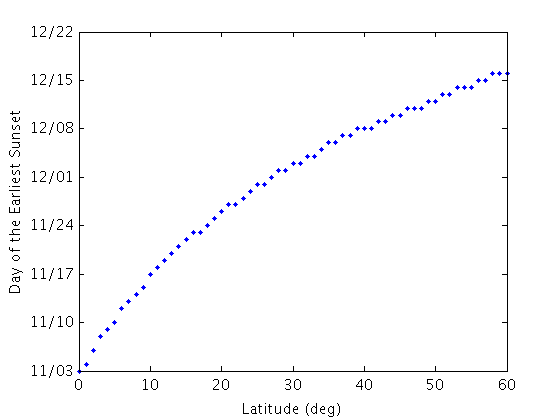
Now the interesting thing about Seculus is that it varies by latitude. The farther north you go, the later it occurs. As such it provides a sort of perpendicular counterpoint to New Year’s Eve. Because everyone on a single meridian celebrates midnight at the same stroke, we are conjoined in longitudinal fraternity. Seculus, on the other hand, unites us with our latitudinal brethren. Are you on Latitude 42? If so, you are my Secular Sibling, and December 9th is our festal day.

Accordingly, last month I wanted to illustrate exactly when, by latitude, the earliest sunset occurs but alas I didn’t get my act together in time. But now, with the help of some code from the U.S. Naval Observatory I can present a chart that is still timely: the latest sunrise by latitude.

The latest sunrise occurs on the far side of the solstice, as you might suspect. At my latitude it happened about a week ago. Since I am not a morning person, I propose no special holiday for the latest sunrise. But you seasonal affective early risers may disagree.

And here, to complete today’s story, is the Seculus Succession, being a chart of the timing of that noble and moveable feast.

Guns for Teachers: an appeal to data

I saw this on CNN today, but here is the Huffington Post version: Oregon State Rep. Dennis Richardson: Teachers With Guns Could Have Stopped Connecticut Shooting. The argument is pretty straightforward: we should give guns to teachers so they can stop attackers.

It’s easy to see why Rep. Richardson is getting air time. He has a perfect lightning rod of an argument, seductive to one side and enraging to the other. But I don’t want to take the rhetorical route here. It’s easy, but without data it’s a pointless descent into mud wrestling. The point I want to make is that data can be brought to bear here. My belief is that there is plenty of data that shows that giving guns to the “good guys” results in net harm, not net safety.

I hope we are moving in a direction where we can appeal to data in situations like this. We saw a nice example of this recently on Fox News, of all places. Megyn Kelly grilled Karl Rove about math you do as a Republican to make yourself feel better. If that election taught us anything, it’s that hallucinatory math has real consequences.

CNN will continue to interview the Dennis Richardsons of the world. They make for good ratings. But I like to think the appeal of magical thinking in the face of hard data is going to wane. More to the point, I think we have data that this is actually happening.

You’re pretty smart. Just not THAT smart.

Earlier this year I read a book called You Are Not So Smart by David McRaney (I discussed it briefly here). The book steps you through various psychological fallacies that all of us fall prey to at one time or another. Things like confirmation bias and anchoring effects and so on. As you read, you are constantly hammered with the message given in the title: you’re an idiot. The research is interesting, but the premise gets a little wearying. I get it! I’m not so smart.

Much of the research presented in the book is the work of Daniel Kahneman and Amos Tversky. So David McRaney must have been a little disappointed to learn that Daniel Kahneman recently published his own book on our psychological shortcomings. The book, Thinking, Fast and Slow, comes from the veritable horse’s mouth. In it, Kahneman describes the arc of his career developing and promoting the school of behavioral economics. Kahneman’s book, as you might imagine, is more thorough but also much more readable and humane. I particularly enjoyed the fact that Kahneman shows great respect for the rapid and intuitive decision-making apparatus that humans rely on. It sometimes causes spectacular problems, but usually it works incredibly well.

If you study genetic diseases for a while, you start to think that genes exist to cause disease. Similarly, if you make a detailed study the failures of intuitive thinking, you can be forgiven for thinking that intuition is disaster-prone mess. But if it were, how could you possibly be so successful and good-looking?

Turns out you’re pretty smart after all. But you already knew that, right?