It’s draining men (white men, that is)

Here’s a question for you. I believe, but am not completely certain, that Barack Obama is the first person to win the presidency while losing the white male vote. That is, up until 2008, people other than white men were allowed to vote, but white men always got the man they wanted anyway. Do you know if that’s true?

I do know that Obama did not win the white male vote in 2008.

This leads to an interesting conundrum for the Republican Party. The island of white men, once dominant, is rapidly shrinking compared to other groups. So if your election strategy depends too much on white men while alienating other demographics, then in the long term you’ve got a losing strategy. It is, to paraphrase Clinton, simple arithmetic. Some Republicans see this coming, as shown in this revealing quote: ‘We’re not generating enough angry white guys’.

Similarly, even as the demographics shift, the attitudes of the demographic groups are shifting. The Pew Research Center found that all demographics are increasing in their approval of gay marriage, with the youngest age groups solidly in favor. It’s easy to see that playing for the anti gay marriage vote is also, in the long term, certain to be a losing strategy.

None of this guarantees what happens in November, but it is eye-opening to look down the road and realize that these new realities are coming, all spluttering rhetoric to the contrary. I think a lot of GOP posturing in this election is what the behaviorists call an extinction burst. Just before an old behavior is eliminated, it can dramatically increase. This may lead to, as in North Carolina and California, some referendums that seek to limit gay marriage. I think there is no question that these measures will be overturned in the coming years.
Diffing Bill Clinton

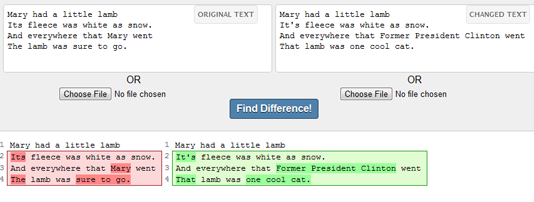
One of the more important tools used by programmers is the so-called diff tool. “Diff” stands for difference, and the tool is used to spot the differences between similar versions of the same program. This problem comes up more often than you might think, especially when two or more people are messing around with the same group of files. Here’s an example.

Typically the text on the left is considered the original file and the text on the right is considered the modified file. Lines with white backgrounds on both sides are identical. New or modified material in the right side gets a green background. Old or removed material on the left side gets red. All this helps your eye spot the changed areas. As you can see, someone has taken some serious poetic license with this rhyme.

This tool that was invented for programmers can be used with things other than programming code. It can dissect variants in a poem, as above. Or it can be used to visualize the evolution of a speech.

Last night Bill Clinton gave a 49 minute speech at the Democratic National Convention. That’s a short speech compared to the stem-winders of yesteryear, but long by modern standards. And not only that, he terrified his handlers by departing from his prepared text for long stretches. How far off? Software to the rescue! Here’s a nice piece in the Atlantic that spells it out for you, using the same kind of diff tool I describe above.

What Bill Clinton Wrote vs. What Bill Clinton Said.

In the judgment of many listeners, his ad libs improved the speech considerably. My favorite insertion: I’m fixing to tell you why. I reckon that little feller wasn’t in the prepared text. Say what you will about his politics, but that boy got a big ol’ head on him to keep all them little words up there.

Sifting through Hubble’s basement

This is a remarkable story of superabundance and what happens when gold becomes just another ore. The folks who run the Hubble Space Telescope sponsored a competition to take a picture. But this competition was not to take a picture with the telescope. It was to take a picture from the telescope. Because since it first opened its vast floating eye Hubble has taken over a million pictures. So much candy! Where will we put it all? Basically it all goes in the basement, and nobody ever sees it.

So this competition (or part of it, anyway) was just to crawl around in the archives and dig up a good picture. We’re inside the treasure chest and we still need a map. What a great way to put the people to work!

See the winners grouped on a single page her in the Atlantic: Hubbles Hidden Treasures.

Augmented Audio Reality (Lite), or Pimp My Prius

Ever seen one of those iPhone astronomy apps where you hold up the phone and it shows which stars you’re looking at (e.g. Star Walk)? That’s augmented reality. You paint useful information on top of the world. There are going to be a LOT of reality-augmenting apps on the way.

Here’s my favorite new example: an app that will turn your Prius (or whatever under-powered car you drive) into a super car. It’s called XLR8 (“accelerate”… get it?). The reviewer says “I didn’t write this app, but I hope the folks that did become wealthy beyond their wildest dreams.” All it does is give your car a new sound, but it’s responsive and realistic. Watch this video.

For comparison with something a little more, shall we say realistic and unaugmented, here’s a famous short film called C’était un Rendez-vous in which a (crazy) guy drives inadvisably fast through the streets of Paris.

Sea life videos, opportunistic and premeditated

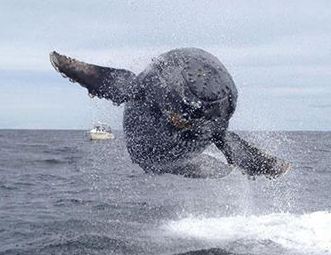
Wildlife videos are ever more impressive these days, and it’s easy to see why. You can carry a cheap, high-quality camera everywhere you go. So we get to see more videos like this flying humpback whale.

With his stubby wings outstretched, he reminded me of the flying penguins on the BBC video by Terry Jones. But this whale is the real deal, and here he is flying, in a classic case of pointing the camera in the right direction at just the right time.

I saw this video on the PetaPixel site, which had a link to a more premeditated video: super slow-motion footage of Great White sharks attacking (fake) seals. The shark is visibly disgusted that he’s just been duped into biting a bogus inflatable seal. And there in an open boat, an open inflatable boat not 30 feet away, is a tasty camera crew. Mmm… naughty camera crew is teasing shark. Shark not laughing. Shark going to let them make one last movie. Movie end with surprise closeup!

Anyway, that brings me to the last video, this of everyone’s favorite smiling mammal from the swimsuit set, the Pacific white-sided dolphin. Here the Huffington Post fills us in on a story about a guy who set out to film albacore tuna, but came away with this instead.

The Blue from Mark Peters on Vimeo.

Ye gods! I’m glad I lived long enough to see that.

Mars a-Twitter

I don’t need to tell you that NASA recently landed a new rover on Mars. You can go to the NASA website and find the latest pictures as easily as I can. But here’s something you might not have seen: a piece from the Atlantic about the use of Twitter during the Curiosity landing: For Posterity: What It Was Like Watching Curiosity’s Descent on Twitter.

I recently started following the tweets from the Atlantic, and I’ve thoroughly enjoyed their coverage of, among other things, the news from Mars. The piece I link to above talks about how much Twitter enriches your enjoyment of an event when you are following the protagonists while trading tweets in real time with your friends. The article is a Storify collection of links and tweets about the landing, and it is by turns funny and very touching.

Simulating life

I think this is a big deal: Stanford and Venter Institute Simulate an Entire Organism With Software (NYTimes.com).

Molecular biology has been running hot and cold in the headlines department. We decoded the human genome! BUT we don’t really understand it. Systems biology will lead to dramatic new treatments for diseases! BUT the diseases that most of us have, well we still don’t understand those well enough for systems biology to make one tiny tater tot’s worth of difference. Craig Venter synthesized a living organism! BUT actually he didn’t. It was more like xeroxing with style. Which is worth something, but it’s not exactly Frankensteiny.

But things are happening faster than ever in molecular biology (which is saying a lot), and some of it feels like a real turning point in our understanding of how life works. First of all, obtaining data is getting easier and easier. New sequencing technologies can (reportedly) sequence a human genome for less than $1000. And if you can sequence a healthy human cheaply, then you can sequence aberrant tumor cells just as cheaply. And this technique is, well and truly, leading to some remarkable success stories.

And now, with Venter’s latest announcement, we are at the beginnings of simulating life. As Richard Feynman said, “What I cannot create, I do not understand.” Biology up to this point has been mostly an exercise of poking at a black box: when I do X, then Y happens. But I have no idea why Y happens. And if I do Z instead of X, I have no real insight into what might happen. Simulation opens a new world of understanding living mechanism rather than living cause and effect. Again, it won’t lead quickly to miracle cures. But it is a big deal.

As the Times article reports,

The simulation, which runs on a cluster of 128 computers, models the complete life span of the cell at the molecular level, charting the interactions of 28 categories of molecules — including DNA, RNA, proteins and small molecules known as metabolites, which are generated by cell processes.

“Right now, running a simulation for a single cell to divide only one time takes around 10 hours and generates half a gigabyte of data,” Dr. Covert wrote. “I find this fact completely fascinating, because I don’t know that anyone has ever asked how much data a living thing truly holds.”

This is as good an indication as any of how much room our computers have to improve. One tiny microbe can do what 128 computers are required to do, spewing 500 Mb along the way. To quote Feynman once again, “There’s plenty of room at the bottom.”

The population is shrinking! The population is growing!

How big will the human population get on this planet? They’re always fiddling with the predictions, but by some estimates, we’ll top out at around 9 billion by 2050 (see this Economist video and article). More dire predictions can be found, but these seem reasonable to me, given current demographic trends.

Slowing population growth is a good thing, but there’s another factor to consider. To what extent will the aggregate needs of the human race grow even as its population begins to shrink? Geoffrey West, a physicist who studies cities, has asked an interesting question. What are the energy needs of the human animal? According to his calculations, a human being at rest runs on 90 watts. Pretty remarkable, eh? I know light bulbs that eat more than that. But then West takes it a step farther. Suppose we rolled up the energy needs of your light bulbs and your car and your house and so on, and we pinned all that on you… in other words, what are your energy needs not as an animal in a box, but as a civilized human going through a normal day? He comes up with something like 11,000 watts. That’s an energy obesity multiplier of 120! He continues.

What kind of animal requires 11,000 watts to live? And what you find is that we have created a lifestyle where we need more watts than a blue whale. We require more energy than the biggest animal that has ever existed. That is why our lifestyle is unsustainable. We can’t have seven billion blue whales on this planet.

As a person’s appetite for energy grows, the infrastructure required to feed them must expand correspondingly. Thus a population that’s getting richer and smaller can grow and shrink at the same time.

In literal terms, think about weighing everybody on the planet on one giant scale. Given enough fat people, you’ll obscure the fact that some skinny people have died. Big bellies hide many mouths. Consider this BBC article: Global weight gain more damaging than rising numbers.

So one projection has the human population peaking in 2050. What I’d like to see is a projection of when the aggregate human energy needs will peak. It will certainly be after peak population. But how much longer? Only then will the human footprint on the planet truly start to recede.

NASA’s Eyes on the Solar System

“Hey waiter! What’s this school bus doing next to my space telescope?” (Hint: not the backstroke.)

I came across this TED talk today and it looked very promising. It’s a program run by NASA to bring the solar system to your browser.

The speaker, Jon Nguyen, made some good points. First of all, NASA would like you to know that, contrary to popular belief, they are not dead. It comes as a surprise to some people that even though we are officially in the post-Shuttle era, there are still Americans living in the International Space Station. Beyond this there are dozens of robotic space probes crawling all over our curious corner of the galaxy. Freakin’ space robots! Taking awesome snapshots for their Facebook pages! What could be cooler than space robots? Why don’t people know about this?

That was the attitude of the JPL team that built Eyes on the Solar System, a sort of Google Not-Earth. As Nguyen points out, what they do is the reverse of Google Earth. You start with the earth in front of you, but instead of zooming in, you zoom out to look at other worlds. You can also look in detail at many of NASA’s space robots. At one point Nguyen said something like “everything I’m showing you, you can go to your browser and do it too.” And I’m here to tell you that it’s true. This is an impressive piece of work. Try it!

Here’s the TED talk.

And now for the answer to my question at the top of the post. If this is such a realistic simulation of outer space, then why is there a school bus next to the Hubble Space Telescope? Well, the school bus is real. It got there by following errant GPS instructions on the way back from a field trip to the St. Louis Zoo. Okay, I take it back. The school bus is part of a feature that lets you compare space robots to well-known objects. Although it seems like a waste of taxpayer money for NASA to send buses up there for that purpose…

Ye olde blogge post: þornography and orthography

I have a question for ye: why are olde shoppes so often prefaced with the word ye? Be they belonging to ye?

It doesn’t have anything to do with the word ye. Instead, it has to do with the mystery of the missing thorn. Thorn is actually the name of an old (sorry, olde) letter that signified the “th” sound. Thorn was a common letter in old English. Beowulf is lousy with thorns. You can’t understand a word of it, but every now and then a sentence jumps out at you.

þæt wæs god cyning! (That was a good king!)

Just as unicorns went extinct because they didn’t get on the ark in time, so too the thorns (sorry, þorns) went extinct because they didn’t get on the printing press. “It’s a fad!” they said “You’ll see. Kids today and their crazy movable type…” Now with Unicode, the thorn’s time has come round again. Watch this: þþþþþþ. Sadly, though, Unicode can do nothing for the unicorn.

At any rate, when trying to typeset English with only 26 thornless letters, some clever soul thought to replace þ with y. So “ye” is nothing more than the definite article “the.” So þere.

I came across this dandy little video on the topic while perusing a YouTube channel called MinutePhysics. I’m not sure why English spelling ended up on a physics channel, but I enjoyed it all the same.

If you’d like to watch something more in line with the physics-oriented nature of the channel, here’s a good one. Learn, in less than one minute, how Einstein went about proving that E = mc2 (note: it does not involve a ka-boom). Very cool!