“Anthropomorphism” is Anthropocentric

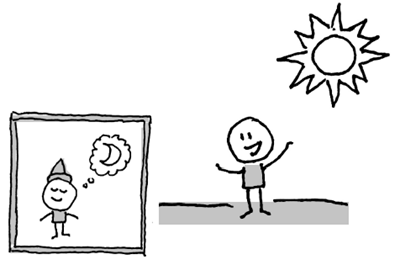
I’ve been reading a book called The Light Eaters by Zoë Schlanger. It’s about our increasing appreciation of the sophistication of plant intelligence and behavior. Right away you might be wondering if those words, intelligence and behavior, belong in a sentence about plants. Well, exactly.

One of the stories in the book is about another book that rose to prominence in the 1970s, the Secret Life of Plants. That book was also about plant intelligence. Two things were true about this book: it made many unsubstantiated claims about clever plants, and it was a huge hit with the public. Non-academics loved hearing stories about intelligent plants. Plant biologists cringed and condemned the book. The professional backlash was so strong that it set back serious discussion of plant intelligence by decades.

Now, many years later, more data is rolling in that makes many scientists ready to take up the question once again. But there is still a burned and wary group of plant scientists protesting the use of these words. “Intelligent behavior” is anthropomorphic. Plants aren’t people. But as the author Schlanger points out, this is a scientific discussion that quickly becomes philosophical. What’s not up for debate is that these plants are doing some impressive things. They can alter their chemistry to repel and poison insect pests. They can broadcast signals to nearby plants to warn them about the danger. They can recognize if neighboring plants are cousins and tailor their messages accordingly, giving preferential treatment to relatives. They can trade for valuable minerals with fungal networks. And through mechanisms not yet understood, some plants can mimic the appearance and even the chemistry of nearby plants. We now have indisputable data, reputable replicable scientific tests in which plants sense their surroundings, communicate with their peers, and solve problems.

Image by Midjourney

So we have this problem: what language should we use to describe it?
Can we talk about what a plant wants, what it hates, how it can be seduced, how it can mislead and betray? Or is that language off limits as anthropomorphic? Efforts to use language carefully scrubbed of anthropomorphism quickly become convoluted. It also begins to feel like a failure of imagination. What we need to acknowledge is that these skills we are loathe to assign to anything not human are not, in fact, uniquely ours. Our refusal starts to look like a petty turf battle. Hey you plants, get off of my lawn! I’m the only one who gets to be intelligent in this neighborhood! The solution is simple enough – we just admit that the intelligent behavior franchise is open for business. It would be churlish to say welcome to the club, since they’ve been here all along.

It is perhaps no coincidence that at this same time we are also building machines that make us question the nature of intelligence and consciousness. As a culture we are breaking into new territory. Up until now, we’ve said, effectively, I’m human and I’m subjectively conscious, and if I see you’re human too, I’m willing to give you the benefit of the doubt. I’m intelligent. You’re intelligent. I’m conscious. You’re conscious. But we then assert nobody else gets to claim this capability. And since nobody (sorry) nothing else speaks our language, they’re in no position to dispute it.

But in fact we have weak tools for assessing what we sometimes call “true intelligence,” whether mechanical or organic. And when it comes to subjective consciousness, we have no tools at all. Since we can’t define what it is, we can’t test whether or not it exists even in our family and friends, let alone in chimpanzees and begonias.

Maybe humans have been swimming in the same pool with all living things, but we just lacked the eyes and the inclination to admit it. Maybe we have to admit, once again, we’re not the center of the universe. Maybe the word “anthropomorphic” is itself inappropriate and anthropocentric. If we can admit at last that plants are canny and chatty and crafty, maybe they’ll be the ones to say, at the risk of being phytocentric, “Welcome to the club.”

Body Time – Talking to the Time Minder

Deep inside your brain, seated on a rocking chair in a special insulated room, there is a tiny Time Minder. Your Time Minder keeps track of your body’s clock, telling it when to wake up, when to get hungry, and so on. When you travel across time zones, you need to let your Time Minder know that the sun will now be setting, say, six hours earlier then it did yesterday. But there’s this maddening problem: you can’t make a direct call to your Time Minder. Think how easy it would be if you could just ring him up and say “Clocks forward six hours, Alfred, if you please.” “Very good, sir.” But no. Because we evolved several years before the advent of jet travel, we have to do everything the old-fashioned way. As advanced as we are, talking to the Time Minder remains slow and painful.

Your Time Minder and You

Everyone has their own favorite technique for getting the message through. You want to go to bed at the right time for the new time zone, but maybe you should take a short nap first. Or maybe a nap is a terrible idea, but make sure and eat a big time-zone appropriate meal as soon as possible. Maybe your trick works better when chasing the sun (flying west) as opposed to running towards it. My own favorite trick is (if possible) to observe the setting sun. Because the Time Minder has a special slot for peeking at the sun at sunrise and sunset. It’s not perfect, but I find it helps a lot.

Another strategy is to look at your watch frequently and will yourself into believing the numbers that appear. Some people only set their watch to the new time zone when they reach their destination. This strikes me as madness, because you’re letting yourself believe you’re in the old time zone for the entire length of the flight. I always set my watch to the new time zone as soon as I’m on the plane. But either way, this is like driving off a time-keeping cliff. It’s hard on the Time Minder. Wouldn’t it be better if there was a way to have the time smoothly shift from the old time zone to the new one as you flew? Then there would be no dramatic discontinuities. You’d look at your watch every now and again, and it would be continuously updating so that when you reached your destination it would be just as accurate and time-zone appropriate as when you left.

I’ve long wanted to make an app that does this time-zone blending, but I’m a terrible JavaScript programmer. But now we have AI, so I thought this is a perfect opportunity to build my app with one of my AI friends. I used Claude (which I currently prefer to ChatGPT).

Here’s my first prompt to Claude. You can see that I drew a picture of the app I wanted and I described how I wanted it to work.

An app-building prompt for Claude

Amazingly, it worked! It took a lot of back and forth to get to the point where I was happy with the app, but I can honestly say I built this app without touching a single line of JavaScript, HTML, or CSS. Here is the result. I call it Body Time, because I think of it as representing the time felt by the body as you travel. In the sample flight, you can see that the clock time experienced on the plane flying from Amsterdam to New York is much slower than real time. This is because, by chasing the sun, we’re lengthening the day.

The completed Body Time app

Follow the link and give it a try: Body Time.

Here it is on GitHub, if you want to see the code that Claude wrote: gulley/Bodytime

If you consult this Body Time clock regularly, your Time Minder will get the message a little bit faster, and you’ll feel a little bit better.

That’s the theory anyway!

Paying Attention Camp

Earlier this year, I finally went to Paying Attention Camp. It had been on my list for a long time. It was very cold there, but that’s just because I went in February.

The rooms were small. Just large enough for a bare-mattress bed, a sink, a chair, and a three-ring binder full of rules. One of the rules was that you had to bring your own sheets and towel. They sent me this rule before I left home, but I hadn’t read it. Attention to detail is not my strong suit. Fortunately they had extras for people like me.

Paying Attention Camp had a lot of rules. It had so many rules that it felt like I was going to prison. Here are a few of them. No phones. No internet. No music. No reading. No staying up late. No talking. No eye contact with other people. No scented personal care products. No noisy clothes.

But really there was only one big rule. Here it is: Pay attention!

That’s why I call it Paying Attention Camp. They didn’t call it that. Officially, it was the Way of Wisdom Three Day Silent Retreat at the Insight Meditation Society of Barre, Massachusetts. Those of us on the retreat were called “retreatants.” Which is a lumpy word, but the alternative was “yogis,” as used in phrases like “Remember to attend your yogi job training before the opening session!” Yogi is nice and short, but I can’t read it without thinking of this.

I imagined my yogi job training might involve picnic baskets. My actual yogi job was to clean up after breakfast.

This is how you pay attention at Paying Attention Camp. You sit down in a big room. Time passes, and eventually somebody rings a bell. When you hear the bell, you can stand up again, assuming your legs still work. In between, you’re supposed to pay attention. Silent and still. Not looking forward, not looking back. Just watching what’s happening right now. That’s all there is to it, but it’s not easy. For one thing, you’re stuck inside your head with just you for company, and that guy’s kind of an asshole.

Also, many aches and itches come to visit, and some of them use power tools to build permanent dwellings in your back and knees. It’s impossible to say how long one of these sitting sessions lasted. By my estimate it was anywhere between six and ten hours. I’m told, but find it hard to believe, that it never lasted more than 45 minutes. I needed a roomful of peer pressure to get through it.

Trying to pay attention for three days is hard. It’s hard to do for even a few minutes at a stretch. Our instructor had a special question when he wanted to make sure we were paying attention: “Is the mind aware?” I’d think, “Duh, of course the mind is aware.” Then I’d look around and wouldn’t you know it, the mind was nowhere to found. Usually I’d find it hanging out at a bar with its buddies, Worry and Distraction. Or else down some back alley with Regret. Embarrassing.

But it turns out that paying attention is good for you in the same way that exercise is good for you. If you do it regularly, you’ll feel better. That’s the promise, anyway. And I believe it, but the problem is that you never know WHEN it’s going to make you feel better. Like exercise, it mostly makes you feel crappy right away. You put in your time meditating, and there you are: sore, stiff, and blinking in the light. At such a moment, you can feel a little entitled. Yo! I paid my dues, Mr. Buddha-pants, so where’s my goddamn bliss? This is not, as the Buddhists say, a skillful question. But such is human perversity.

Over my three day retreat, I thought more and more about this analogy to physical exercise. I thought, I’m building up a muscle. An attention muscle. But what does the attention muscle do? I think it works like this.

Can we have the next slide please?

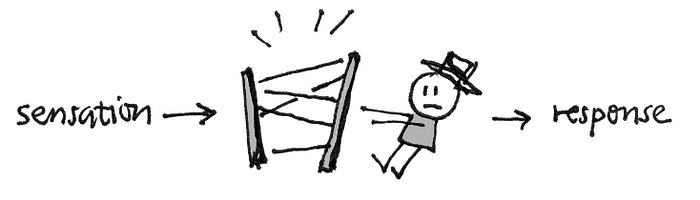
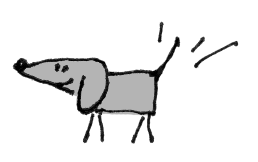
Here you are, responding to the world. That scrawny little thing in the middle is your brain. Let’s consider a specific example. Imagine you’re hammering a nail, but you miss it and instead you whack the shit out of your left thumb. In frustration you kick the dog, who has the misfortune to be nearby.

Kicking the dog is stupid and cruel, but what choice did you have? It just happened. It’s not your fault the dog was there.

See how it works? Your brain is so thin and inflexible that your hammer-catcher is wired directly to your dog-kicker. That’s the thing we’re trying to fix. Here’s where the attention-strength comes in. You can actually pry apart the sensation from the response and make a little space in there. It’s hard work, but it’s possible. It takes a lot of attention-strength.

And just look at that mess! It’s a snake’s nest of mindless behavior circuits. Those are all hardwired responses: snarling retorts, sullen pouts, sarcastic insults… a minefield of poor choices and bad moods just waiting to happen. After a time, you realize each wire is a choice, not an inevitability.

You don’t have to react to all those sensations. You can just let the happening things happen. Not that it’s easy, but that’s why you exercise. You can pull out those wires. You don’t have to kick the dog.

Clear enough space between sensation and response, and you can just sit in there and watch the world go by. That’s your brain getting bigger! This is where the work pays off.

And when you choose to act, you can be skillful about it. That’s what they call it at Paying Attention Camp: “being skillful.” That is, don’t act out of habit or craving or fear. Act out of wisdom, compassion, and the needs of the moment. Bad things still happen, but it’s amazing how much self-inflicted damage you can avoid just by paying attention. Your dog will thank you.

How can so much value come from such a simple practice? It’s a good question. I think it is a great mystery. But it seems to work. “Pay attention,” says Mr. Buddha, “You’ll see.”

Thinking about attention as skilled physical effort also help me frame how I thought about my three-day retreat. It was basically like a weekend sports clinic. Did I become enlightened? That’s like asking someone just back from soccer camp if they won the World Cup. It’s a nonsense question. You gain a few skills, you meet some nice people, and you get a better sense of the vast landscape you inhabit. You get a sense that the journey is worthwhile. But you also realize that you have to keep up the practice if you want to get good and stay good. Like sports, getting in shape once doesn’t mean you stay in shape forever. But you can develop a lasting taste for the fruits of discipline. That was the gift of Paying Attention Camp. That’s why I’m glad I went.

Note: this post originally appeared on Medium. I’m repatriating it over here on starchamber.com.

52!

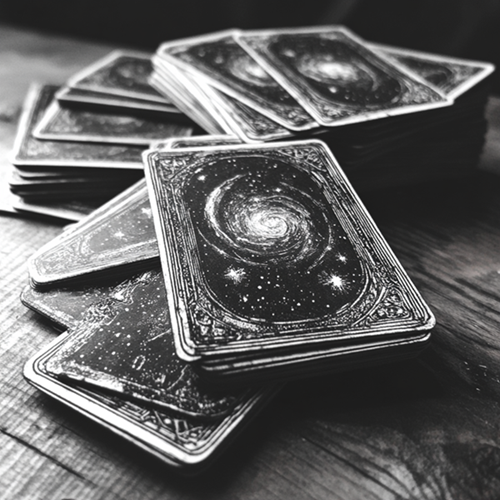
I want to show you a trick. I’ll need you to supply me with a deck of cards. Make sure it is well shuffled, please.

Thank you. Here you see I have your deck of cards in my hands. No monkey business. It’s just the way you gave it to me. Shuffle it again if you like. Now here is your question: what are the odds that this exact ordering of cards has previously existed in all the time since the development of the standard card deck? I’m including every time anyone in the world has ever shuffled a deck. It’s probably quite low. Would you guess something like a tenth of a percent chance? A hundredth of a percent?

Some hands of poker are common enough to have their own names, like Wild Bill Hickok’s “Dead Man’s Hand.” Two pair, aces over eights. Perhaps your deck’s twin first appeared in a riverboat poker room on the Mississippi in 1869. Who knows? Maybe old Wild Bill himself was dealt from a doppelganger deck. But probably not. And to say probably not is an understatement. The extraordinarily high likelihood is that your particular deck ordering has never before existed in the history of the universe, and get this, will never recur before the last sun in the last galaxy darkens and drains into the inky void. Even though the science of combinatorics assures that this is so, it still seems odd, doesn’t it? It seems odd because humans find it hard to reason about combinatorics. Don’t feel bad. I’m not sure why, but that’s just how we’re built.

Here, let’s do the math. It won’t hurt. Much.

Instead of a deck of cards, let’s play a guessing game. I’ll think of a number from 1 to 52. Can you guess it? It wouldn’t take you too many tries to guess my number, 37. Let’s say that number corresponds to the Jack of Hearts. What would the guessing game look like with two cards? Now there are 52 x 51 = 2652 possibilities. How long would it take you to guess my number if it was between 1 and 2652? A while. Okay now (you knew this part was coming) how many possibilities are there with 52 cards? There are 52 x 51 x 50 x … x 2 x 1 possible decks. This is denoted as 52 factorial, or 52! And hoo boy, is this number a doozy!

What are the odds you could guess my number now? It’s between 1 and (checks calculator) 8 x 1067? What’s that? You want to see it unrolled in all its glory? Okay fine. Stand back. Could we zoom out the camera a bit, please?

Your odds are 1 in

80,658,175,170,943,878,571,660,636,856,403,766,975,289,505,440,883,277,824,000,000,000,000.

Happy now? I’ll spare you the stacks of words that rhyme with “zillion.” Just be aware that this is a freaking big number. In practical terms, it means your chances of guessing my number are zero. Not a chance. Even if you drove to the moon and back 15 times in a Winnebago filled with frictionless monkeys. The odds that your deck has existed before is so close to zero that it’s pointless to call it anything except zero.

Image by Midjourney

I don’t know about you, but this makes me feel optimistic. The universe is so full of possibility – think of all the magic hiding in a single deck of cards! Right there in the palm of your hand! From 26 letters we can deal not only the works of Shakespeare (typing monkeys notwithstanding) but all past and all future works in English. From 88 piano keys comes a never-ending geyser of tunes. There are only 92 stable elements, yet from this deck we can deal a universe that, all by itself, invented you. And you’re pretty special, so that’s saying something. Sometimes I brandish a deck of cards just to feel, just to wield the incredible life-giving power of combinatorics. There is no end to novelty! You don’t live in a desert. The exits are not blocked and the labyrinth goes on forever. In every conceivable direction there is naught but bewildering delight!

Here. Let me show a card trick. The best kind of magic.

The Supernote Nomad

Do you, like my sister-in-law, make a distinction between listening to books and “real reading”? Real reading, so this interpretation goes, occurs when your eyes scan words. Some people go so far as to say that it only counts as real reading when you are touching paper pages. No Kindles allowed. Speaking for myself, I am happy to say that I read books to which I only listened.

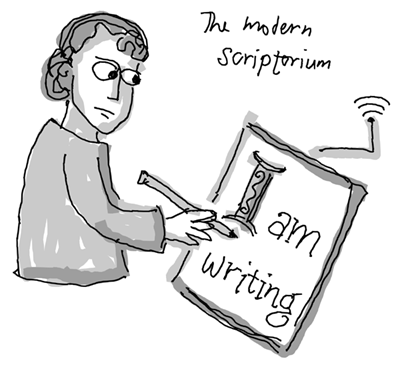
I’m thinking about this because I’m writing this while sitting on an airplane flying home from a vacation. When I say I’m writing, I mean that I am engaged in what might be called “real writing” in the same sense that my sister-in-law refers to “real reading.” That is, I am using a pen and writing in longhand. But much like reading a Kindle, I’m not using ink or paper. I’m using a device called a Supernote Nomad. I like it a lot. In fact, I like it so much that I’m trying explain to myself why. Why is it better, at least to me, than using pen and ink? And why is it better than a keyboard? Well, for one thing, it’s a shiny new gadget, and I love shiny new gadgets. So there’s that. I could still be in the new gadget honeymoon phase. But the Nomad holds all my writing in one convenient location. No notebooks or loose leaves spilling about. The feeling of the stylus moving against the “page” is very comfortable. And when I’m ready to transfer something I wrote to the computer, it has handwriting recognition, saving me the trouble of re-typing anything.

Drawn on a Nomad

I’m reminded of when I first bought an electric piano years ago (a Yamaha Clavinova). I wanted it to have the full complement of keys, feel as natural as possible, and otherwise be very minimal and clean. It was the same with this device. It’s small, simple, comfortable, and dedicated to a single task. I ask myself: why not just type into the keyboard of a small laptop or iPad? This thing is compact. I have it on my lap right now as we go through turbulence before landing at Logan Airport in Boston. But quite apart from its compact form, I like the fact that this device is dedicated to one task. With an iPad or a laptop, there is always the lurking danger of Distraction By Internet. That’s simply not possible with this device. And also by virtue of being dedicated to a single task, it feels more private. I share my iPad with others, but not this. What I write here stays here. Unless of course I choose to export it to the wide world, which I now do, if only to sing the praises of the Supernote Nomad.

Ultimately, using a pen takes my writing to a different place than typing does. I enjoy it and so it keeps me at the task longer. That is surely a very idiosyncratic thing. But if you, like me, enjoy the feel of writing in longhand and the convenience of a digital notebook, you should give this thing a try. It’s a keeper.

Happy Maps and Hedonic Cartography

Driving north on Massachusetts Route 3 today, I noticed traffic was starting to back up. How serious is this slowdown? Waze informed me that traffic was getting worse and offered to re-route me. A quick peek at the map showed clotted red roads ahead. I took the suggested route change. Thanks Waze!

Have you ever wondered where all that traffic data comes from? In the old days, some poor slob would be leaning out of a helicopter with binoculars, checking on the Tobin Bridge or whatever. But those days are over. Now, dear reader, the traffic data comes from you. Or from your phone, to be specific. That phone is telling the world where you are and how fast you’re moving, and this information can be aggregated into a beautiful map.

Your phone knows an awful lot about you. In addition to where you are, it knows who you’re talking to, what you’re listening to, what you’re searching for. Throw in a wearable, like an Apple Watch, and it knows even more: temperature, heart rate, respiratory rate. Let’s imagine it also knew how happy you were at any given time. It seems to me not unreasonable that this will soon be a thing: continuous automatic mood detection. It would be really interesting to look at maps of aggregated happiness values. Then we could have happy maps the same way we have traffic maps now. Imagine looking at the Happiness Layer on Google Maps. Want to feel better? Just steer into the area crowded with yellow bubbles.

Some of the results might be obvious. It’s pretty clear that parks make people happier than parking lots. But it would be fascinating to see when the hours of peak happiness are for a park. Why are some parks happier than others? When do crowds make people more happy and when do they make them less happy? How strong is the correlation between wealthy areas and happy areas? I like the idea of getting a notification that my neighborhood is “more happy than usual” tonight.

If we measure changes in happiness, we can see what areas are associated with large improvements in happiness (as opposed to just being places where happy people go). I’ll make an app called Happy Feet. Where should you walk if you want to improve your mood? If you follow the happiness gradient uphill or downhill, where will you end up?

Image by Midjourney

So far I’m describing this in terms of location-based happiness. But we can look for all kinds of correlations. What music makes people happiest? What food? What gifts? Data science and artificial intelligence are going to give us ways to sift through huge amounts of data looking for interesting connections. This whole notion may seem creepy and invasive, but consider how valuable it will be to advertisers, and thus how inevitable it is. You use Google every day, but its premise is kind of dystopian: several times an hour, tell a giant corporation exactly what you desire at this moment. If it wasn’t so damn useful, you’d never do it.

So that’s my prediction for a thing that’s on the way: happy maps. I can’t tell you how to be happy, but I can tell you where to go stand to be next to happy people. Of course, that might just make you miserable. Your smileage may vary.

Attention Hygiene and the Snooze Feed

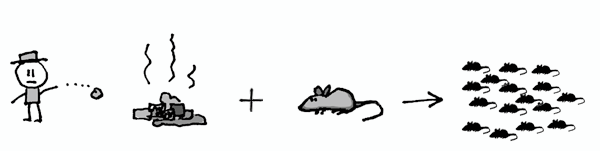
You are the mayor of a town with a serious rat problem. The municipal rat catcher comes by with his report: “I killed a thousand rats this month.” “Well done!” you say, and you write him a check. But this goes on month after month for years. Sometimes more rats, sometimes fewer. One day you think, shouldn’t we be coming to the end of the rats soon? At that moment, you are enlightened: You’re not in the rat extermination business. You’re in the rat FARMING business. Farmers don’t run out of wheat. They help it grow, they harvest it, then they start over again. Until you eliminate the conditions that let rats thrive, you’re just another farmer harvesting regular crops of rats. Chastened by this realization, you look around your town with fresh eyes.

It’s a rat paradise! Piles of food left out to rot, uncovered garbage, and a rat catcher who is more than happy to be fully employed month after month. Only when you clean the place up does the rat population finally start to go down for good.

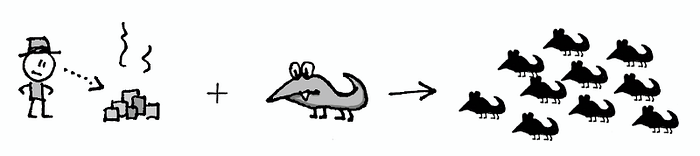
Eventually you move on from your job in Ratburg. You are now the mayor of Facebookville, and you have a serious meme problem. Toxic fake news memes are running rampant, biting your citizens. You pay meme debunkers to come in every month and spray them with facts and explainers. Mr. Snopes, the municipal debunker, assures you that he is making good progress. “We killed a thousand memes this month!” But one day, as you ponder the meme food chain, it hits you. You’re a freaking MEME FARMER!

Here’s how it works. Humans excrete attention through their eyeballs. Memes feast on it, and then multiply into toxic blooms of fake news. It doesn’t pay to intervene by debunking individual memes. More will keep pouring in. You can never get ahead of the meme population until you control the steaming heaps of waste attention that pollute your streets. You thank Mr. Snopes for his valiant but ultimately misguided work. The real work lies elsewhere.

Advertisers have rewarded Facebook for consolidating all this thinly spread and divergent attention into one convenient pile. They eat their fill and leave behind a filthy mess. Until we address this problem of attention hygiene, fake news will only proliferate. Every time you take the click bait, you delight the meme, the troll who created him, and the debunker who lives for the tiny noiseless take-downs that currently pass for progress. Your untended attention is a menace to society.

So what does attention hygiene look like?

Do a social media fast every other day. Consider not forwarding or re-tweeting that stupid thing the stupid politician did. Know your triggers and steer clear of them. See a headline about a maddening NRA ad? Don’t click! You know nothing good will come of it. Importantly, even the institutions are starting to acknowledge the problem and respond. Facebook has introduced a snooze button that will let you temporarily unfollow a person, page, or group for 30 days. Call it the Snooze Feed.

We’re getting better at this. Eventually we’ll have clean streets and good attention sewers. But for now we’re still in the filthy old London typhoid ‘n cholera stage. Boil your newsfeed, and please, don’t sneeze into your browser!

Note: this post originally appeared on Medium. I’m repatriating it over here on starchamber.com.

To Hallucinate Is Human

Do you know the names of the three wise men in the Christmas story? They are Caspar, Melchior, and Balthazar.

Image by Midjourney

We know quite a lot about them. Caspar, the gold-giver, was an old man from Tarsus. Melchior, a middle-aged man from Arabian, brought the frankincense. And the myrrh came courtesy of the young man from Saba, Balthazar. This was all carefully recorded, as you know, in the Bible. Or rather, it might have been, if anyone had thought to write it down when they came a-visiting. But nobody did. The actual biblical text simply refers to an unspecified number of wise men and their gifts. Into this void, different traditions have supplied wildly varying backstories. Now might be a good time to mention that according to Armenian Catholics, the wise men are named Kagpha, Badadakharida, and Badadilma, while in the Syriac tradition, there might be a dozen of them. That’s a lot of myrrh.

Where do all these extra details come from? Nature abhors a vacuum, and humans abhor a vacant backstory. Somewhere along the way, somebody just made them up, and it stuck. In short, they were hallucinated.

Hallucination also happens to be a naughty habit of modern AI Large Language Models. Ask ChatGPT to describe what’s on a blank piece of paper, and it can fabricate the most wonderful details. Ask it for the biography of a semi-famous person, and some details will be accurate, while others will be reasonable-sounding fictions. We call this pathological, but we shouldn’t act so surprised. Hallucination is a hallmark of intelligence. Humans do this shit all the time.

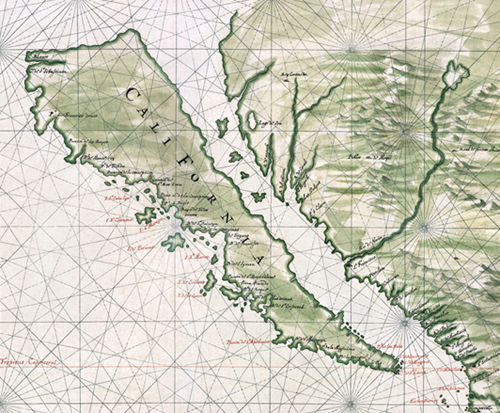
Here’s another story I like, about the island of California. The first maps of California depicted it as an island, and this error persisted in hundreds of other later maps well into the 17th century. Take a look.

Image courtesy of Wikipedia

It’s not wholly inaccurate. It represents Baja California reasonably well. But note that there are two kinds of lines on this map. One is based on actual observation and may be said to represent reality. The other kind is a bullshitter’s ramble, a fabrication, a hallucination. The mapmaker crafted reasonable-looking wiggles for fictional rivers and coastlines (“I bet it probably looks like this…”). The problem is that the two kinds of lines look the same. It would have been nice if they included little footnotes like “Seriously, don’t sail here or you will hit these rocks and sink” or “I just made this river up LOL.”

The big question is: when is hallucination acceptable, and when is it a sin? The question comes down to this: what job is the text being hired to do? The map’s job is to describe the landscape, to prevent shipwrecks. It does this by being accurate. Over time, the map will become more accurate. Hallucination in cartography is a sin.

But religion isn’t cartography. The stories can shift so long as the truth they point to is stable and meaningful. This shows up in religious traditions all the time, and it just goes to show that the purpose of religion is not factual accuracy. Sometimes, hallucination is the right tool for the job. I think of it this way. Culture is a sort of big brain. Culture thinks in myth. Culture creates myth the way humans create memory. We continuously construct it so that we might make the world plausible and legible. We hallucinate. Sometimes that causes shipwrecks, but sometimes it’s freaking brilliant.

People get upset about AI’s tendency to hallucinate, but the AI is really just breezing through one section of the Turing Test. There are things that we think of as pathologies that can never be purged from intelligence because they are a consequence of it.

Hallucination is, of course, just a start. Once AIs start to insist that the world is flat, we’ll know they have at last arrived in the land of the truly intelligent.

Lines Written One Year Ago

It is a hell of a thing to watch someone you love slowly die.
To watch them dissolve before your eyes in the house that you share.
It is a sad, strange privilege.
There is an exaltation to it.
This is the edge of all we know, all we can know.
We spend so much time avoiding the edge, shrinking from it.
But I have been dragged here, and I will not shrink. I must not shrink.
The void is so close. Silent and vast.
It is reflected in her eyes, her yellowing upturned eyes that no longer fully close.
She drowses, pale and thin and full of everything that a life can hold.
It’s all still there, coiled up inside her, even now.
Where will it go?
What will remain?
She is leaving, slowly leaving me even as I watch
She is going
She goes
And I cannot point where.
Somehow it seems as though I should.

Image by Midjourney

Mount Everest Trivia

It’s May, which means it’s summiting season on Mount Everest. If you haven’t already booked your trip to Nepal, I’m afraid it’s probably too late for you to reach the top this year. On the plus side, it’s never too late to learn some pedantic facts about Mount Everest so you can irritate people at your next cocktail party. Also, this way you don’t have to risk losing toes and fingers to frostbite.

Here’s your first fun fact: you’ve been saying it wrong. You may know that the famous peak was named after Sir George Everest, the first Surveyor General of India. But as with poor old Edmond Halley (of Halley’s Comet fame), his namesake is not pronounced the way his name would have been said during his lifetime. Halley rhymed with “valley,” not “daily.” And the first syllable of Everest sounded like “eave.”

But why was Mount Everest named after a British citizen, anyway? All the other big peaks in Nepal have local names (repeat after me: Lhotse, Nuptse, Annapurna II; Jannu, Kabru, Thamserku). More to the point, the peak wasn’t even inside of British-controlled India at the time. The government of Nepal was suspicious of the British, so they didn’t allow the survey team inside their borders. The surveyors had to work out how tall Everest was by means of telescopic transnational peak-peeking. But then they were stymied by the fact that there was no obvious and unambiguous local contender for the name. Depending on where you stand, it is Chomolangma or Sagarmatha or maybe Devadhunga. This gets us to the real reason a British name prevailed: it was Britain was making the maps. To be a little more specific, the office that Sir George Everest built was making the maps. In fairness, Everest didn’t name the mountain after himself. Andrew Scott Waugh, his successor as Surveyor General, did that part.

But here, at last, is my favorite fun fact about Mount Everest: it was discovered by a computer. Stop for a second and consider that “the tallest mountain in the world” is remarkably abstract concept. Tallest compared to what? The ocean? The ocean is 440 miles away from Mount Everest! How would you even begin to compare a mountain in Asia to a mountain in South America? In a very real sense, the tallest mountain in the world didn’t even exist until the Royal Geographical Society declared that it had been found. Working out the world’s tallest mountain meant reducing huge amounts of data with extravagant trigonometric calculations. In the nineteenth century, the people who did these calculations were called “computers.” The chief computer for the Great Trigonometrical Survey of India was a man named Radhanath Sikdar. Sikdar was a talented mathematician who would have been overseeing the construction of the distance and altitude tables. And after more than ten years of work, he would have been one of the first people to know. Many people saw the mountain, but who saw exactly how tall it was? A computer, that’s who. A computer named Radhanath Sikdar.