Aurora from above

Lots of people in high latitudes get to look up at the aurora borealis (or australis as the case may be). But it’s a rare soul who gets to look down on the aurora. Imagine looking out your window and seeing this boiling phosphorescent sea.

Good day to be an astronaut! I was going to say it’s a shame about the extra radiation pounding on the observing astronauts. After all, you might expect ionizing radiation that can squeeze green light out of thin air might make your delicate organs shine with purple fire. But it turns out that aurora at night is a spacefarer’s delight. It actually decreases the radiation impinging on the Space Station.

Here’s a link to the credible version of the story from NASA, but think of it this way. A solar flare is like a gargantuan coughing fit. All that phlegm and sputum from the sun gets in the way of visiting cosmic rays, and that’s a good thing if you’re an orbiting testicle. Or any other part of an astronaut, I suppose.

In other news, my sister-in-law sends this. I dare you not to click on napping panda babies!

(Video via Steve Crandall. Pandas via Anne.)

Focus is the skill of the future

In an age where everything is abundant and colorful noise presses in from all sides, what’s scarce is scarcity. Silence, clarity, focus. If there is an economy of attention, then focus is its currency.

They should teach college classes on focus. The lab would occur on meditation cushions. I’ve heard stories about how, during exams, roommates have “uninstall ceremonies,” where they witness each other removing addictive computer games from their hard drives. That’s a terrific response to a modern problem, a spontaneous ritual that creates intentional space where there was clutter. Whoever can successfully cultivate focus will command a high price.

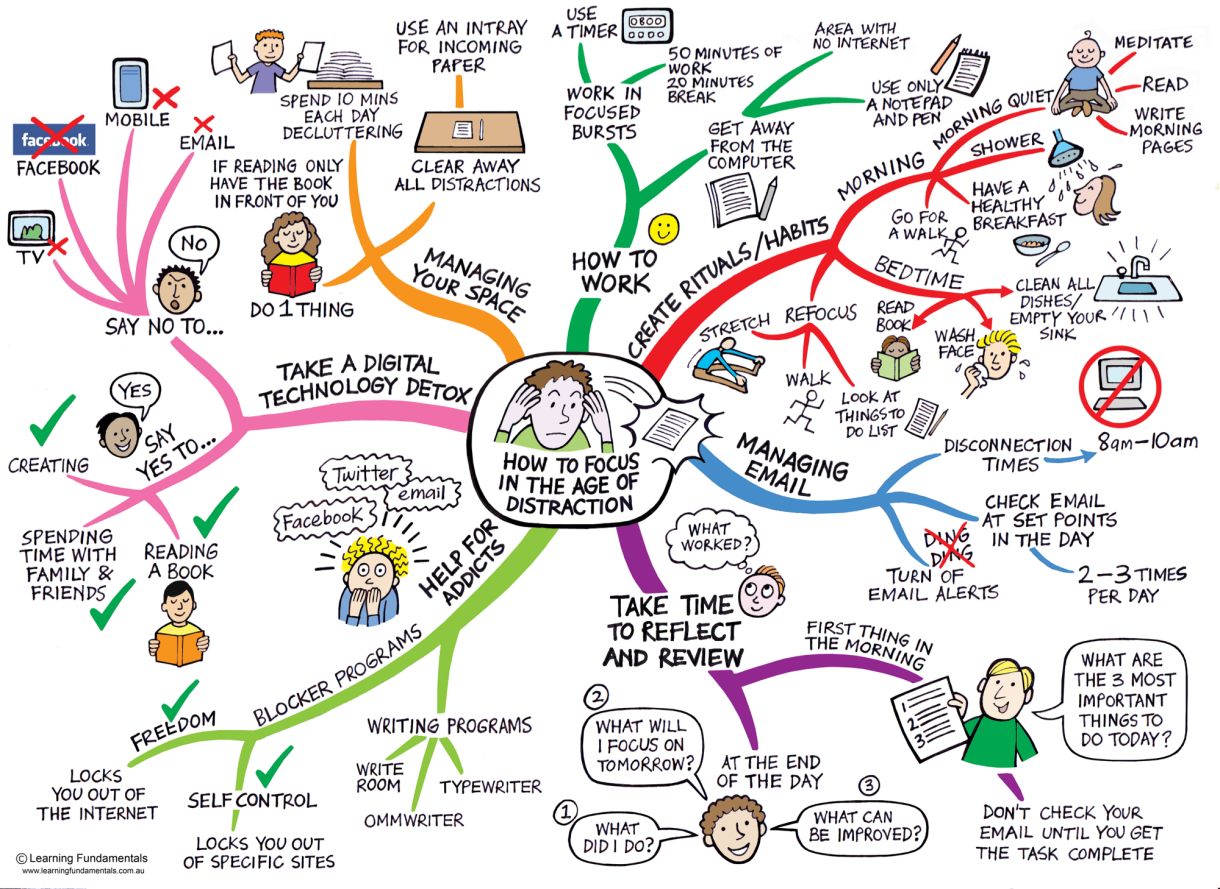
I came across this nifty review of a book on this very topic: Focus by Leo Babauta. The review is nifty because it comes with this handy mind map that summarizes the book. There, I’ve saved you the price of the book.

On a related topic, I love this video on procrastination. It’s actually a teaser for another book: You Are Not So Smart.

Key takeaway: you’re not one person. You’re many people joined by a calendar. You From Yesterday is a bum who should’ve gone to the gym. But he didn’t. He played a computer game until 3 AM. Not only that, he kept you up half the night. Asshole. But for some reason, some strange reason, you have confidence that You From Tomorrow will do the right thing. Here’s the thing: You have to realize that these guys are related. You From Tomorrow is a bum too. Why do you think he’s going to help you? He’s as bad as You From Yesterday. It’s too late to do anything about You From Yesterday. The cruel part is he doesn’t even have to live with his bad decisions. He blithely hands them to you. Even now he’s still playing that damn computer game. The good news is that it’s not too late to help that feckless layabout, You From Tomorrow. He’s been hanging out with a bad crowd. Take pity on him! For instance, you know the poor guy is wretched when he doesn’t get enough sleep. There’s one nice thing you can do: go to sleep early. Keep in mind how little willpower he has, and set him up for success wherever possible. Limit his options. Take away his computer games.

He’ll hate you at first, but eventually he’ll thank you. And over time you might realize that idiot from yesterday isn’t so bad either.

A squid of a different color

Look at this video. Don’t miss the part around 2:15 where they zoom in on the squid skin. For years I’ve seen these amazing videos of squids and octopuses showing how rapidly they can change color, but I never had any clear idea how they accomplished it.

It’s amazing to see the restless, boiling appearance of the chromatophores. These color-bearing cells take a constant amount of pigment and either squeeze it down so you can’t see much of it or squash it flat so you see a lot of it. Taken together it amounts to a large flexible low-power color display with a rapid refresh rate.

Say! When you put it like that, it starts to sound like a pretty cool technology. Which of course it is. As you might guess, human engineers are trying to learn from the canny cephalopod. Gamma Dynamics is a company that’s trying to bring chromatophore-inspired electrofluidic displays to an electronic display near you. It has a lot of attractive features: speed, low power, and color. But since it’s not here just yet, we can assume that it’s tricky to get it right. This IEEE Spectrum article on display technologies is clearly somewhat biased, since it was written by the principal scientist at Gamma Dynamics, but it’s a good overview.

Wrangling the web

A month or so ago I bemoaned the lack of any kind of universal queue for keeping track of web stuff. The basic idea is that I want to take my various interactions with interesting web stuff and stitch it together into one manageable work flow. Instapaper is pretty close to what I want, but not it’s not quite universal enough yet.

Now along comes ifttt, which comes at the same problem from a different direction. I was thinking about the noun, the big queue that I would use to keep track of stuff: Flickr pictures, RSS feeds, movie reviews, newspaper articles. But ifttt is all about verbs. They just opened their doors, and it’s a very impressive service. The name “ifttt” stands for “if this then that,” which in turn is short for the sort of instructions you would give your personal assistant:
“If I put a picture on Flickr, then put it in my Dropbox account.”
“If someone tweets about me, tell me right away.”
“If the gin is cold, bring me a martini.”

Like Instapaper, ifttt is service-agnostic. So it’s well positioned to make friends with everybody. Most of all, I think it’s a proof-of-concept of what comes next, once we agree on standards that can bridge between various proprietary fiefdoms. Things like ifttt will get easier and easier. We’ll look back and realize that Yahoo Pipes was too early, but ifttt showed up right on time.

Here are two good reviews with extensive examples. First this from Scott Hanselman: Essential IFTTT (IfThisThenThat) – Programming Workflows for Humans using the Web’s Social Glue. And here is ReadWriteWeb: How To Back Up Your Life Automatically with Ifttt

Earthquakes and info-quakes

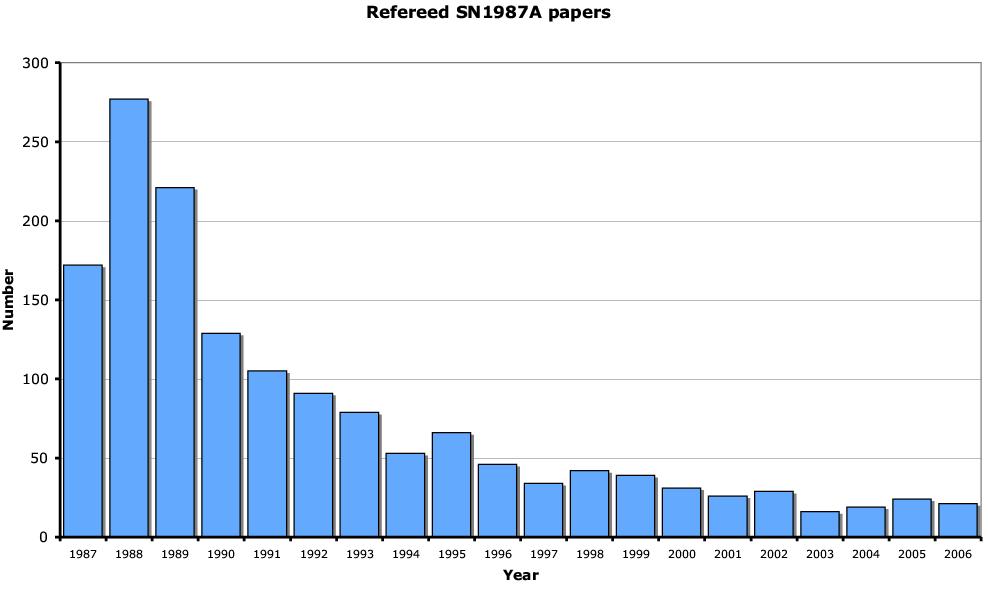
Physical events cause ripples in information space as well as physical space. For instance, every morning I pass a speed trap on the Massachusetts Turnpike. Usually there’s no cop there, but when there is one, I can detect him well before he sees me. I don’t have a radar detector. I just have to watch for people ahead of me slowing down in an odd way. I don’t see the cop, but I do see the information radiation that they shed: brake light enlightenment. Similarly, there was a famous supernova that was first observed in 1987. Cleverly, someone had the presence of mind to call it Supernova 1987A. But we could have detected approximately when it occurred anyway based on the huge spike in astrophysics papers mentioning the word “supernova”.

All this brings us to the Somewhat Large Earthquake of 2011. Can you detect when and where it happened given only the information contained in Twitter? Yes you can. Look at this SocialFlow analysis. Be sure and try the little map animation near the end.

In the future, when we all live in sealed info-pods, people will be more likely to believe something that was heavily tweeted than something they saw with their own eyes. After all, tweeting is believing.

Demystifying biological self assembly

Perhaps the most mysterious and remarkable property of living systems is that they build themselves. That phrase is loaded, though, because it suggests that there is a builder. But there’s no entity to do the assembling before the assembly has itself started. What living systems do is sort of “fall together.” Unfortunately this defies our everyday logic. We never see anything like it.

Why is it we never see the very thing that makes life possible? It’s because life’s magic happens at the scale of molecules, whereas we observe things at the scale of cats and dogs. There are a lot of molecules in a cat.

This seeming impossibility of complex self-assembly is at the root of a lot of mischief. In particular, it leads many to a deep emotional conviction that there must be something to intelligent design. I’m convinced that if we could make self-assembly more comprehensible, more real, it would lead to corresponding improvements in scientific fluency.

Here is a good three dimensional representation of the kind of self-assembly that viruses do. It has some magnets that simulate the forces of molecular binding. Watch carefully as the random jiggling turns it back into a virus.

[via the MAKE site]

If you’d like to get more (virtual) hands-on experience with self-assembly, check out this interactive modeling environment: Molecular Workbench Simulation

[via Mark Guzdial’s blog]

Seeing Eye Birds: Parahawking

Guide dogs can see what a blind person cannot: doors, stoplights, crosswalks. Hawks can see what no person can see: thermals. Wouldn’t it be nice if someone flying a glider could keep a hawk on a tether for the purpose of sniffing out flight-sustaining thermal updrafts?

There’s no tether, but that’s the basic idea behind parahawking. The birds fly free but are rewarded from time to time. As it says in the FAQ.

Our birds need to be rewarded for guiding us into the thermals. During the flight the passenger will place small morsels of meat onto his gloved hand, the birds will come and gently land on the hand to take the food, and then gracefully fly away to find the next thermal. A perfect symbiotic relationship.

The video is a little long and same-y, but it’s worth watching to see the birds landing on the customer’s arm for a mid-flight snack. Start about 2 minutes in if you want to jump right to the good stuff.

I can see how this would go down big with the swim-with-dolphins set.

[Spotted on DIY Drones]

How ironic!

Mike Duncan runs a podcast called The History of Rome which I thoroughly recommend. One of the things that makes it enjoyable is oddball digressions like this. You won’t run across a passage like this in a textbook.

In November of 361 AD, Constantius II died and Julian, last of the Constantinians, inherited the empire. It would be an ironic end to the dynasty. At least I’m pretty sure it’s ironic. Sometimes I think that no situation actually fits the technical definition of irony and that the word just sort of hangs out in the linguistic ether singing a siren’s song that’s designed to crash the unsuspecting against the jagged rocks of pedantry. But I’m pretty sure it’s ironic. Constantine began the dynasty by single-handedly launching Christianity to prominence, and his nephew would end it by attempting to single-handedly turn back the clock and bury Christianity. That’s ironic right? It sure seems ironic. But it’s probably just interesting.

That’s from Episode 145, Julian the Apostate. We’re down to the last hundred or so years before the fall of Rome. I have no idea how long he intends to follow events in the east. Could take a while given that Constantinople didn’t fall for another thousand years.

You know what would really be ironic? If… no, wait, suppose that… oh never mind.

The New York Times Paywall

Whenever I’m talking to someone who believes that only chumps pay for digital content (Dude, why do you pay for music?), I think about street performers. Have you ever dropped a dollar in the cigar box in front of that cellist in Harvard Square? Yeah? Well what kind of a dope are you? That guy would’ve kept playing with or without your money. Sucker.

Like a lot of people, I was sad to see the New York Times turn off free iPhone access for all articles, but I had to concede that you can’t really expect a company to give away its primary source of revenue forever. I knew this day would come. I had expected a barbed wire fence to go up around the paper, so I’ve been impressed with the relatively enlightened approach that they’ve taken.

My brother just sent me this article called How The New York Times Paywall Is Working. It does a good job of explaining the difference between a gentle paywall (think “please”) and a fierce paywall (think barbed wire). It’s easy to saunter past the gentle paywall, and a lot of hard core geeks are going to laugh in your face. But ultimately that’s the one that’s going to work. The Times is running a great big experiment to see if the gentle paywall will work. And good for them.

There’s a theory about taxation that says people, on average, will pay what they think they should pay. If they think they’re getting screwed, they use fraud and willful neglect to limit what the government can collect. If they’re getting a good deal, so the theory goes, enough reasonable people will pay up to let the enterprise keep rolling. It may well be that the United States is going through its own New York Times-like convulsion (Dude, why do you pay for government?).

Call me an optimist, but I think enough reasonable people can recognize a good deal when they see one. Transparency serves everyone eventually, but it does take a while for the lessons to come home. As Washington remarked to Lafayette, “It is to be regretted, I confess, that democratical states must always feel before they can see. It is this that makes their government slow, but the people will be right at last.”

I’m convinced that almost all content will shift to this sort of honor system. The New York Times, like the US government, will be leaner, but it will be solvent and functional.

Then again, it might work more like this old Monty Python sketch in which Mr. Ford from the orphanage (Terry Jones) tries to convince a puzzled merchant banker (John Cleese) to give him a pound for charity.

Banker: I’m awfully sorry I don’t understand. Can you just explain exactly what you want.

Mr Ford: Well, I want you to give me a pound, and then I go away and give it to the orphans.

Banker: Yes?

Mr Ford: Well, that’s it.

Banker: No, no, no, I don’t follow this at all, I mean, I don’t want to seem stupid but it looks to me as though I’m a pound down on the whole deal.

Civilization is for suckers.

Managing contact info for couples

I keep thinking there must be a standard way to handle this situation. My contact managers (in the iPhone and GMail) want to divide the world into individuals. But I want to maintain contacts for couples too. That way if they share an address, children, or even (gasp!) a common land line phone number, I see it all in one place, rather than maybe here with her info or maybe there with his.

As a result I end up with three records: one for him, one for her, and one for the two of them. Birthdays travel with the individual, and anniversaries travel with the couple.

It’s a small enough annoyance, but what’s the canonical way to solve this?