Statistician, Rock Star

Hal Varian, the chief economist at Google, likes to say that “the sexy job in the next ten years will be statisticians.” I’ve seen this quote in a few different places, and he always follows up by saying something like “I’m not kidding.” And he’s not. I’m inclined to believe him. The stat stars are aligning: reams of valuable data, expansive visualization tools, and genuinely meaningful results.

In fact, I already know of at least one statistician rock star: Hans Rosling. He’s been working for years in health and economic development in poor countries. Trained as both a doctor and a statistician, he now runs something called the Gapminder Foundation in Sweden. In recent years, he has come to fame because of his dynamic charts and his dynamic speaking style at various TED talks. This is a man who is vibrating with energy and enthusiasm for his message. Take a look. Here’s a video that was forwarded to me (thanks Mom!).

The Earliest Sunset

Two happy facts: today is my birthday, and this evening the sun set at 4:13 PM. Depending on your latitude, 4:13 may sound pretty dismal, but consider this. Last week the sun was setting at 4:12 PM. I call that progress.

For years I’ve been talking about the happy fact that in December the earliest sunset happens well in advance of the solstice. This little known and little noticed boon helps me get through the dark days of December, because I know that, starting on December 9th, the afternoons are going to be getting a little longer. This year I decided to spend a little more time explaining why this should be.

How Long is the Day? Apparent Solar Time

Even if you have no clock, you can still tell when it’s noon. Noon is defined as the instant at which a straight stick leaves the shortest shadow. At that moment, the sun is as high in the sky as it’s going to get. This is the principle of the sundial, and it’s how the ancients told time. But suppose you now have a stopwatch, and you can accurately measure how much time passes between two noons. You’ll notice something strange about your measurements: the length of the day varies up to half a minute.

This is the length of the day, as measured from noon to noon.

It might not seem like a big deal, and in fact nobody cared at all until the first accurate clocks were invented starting in the 1600s. But this discrepency ends up being a big inconvenience for the sorts of people who make schedules. Think about it this way: if a day is 24 hours long, then what we’re saying is that the length of an hour depends on what day of the year it is.

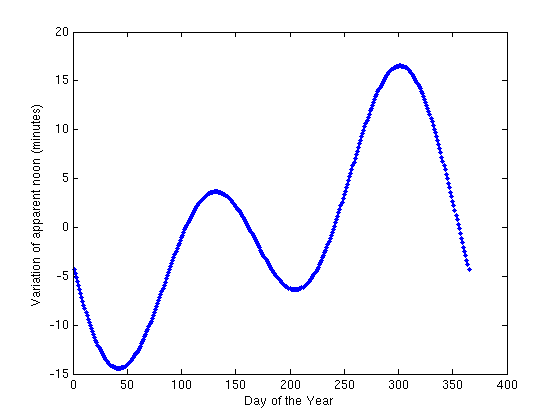
What to do? To smooth things over, astronomers created a mean solar day that is the average length of all the days in one year. So the time from noon to noon is declared by fiat to be 24 standard unvarying hours. But now you have a different problem. Instead of the hour misbehaving because of the sun, we now have the sun misbehaving because of the hour. That is, we modern folks simply decree that it is noon even when the sun isn’t close to being overhead. These variations of the day’s length pile up at different times of the year, leading the sun to be out of step with the clock by as much as 16 minutes.

It’s a little ironic that the sun gave us our very definition of time, and then we turn around and call it out for its flaws in timing. But there you go.

Fudge Factor: The Equation of Time

The degree to which the sun is out of step with the clock is called the Equation of Time. That’s a grand name, but this equation solved a problem that people had in the days before you could call up official time on your phone or a website. To set your clock accurately, you just figure out when it’s noon (using a sundial or a sextant), and then add or subtract the Equation of Time factor.

Here’s what the Equation of Time looks like. I’m not going to bother explaining why it wiggles around other than to say that it results from two factors: the elliptical nature of the earth’s orbit and the tilt of the earth on its axis.
The Earliest Sunset

Now we are ready to tackle the problem of the earliest sunset. We’ve done the hard part. In the ancient sundial world, there were always as many hours between sunrise and noon as there were hours between noon and sunset. That’s the old definition of noon: it splits the day into equal parts forenoon and afternoon.

Here’s what the length of the day might look like in the mid-northern latitudes as we pass through the winter solstice. Each blue line represents the length of a single day. Calendar days are going from the top to the bottom. The sun rises on the left, passes through noon in the middle, and sets on the right.

The red circles show the earliest sunset and the latest sunrise happening as expected on the shortest day, the winter solstice. The symmetry of the diagram is very satisfying.

But we don’t live in the ancient world. The modern world has the sun shifted away from overhead when our clocks tell us it’s noon. That’s the Equation of Time. That means that extra minutes are being added to the morning and removed from the afternoon, or vice versa. So imagine we’re taking these days, which are like stacked plates in this visualization, and skewing them as shown by the leaning black line. Now the day length is shown in light blue (the dark blue lines from the previous plot are left in place for comparison).

Behold! The earliest sunset now arrives a few days in advance of the solstice. Similarly, the latest sunrise has been shifted to a few days later than the solstice. As for the timing of the solstice itself, no amount of shifting noon this way or that will change the length of the day, so we experience solstice on the same day as the Romans and the Babylonians.

Fun with dynamic text

There’s something mesmerizing about watching animated text and graphics that exactly match what’s being said. It’s not exactly a new medium, since hand-drawn animation has been around for ages. But editing tools have made the process a lot easier, and the results are striking.

Here are two examples I came across recently. From Steve Crandall’s blog, I found this rendition of Jonathan Coulton‘s song “Shop Vac”. See how many corporate logos you can spot being adapted for this video.

Shop Vac from Jarrett Heather on Vimeo.

The other example that I saw recently is very different in composition. The Royal Society for the encouragement of Arts, Manufactures and Commerce (RSA) in the UK has been recording talks and then adding hand-drawn animations to provide visual stimulus. Definitely better than PowerPoint! Here’s a riveting talk on a topic you might not expect to be riveting: Sir Ken Robinson on Changing Education Paradigms.

The codification of skillz

While trying out Netflix on the new Apple TV widget, I recently watched Dogtown and Z-Boys. It’s a well made documentary about the rise of the modern skateboarding movement in Southern California. By the early 1970s, skateboarding had already come and gone as a thoroughly domesticated Leave-It-To-Beaveresque fad. The Z-Boys were surfers from a disreputable LA beach (Dogtown) who took up skateboarding when the waves were bad. We learn how they transformed skateboarding by completely disregarding the rules. They don’t give a shit, and without trying, they become counterculture heroes for a generation of young skateboarders. This rising generation quickly codifies the sport into new rules and orthodoxies. Turbo Rad Angry EXTREME orthodoxies!!!

It’s an old story, but well told. Icons are smashed, and heretics become saints. Still, I’d have to guess that part of the glowing treatment of the Z-Boys must be due to the fact that the filmmaker, Stacy Peralta, was one of them.

This movie was on my mind when I saw the latest jaw-dropping bicycle video by virtuoso rider Danny MacAskill. He’s an outsider setting a new standard for what can be done. No pop culture analysis can take away from the fact that what he does is just incredible. Imagine being able to do this:

Now compare that with this video. Again, the riding is incredible. It’s amazing how quickly this kind of cycling has been domesticated and codified into, in this case, the Junioren Europa-Meisterschaft Hallenradsport (more here). The polite crowd in the quiet gymnasium. The competitors in matching tights bearing National Emblems. I was so happy they weren’t playing raging fist-pumping rock music that I wanted to hug them by the end.

I think these iconoclast-orthodoxy cycles are getting shorter and shorter.

MapCrunch, the travel guide to Anywheresville

MapCrunch is a good example of what Bruce Sterling calls “composting”: one technology emerging as an unexpected bright green shoot from a steaming pile of some other technology. Less poetically, we might call it a mashup, or merely an unintended consequence. However we choose to describe it, MapCrunch is a tasty treat growing straight out of Google Maps’ Street View mode. There’s plenty of good fertilizer in Google Maps.

The idea is simple: click on a link and visit a random Street View location somewhere in Google’s vast corpus of street views. Which corpus being essentially comprehensive of the entire planet, you can just go and go and go and go. Their tagline is “teleport to a random place in the world.”

Try it!

It’s addictive. You start clicking and the questions just flow.

What do street signs look like in Finland? Why do they have street view in Antarctica? (It’s a small but entertaining sample. Penguins!)

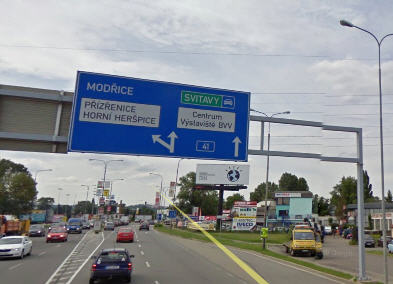
If you hide the map that shows where you are, can you figure out what continent you’re on? What country? (Where was the image above taken?) How long can your teleport around Germany before you find a blurred-out building? (Only three clicks for me!) Is there a hill in Holland? Can you do better than random playing “Is this Portugal or Brazil”? What’s around that corner?

What meta-MapCrunch games can you come up with?

The Evolution of TED

For lunch on Thursdays I meet up with a few friends in a conference room at work and we watch TED videos. What are TED videos? I’m sure you’ve seen some. I’ve linked to several of them from here. TED is a conference, and the videos are from talks at that conference. But there are lots of conferences… why have TED talks become their own special category?

TED was created by Richard Saul Wurman many years ago as an exclusive conference dedicated to Technology, Entertainment, and Design (hence the name). Since then the ownership has changed hands, and TED has become something bigger. Chris Anderson, the owner since 2001, has pushed it in a more open direction, building on the mission “ideas worth spreading.” With the help of some generous sponsors, TED now makes available an astonishing amount of high quality video for free. The latest Fast Company magazine talks about how TED is the new Harvard. That’s overblown of course, but it does make me happy to know that clever people in all corners of the globe are able to enjoy these talks free of charge. It may not be Harvard, but it’s a darn good education.

Here’s a talk from TED employee June Cohen at O’Reilly’s Web 2.0 conference this year. It’s interesting to see how the process looks from the inside. Even when you have strong managerial belief that giving stuff away is the right thing to do, it’s very scary actually doing it. And yet it’s paid off in the most dramatic way. TED is more successful than ever, and has, in the words of her title, transitioned from “a conference to a platform.” In the same way that Google has been well served by its mission of organizing the world’s information, TED has been able to grow beyond its wildest ambitions by following its own mission of spreading great ideas.

Extra bonus: Greatest Hits of TED Videos. I recommend watching them at lunchtime with friends.

Molecular biology cinema

Hey, so I totally scooped the New York Times with my post last week about animation and molecular biology. Only two days ago they came out with this article: Molecular Animation – Where Cinema and Biology Meet. I’m sure they were peeved about my piece, and they probably rushed theirs into production as a result, but it’s a nice article.

It’s accompanied by this video, which I would embed here, but it appears they don’t permit that.

MATLAB Contest gets a mention on Freakonomics

The MATLAB programming contest we run twice a year is currently up and running right now. The rules are here, and there are also some entertaining statistics and graphs showing how things are progressing. I’m particularly impressed with how the code has improved this year. It’s getting better and smaller at the same time, which is unusual (and rare) for code in general, but especially so for our contest.

So it’s lucky timing that we got a nice mention in the New York Times Freakonomics blog: Geeks and Tweaks: What Computer Programming Contests Can Teach Us About Innovation. The post was written by guest bloggers Kal Raustiala and Chris Sprigman, and it includes a long quote from me which comes from my paper in Interactions magazine, In Praise of Tweaking.

Raustiala and Sprigman’s post is broken into three parts. The contest comes up in the third. The first two (part one and part two) talk about what the world of football can tell us about copyright law. In short form, the argument goes like this: copyright law came about because if creators don’t have protection from the law, they will lose their incentive to innovate and create. That’s the theory, at least. But wait a minute, say the authors. Football is good counterexample to this argument. You can’t copyright a defensive formation, but that doesn’t stop innovation from happening. In fact, football is one of the most innovative professional sports. The MATLAB contest comes up because it offers no special protection to innovators, and yet innovation flourishes there too.

I just like the fact that our programming contest is presented as being analogous (in some small way) to the NFL.

Molecular models

It used to be that biology class was full of pictures of labeled blobs. You could see why: cells are teeny tiny. It’s hard to see what’s going on in there, and there’s a fair amount of guesswork as to what all the parts do. Everything is called a this-o-some or a that-o-some, which just comes from the Greek for “blob” (okay, it’s Greek for “body,” but it’s the same idea). I count 25 different somes of one kind or another on the Wikipedia organelle page. Parenthesomes! Ejectosomes! Spherosomes!

So you ended up with lots of cartoonish diagrams or grainy electron micrographs. Here, for example, is our friend the bacteriophage.

You’d like to zoom in for a close-up and see what’s really going on down there, but the physics of looking at tiny things says no. Move along folks. Nothing to see here.

That’s changing now, because we’ve made such strides in molecular biology. Compare the pictures above with this movie. We now know the molecular structure of this phage down to the last atom.

There’s so much good stuff for biology students to look at these days, it makes me weep. Maybe you’ve seen The Inner Life of the Cell video that was funded by Harvard. More recently they made a beautiful mitochondria video. And since we’re into flu season, take a look at this NPR piece: How A Virus Invades Your Body. While you’re at it, how about this super zoom close-up of H1N1.

Finally, if you like this kind of thing, or if you know someone who does, then I highly recommend a copy of David Goodsell’s The Machinery of Life (second edition).

3D prints kickstart an iPhone tripod business

3D printing is hitting the news a lot these days.

There are dozens of technologies waiting to do the work for you. You can print chairs. You can print cars and airplanes. You can even print skin back onto your body. There is a growing sense that 3D printers are going to start appearing in every house. It’s the new inkjet printer… why buy stuff when you can just print it out?

I’m a big fan of 3D printing, but that’s not going to happen. Not anytime soon.

One of the reasons I enjoy Joseph Flaherty’s Replicator blog, which is dedicated to mass customization and 3D printing, is that he takes the long view on these matters. He knows there are many barriers to mainstream usage of 3D printing. In this post he sums up what is and isn’t possible:

Replacement coat hooks and air conditioner knobs are not going to drive broad adoption and there are too many technical hurdles to take on complex objects like cell phones.

So what is possible then? Is it still worth getting excited about?

What’s possible (and exciting) is that it enables a whole class of serious amateurs. Flaherty describes this as product design as a hobby, and it’s sure to drive a fascinating wave of new products. Here’s a success story of one such product. Two designers came up with an idea for a tripod to support an iPhone. The widget they invented, with the help of 3D printing, is called the Glif. They raised all the money they needed on Kickstarter (another interesting story), and now they have business.

I can’t say for sure whether or not the Glif designers would have built a business without novel technology (3D printing) and novel access to capital (Kickstarter). But even if it didn’t enable it, it sure accelerated the whole process. And in times like these, we need the ideas that serious amateurs are going to bring us.