Visit a Curious Cabinet this Obscura Day

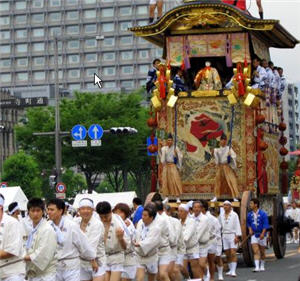
Ever wonder, as you’re watching the Pasadena Tournament of Roses parade, or some equally bizarre weirdness-on-wheels spectacle, just who first came up with the idea for floats? If you’re a regular at the Atlas Obscura, you would know that they’ve been building floats for the Yamaboko festival in Kyoto ever since the year 869. That’s more than 2010 minus 870 years ago!

yamaboko

The Atlas Obscura, which bills itself as a compendium of the world’s wonders, curiosities and esoterica, is the sort of place you go to learn about the mud volcanoes of Azerbaijan and the firefly squid of Toyama Bay. But in addition to the remote and unearthly, you might find something quirky and much closer to home. As luck would have it, Obscura Day is coming up on March 20th. Look at the list and you might find something obscure near you. If, for instance, you live near Elkin, North Carolina, you should consider a visit to the Private Cabinet of Curiosities maintained by sister-in-law Anne. As they say in the Michelin Guide, it’s “worth a detour.”

cabinet

Ask to see Frederick, the stuffed hamster. And tell ’em Ned sent you.

What We Mean When We Say Magic

“The larger the island of knowledge, the longer the shoreline of wonder.” -Ralph W. Sockman.

Magic is a slippery word. Does it refer to a trick or a glimpse of something deeper? This simple question has always puzzled me. This little essay is my attempt to nail down why that is. I want to talk about what we mean when we say magic.

But first let me tell a story.

Continue reading “What We Mean When We Say Magic”

Military theater at the India Pakistan border

Pakistan and India share a border that is well over 1000 miles long, but in all that distance, there is only one road that goes directly across the border. Or at least that’s what is claimed by the Wikipedia entry for Wagah, a town that straddles the Grand Trunk Road between Amritsar (India) and Lahore (Pakistan) in the restless Punjab. A little poking around with Google Earth reveals that you can cross the border a few other places (like the Kasur Gate), but it’s absolutely incredible how few opportunities there are given the length of the frontier.

All this focuses great attention on the Wagah nightly border-closing ceremony. Military ceremonies have always been about theater, and the intense mixture of chauvinism and bitterness in the Punjab have ratcheted the cold war anxiety up to such stratospheric levels that the resulting theater would be laughable if the stakes weren’t so high. My dad recently sent me a link to this video of the border-closing ceremony. I find it simultaneously stirring and hilarious.

Here’s another good (slightly longer) video of the same ceremony. I watch this and I keep reminding myself that farcical military silly-walks theater is better than war. In fact, this video was produced by someone who knows a thing or two about silly walks: former Python troupe member Michael Palin.

And one more thing. I can’t shake the feeling that I’ve seen this kind of preening and strutting somewhere else. Ah yes, that’s it.

CubeStormer solves the Rubik’s Cube

This is, to me, serious evidence that the robot age is right around the corner. For a long time now, it’s been easy enough to solve the Rubik’s Cube problem on a computer. But solving a real cube using a computer, that’s a different matter. First you have to take pictures of all the sides. Then you have to physically manipulate the cube according to your algorithm. The interface to the real world is always a pain.

But here is a robotic Rubik’s Cube solver built out of Lego Mindstorms components. The guy who built this is a hardcore hobbyist, but still, this is relatively cheap stuff, as robots go. Now watch…

A “Keep Calm” Meme Tree

You know you’ve struck a cultural nerve when you inspire not just one but dozens of parodies and copycats. It’s hard to say, for instance, why the Lazy Sunday video inspired so many spin-offs, but YouTube tells me there are 278 as of this writing.

Across the Pond, the Keep Calm and Carry On poster hits all the right notes to make it a cultural phenomenon in the UK. Originally created in 1939 to steel the British public to the stresses of the coming war with Germany, it was rediscovered in 2000 and has been a gold mine of merchandising and parody ever since. Its nostalgic evocation of the steady resolve of bygone days has mated with its easily mocked earnestness to breed a deranged litter of spin-offs.

Via BlogLESS I came across Christina Agapakis’s Meme Tree. She’s a biologist, so as you might expect, she’s built a nice phylogenetic tree. Like her, I’m amused by the evolution from simple transpositions like “Keep Calm and Rock On” to “Drink Lots and Pass Out” to more ironic assertions like “Change Words and Be Hilarious”. From there, it’s a short step to the self-mocking “Run Out of Ideas and Make a Parody” and the meta-self-mockingly abstract “Meme Meme and Memey Meme.”

keep-calm

Dan’s latest: Yet Another Planetarium Simulation

Great news! Dan Schroeder, the physics professor whom some of you will remember from his excellent reviews of iPhone astronomy apps, has written his own astronomy applet. Give it a look.

Why write another astronomy program? Here’s Dan’s answer.

To be useful to most of my students, a simulation program has to be (a) free; (b) delivered through a web browser, with nothing to download or install; (c) easy for beginners to understand; and (d) convenient for showing the motions of the stars and other objects with respect to earth’s horizon.

It’s a lot of fun to play with, and I like how Dan notes that his UI was partially inspired by H.A. Rey’s stargazing books, of which I too was, and remain, a loyal fan.

Coking the WX Build

Here’s a little slice of Ned’s Ancient History: I artfully surfed the dying wave of the Cold War. I paid for an expensive education with the help of an Air Force ROTC scholarship, thanks to Ronald Reagan’s extravagant defense bender. After three years of thoroughly enjoyable active duty, I emerged from the Air Force earlier than expected, thanks to George Bush the Elder’s frantic defense downsizing. Between those bookends, I pulled down the Berlin Wall, caused the Soviet Union to collapse, and co-wrote the smash hit “99 Luftballons”. Which is to say, I came of age in the 80s, and I wore the blue uniform. And I remember the Strategic Air Command (“Peace is our profession”). So does my buddy JMike, who, like me, was a Cold War cadet. For a while, back in the day, he actually worked at SAC Headquarters at Offutt Air Force Base. He was a weather guy, and one day he coked the WX build. I’ll let JMike explain the significance of the phrase. I like this story, and I want you to know that I specifically requested that JMike include the bonus phrase “spooge jar”.

Continue reading “Coking the WX Build”

Nature Biotechnology on Synthetic Biology

If you have any interest in synthetic biology, Nature Biotechnology has been kind enough to A) devote a special issue to the topic and B) make it available for free. I first learned about this on Rob Carlson’s Synthesis blog because he’s the author of an article on the economics of DNA synthesis (PDF).

carlson-curve

I also recommend the survey by Lu, Khalil, and Collins: Next-generation synthetic gene networks (also PDF). Taken all together, the issue communicates a sense “We’re moving faster and faster” combined with “Jesus this stuff is complicated!” Commercial breakthroughs won’t come quickly, but it’s hard not to be impressed with the progress being made.

For an indication of where things are headed, look at the projects being built by student teams for the International Genetically Engineered Machine (iGEM) competition. Browse through the abstracts here and remind yourself that these things (these organisms) are being built by undergraduates in a matter of months. The team from Valencia is building the Valencia Lighting Cell Display (iLCD):

We are making a “bio-screen” of voltage-activated cells, where every “cellular pixel” produces light. It is just like a bacterial photographic system, but it’s digital. Within seconds, instead of hours, you can get an image formed of living cells.

I recall doing much less impressive things with my college projects.

GIMME SOME CAW-FEE!

Font designer Mark Simonson does an occasional blog piece called Typecasting (or more recently Son of Typecasting) in which he skewers films for the anachronistic foibles in their fonts. Did you know, for instance, that the steam pressure gauge on James Cameron’s Titanic was set in Helvetica? Crikey! That font was sinking 45 years before it was invented!

It’s a professional hazard. Just as Mark Twain could never look at the Mississippi the same way once he became a riverboat captain, Simonson can’t look at the tombstone in a Western without thinking How did Helvetica (1957) and Eurostile (1962) end up on a tombstone in the year 1885?

When it comes to language, regular readers of the Star Chamber will know that frequent contributor Alan Kennedy is the local expert. This week he has a few thoughts to share about actors and accents.

Continue reading “GIMME SOME CAW-FEE!”