The Big Brain, or How Do You Make a Hand?

Consider your hand: dozens of small precisely aligned bones and the muscles that animate them. More than a hundred ligaments and tendons, not to mention all the nerves and blood vessels that need to be woven together and threaded through the wrist and up the arm. And all of this bound up in one felicitous, functional, compact package. It’s an architectural masterpiece. Where is the blueprint?

Your first guess might be “in the DNA.” Because that’s about the only place we know about where biology stores explicit plans. But you will search in vain to find the blueprint for a hand in your DNA. But if it’s not in our genes, then where is it? Here is the astonishing answer: We have no idea. Ain’t that a hoot? Seems like kind of a big lapse, eh?

You can, of course, zoom into any part of the body and ask the same questions. Everywhere you look, there is incredibly specific and robustly reproduced three-dimensional detail, and yet there is nowhere we can point and say “this is where the plan is kept.” That’s not to say that there is no such place. There must be. But we are, for now, largely ignorant of whole systems of cellular organization and direction.

In the name of exposition, I overstated our ignorance a little. We’re starting to have some inkling of how growth is modulated, thanks to the work of people like Dr. Michael Levin of Tufts University. Levin has been an energetic spokesperson for the idea of bioelectricity as a basis for what might be called cellular cognition. What is bioelectricity? It sounds kind of woo-woo at first, but the notion is straightforward. We all understand that our brain function is based on a network of neurons connected by synapses. It turns out that all cells, not just neurons, have the ability to communicate with each other via electric potentials and gradients. And they’ve been at it for a long time. In a sense, your entire body is a big brain with the ability to manage growth.

It’s not controversial that your brain can use electricity to maintain and reason about a vast set of complex topics. It’s not controversial because you’re doing it right now by reading this sentence. And well done, you! By analogy, it’s not unreasonable that networks of electrically-connected cells can reason on the problem of three-dimensional assembly. And Levin’s lab is starting to turn up evidence that this is the case. For instance, experiments with flatworms (we’re a long way from doing these things with humans) have shown that the same DNA can lead to very different body plans. There is some kind of as-yet poorly understood software layer that mediates physiological assembly. We will eventually understand it, and when we do, Levin predicts that we’ll be in a position to build what he calls an “anatomical compiler.” Dial in how many legs and eyes you want, press the GROW button, and stand back.

The big lesson here is that cognition is old, older than brains. It exists in some form wherever there is life, and it exists at many levels in many systems even in the same organism. It’s fun to watch this research unfold in real time. We’re witnessing the birth of an entire field. If you’re interested in learning more about this work, here are some links.

There’s even a TED talk:

Alien Commentary

A lot of discussion about the problems of our world is framed like this: “If an alien visited our planet and saw how much we were polluting it, they would be horrified by how short-sighted and self-destructive we are.” Or something like that. Pick your favorite bad thing that humans do, then have an alien visit and comment on our stupidity.

I understand why people use this framing. If you want to make some critical commentary, it helps to imagine an outsider’s perspective. But I think we need to give those aliens a little more credit. They’re not naive. They’ve seen it all before. To reach a point where they could zoom across the galaxy and pontificate about earthlings, they had to pass through a larval stage similar to the one we’re in now. They may be disgusted by our smell, but I doubt they’ll be shocked.

Image by Midjourney

I suppose there’s a chance they’ll treat us like worms, to be harvested or simply removed, but my expectation is that they’ll treat us with fascination and at least a little sympathy. I like to imagine an alien saying something like this: “Jeez, I remember middle school. Man that sucked. Don’t be too hard on yourself. It gets better.” Or maybe: “Ha! Your languages are just as irregular and hard to pronounce as Vugxshimnhiac! And your government – that bozo reminds me of Herpderp the Vain back home.”

They won’t be disinterested, rational superbeings. They’ll be a collection of the hardworking and the lazy, the conformists and the oddballs. You know, kind of like us. “Why does that weirdo Ixnagulon keep doing butt probe research on these poor natives? He’ll lose his funding if he keeps that up.”

My premise is that people are people, and er… so are aliens. Any sufficiently advanced alien is indistinguishable from your uncle. As a result, they’ll have a good chuckle when they see a lot of our stupid behavior. Of course, they might also say “By the way, give us your lunch money.” But at least they won’t be surprised at our stupidity.

On the Primacy of Desire

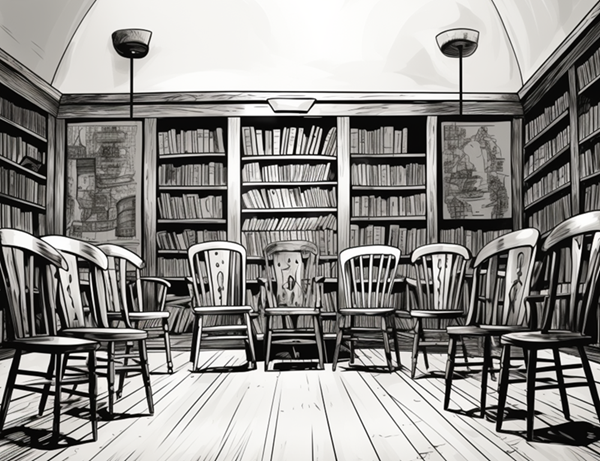
I recently attended my 40th high school reunion. As part of it, a few of us agreed to participate in a mentoring session for the current students. We were asked to give our “Obi-Wan Kenobi nuggets of wisdom” to a crowd of high school seniors in the library. This struck me as inauspicious. These high school seniors did not want to be in that library with us, and I promise you that none of them would mistake any of us for Obi-Wan Kenobi. So the event was actually a kind of panel where a few old people without credibility dumped life-advice platitudes on a crowd of sullen, motionless students. You’d be surprised how well we thought we did after the session was over. It’s a good thing we didn’t ask the students.

Image by Midjourney

I wondered: When does advice make a difference? And why is there such asymmetry between what we want to hear and what we want to say? Nobody wants to hear “When life gives you lemons, make lemonade.” But when called upon to dispense wisdom onstage, we say it all the same.

I won’t excuse myself. I was slinging clichés up there with everybody else. The best opening line came from the guy next to me, a successful dentist and business man: “I hated school. I absolutely hated it.” It was one of the few raw, unpackaged moments. I thought “Oh man, that’s hit the target.” But still there was no flicker of reaction. Tough crowd.

It occurred to me that these platitudes weren’t actually bad advice. You really should turn lemons into lemonade, after all. Platitudes are true enough, if you can hear them and act on them. But so much advice is already downstream of any chance at making a difference. Here’s an example of what I mean: “Set your goals and then work really hard to achieve those goals!” Good advice, yeah? But what if I don’t know my goals are? How do I follow my freakin’ bliss if I don’t know what my bliss is? This is the big question. Before it’s answered, career advice is worthless. After, it is superfluous. If you don’t care, there’s not much I can do to start you, and if you do care, there’s not much I can do to stop you. But where does the care come from?

We love to give advice about how: here’s how to achieve your goal! We don’t give so much advice about what: what is your goal? And it’s probably just as well, because nobody can give you advice about what. I’ve always liked this quote from Schopenhauer: A man can do what he wants, but he cannot will what he wants. You choose actions based on desires, but desires choose you. Your desires are not subject to negotiation, and so they define you more completely than your talents. I keep coming back to this prayer of gratitude: Lord I am grateful for my talents, but more so am I grateful for my interests. Talent can follow interest, but it can never lead. Hard work can make up for missing talent, but neither talent nor effort can make up for missing interest.

Is there anything we can say to high school seniors who don’t know what they want? If I could travel back to that mentoring session, I might say something like this.

  1. Try a lot of stuff to see what sticks
  2. Get quiet to hear the quiet voice inside you that might already know

To do the first, you need to be willing to work hard at something that you might not like. That might be hard, but as long as you think of it as a trial period, as long as you have a plan for rotating into trying something else, it might be tolerable. To listen to the quiet voice, you sometimes have to be willing to take a flying leap into something strange. But if you have that small interest, pay attention! Large desires grow from small ones.

It’s still advice from an old guy who likely seems irrelevant. But I believe what-talk is a better starting point than how-talk. I’d love to find out if that’s true.

Empty Closets

My big house clean-out is mostly done. One major task remains. Closets. I still have several closets filled with my wife’s clothes. Dresses, sweaters, skirts, shoes. What do I make of all these clothes?

Image by Midjourney

When the clothes go, it feels like goodbye. Everything else felt easy, in comparison. My sorting algorithm went like this: Photos and letters, keep them. Work notes and textbooks, out they go. Sentimental, keep. Mundane, toss. But clothes are in a special category. When I see this red dress with the small spiral patch, I see my wife before me, wearing it. She is elegant. We are getting ready for a night out. The sitter has arrived, and my wife is leaning in close to the bathroom mirror as she puts on mascara. Always a multi-tasker, she calls out to me: Look up parking near the theater! And check the traffic on Google Maps.

When the red dress leaves, that image, that much of my working memory, starts to unravel. It is a slow, subdued ripping sound in the center of my head.

At the same time, I don’t want to hold on to these things forever. The nice thing about these clothes is that they can still do somebody else good. They can live again. I want them to be out there in the world making someone else sparkle just as my wife did when she wore that long blue dress. Someone else should have a night like the one this outfit calls to mind. It makes me happy to picture these things re-animated, no longer dangling unseen in a dark closet. It’s time to donate them and hope they make somebody somewhere a little happier.

But it’s taken me a while to get around to it. One of the things that makes me hesitate is that, should my wife walk back in the door tomorrow, this is the one thing that would really annoy her.

“Welcome back,” I would say, “I missed you!”
“I missed you too!” she would reply. And then… “Wait! what did you do with my clothes? Now what am I supposed to wear?”
“I’m sorry, sweetie.”

I think you can see the importance of this consideration. Nevertheless, when pressed, this is what my poor brain offers up as resistance. Some milestones are easy, some are hard. This one caught me in the shin.

I can’t escape the feeling that these clothes, which in a literal sense embodied my wife, still contain something, still house a motive force. They were closer to her person than anything else in the house. When she danced, they danced. They expressed her taste and knew her form, even as it changed. They knew when she was getting thin. So thin. They understood. And they stood by her. With her. On her.

Clothes cling to us, but it does no good to cling to clothes. It’s time. Still, the emptiness is painful to contemplate. I’m afraid she won’t come back now. She won’t. Goodbye, red dress. Goodbye, my love. Goodbye.

Shipping Memories

One of the tasks I’ve been working on since my wife died is a big house clean-out. I’ve been sorting and donating things no longer needed in this truncated household. It feels useful and it keeps me busy.

But it’s an ambiguous exercise. One that flips rapidly between being happy for what was and sad for what is no longer. Among other things, I’m sifting through lots of old photos. The kind printed on paper and kept in albums. So many photos! I haven’t looked at them in ages. They are from the lost time before the age of digital photos. My digital photos are easily sorted, viewed, and edited. But these old photos feel more like memories trapped in Jurassic amber, at once remote and close. Time grants them a special legitimacy. Time decorates them with ticklish, aching melancholy.

If someone close to you has died, you too have received cards that say something like this: Your beloved isn’t gone. They are still present in a thousand ways. It’s one of those things that’s true and not true. On the one hand, don’t tell me they’re not gone. They’re gone. There is no solid warmth to draw close in an embrace, no cheek to place here against my own. My cat looks in vain for the missing lap. The absence of the departed is indisputable. But their presence is also true enough. Look at all these photos! Every one of them rekindles a memory.

Image by Midjourney

There we are on the beach in Jamaica. And I remember this picture outside the restaurant in San Francisco. We look happy, but I remember we were both hungry and tired and we were about to have a fight.

These photos make the past seem more present, more legitimate than the present. It’s a hazard, because intoxicating nostalgia can cheapen THIS moment, this now. Your loved one is still present, says the card. But we forget to flip this around. If those impressions radiate from the past, then so must we all be radiating into the future. You’re doing it right now! You’re distributing yourself into many futures. Uploading yourself into the timelines of everyone you know. In photos, in the forward recollections of others. We are forever busy shipping memories into the future.

Listen: Everything depends on this moment. This sweet, solid, pungent moment. This legitimate moment. Five years from now, ten years from now, the people we become will look back at the people we are now. What will they make of us? What will they see? They want to believe in us. Now is the time to be worthy of the stories they will tell.

You Were Never Broken

My wife died earlier this year. Five years ago, there was cancer in her pancreas. We tried to cut it out, but some of it relocated to her liver. With treatment, she lived in that state for several years, several good years. But eventually the cancer blocked her bile ducts. No longer able to process food, she starved. “Died of cancer” means many things, but for my wife, it meant starvation.

In her case, there was a fairly rapid transition from coping to starving. She went to the hospital one day for a regular appointment, and they looked at her liver numbers and said “We’re admitting you to the hospital right now.” She didn’t even feel that bad, but the numbers weren’t lying. Things were breaking down, breaking down for the last time. They weren’t going to get better.

I want you to know that we were very fortunate with medical care. We live close to an excellent cancer center. Insurance was not a problem. The medical professionals we worked with were all you could hope for: compassionate and competent. They did what they could to help my wife. But this last stay in the hospital was driving her crazy. She wanted to come home. She wanted to come home even though she knew she was very very sick. She wanted to see the flowers in her yard. She wanted to be with her cat.

She knew what the score was. She had been living under the heavy stone of this disease for more than four years. And she had spent the last two weeks in a noisy, shared hospital room, losing sleep, unable to eat, and getting increasingly bad news. She had had enough. At this point she had a serious argument with her doctors. She said I want to go home. They said we can’t let you leave. She said I’m going to walk out. They said: Of course you can, but you will be doing it against medical advice. You are too sick to leave.

It was tense.

I want to stress this: the doctors at the hospital were very good, very helpful. They were committed to making their patients healthy. But for my wife a return to health was no longer an option. Now all of their instincts were somehow wrong-footed, misaligned. They were suggesting short-term interventions that no longer made sense, because they would be painful and expensive and they couldn’t possibly bring her even one more day of health.

Image by Midjourney

This is when hospice entered the scene. And everything changed. The exit door, the door so recently blocked by stern, disapproving professionals, swung wide open. Discharge was fast and easy. It was so strange to leave the hospital knowing that you were not, under any circumstances, going to return.

Here is the basic premise for hospice care: they’re not trying to fix you. They’re trying to make you comfortable. The hospice staff set us up at home, and the hospice doctors visited. And I realized that I had gotten accustomed to doctors looking with alarm at everything related to my wife’s medical situation. Good lord! Look at these liver numbers! These platelet counts! This x-ray! Not good. Not good at all. You start to feel broken all the time.

Under hospice care, we moved from doctors who were always alarmed to doctors who were calm. We would hear numbers, and I knew these numbers were terrible. I knew they represented desperate brokenness. But the hospice doctors weren’t alarmed. They were calm. This is what their calmness said: you aren’t broken. You are here and you are whole and I am here with you. You were never broken.

It meant so much to me. Even for those of us living without serious disease, it’s easy to feel broken most of the time. You’re off the path of health. You’re making so many mistakes, so many poor choices. And yet here is this radiating calm. It is a profound shift, a shift from constantly feeling broken, off the path of health, to being on the path that binds us all. The path which must, after all, be life itself. You are not broken. You are on the great arc. You are part of the tapestry, perfect and endless. You were never broken.

One day you will die. And you won’t die because you break. You will die because that is what happens to all those who live. The lucky. You were never broken.

Catching Bad

When someone close to you dies, people want to offer condolences. Lots of people. The notion is of course that those who comfort take care of those who grieve. But if you’ve been in the unfortunate position of navigating loss, you know it doesn’t always work that way. Sometimes those who grieve need to take care of those who comfort.

What are the rules for condolence? Our shared secular culture doesn’t offer much guidance. Many people are at a loss. They feel awkward. They don’t want to cry, and they don’t want to see you cry. They want to say something, but the words feel false. They want to fix something that they know cannot be fixed. In short, they need to be let off the hook so they can move quickly out of the danger zone.

“There are no words.”
“I don’t know how you manage it. I couldn’t do what you’re doing.”
“If there’s anything I can do for you, let me know.”

All words of comfort are welcome, but sometimes you see people floundering. This is where counter-consolation can be helpful. “Thanks. I appreciate it. You’ve done enough already.” You can see their relief as they move away, as they merge back into the traffic of life.

Recently I’ve had time to ponder the nature of this awkwardness. Is it simply the case that our happy-success culture doesn’t give people the grounding they need to embrace suffering? That’s part of it. But I think there’s something else going on too.

I think people are afraid of catching bad.

We all have an innate understanding of infectious disease: don’t loiter with the sick lest you sicken. Similarly, deep in our psyche is a less rational notion of infection, that being around bad things can make you susceptible to them. That’s what I mean by “catching bad.” It’s uncomfortable to be around people who are under a cloud, because that cloud might rain on you.

Image by Midjourney

I can relate. When my wife was sick with pancreatic cancer, I met a man whose wife had died of pancreatic cancer. He was willing to talk to me about his experience, but I didn’t want to hear it. My wife was still alive. I didn’t want to catch bad.

Seeing things through this lens makes some behavior more clear. Let’s say I’m trying to comfort you, and I say “I don’t know how you manage it. I couldn’t do what you’re doing.” What I’m really saying is something like this: “You can handle this, and God knew that, and so he sent this malady to you.” It follows logically that I should proclaim that I can’t handle it, thereby keeping God off my case. You’re heroic and I’m not! You’re strong and I’m not! The more distance I put between you and me, the better. Your grief competence is a disaster magnet. My grief incompetence is a shield. It will protect me from catching bad.

I find it useful to think about catching bad, because when you see it, when you see yourself squirming under its influence, you can stop and observe that it’s not really a thing. It’s a superstition based on magical thinking. This lets you settle into more helpful behavior: embrace the awkwardness. Be with the afflicted. Cry and bear witness to crying. Listen more than you talk. We all know you can’t fix what’s happened. But you can sit here next to me and watch the sun set. And maybe tell me a story about that time my wife gave you a ride home from swim practice, and you both were laughing so hard that she missed her turn off Storrow Drive. I would like that.

When Does Code-Breaking Matter?

I recently read a book about the Enigma code machine that the Germans used in World War II (Seizing the Enigma: The Race to Break the German U-Boat Codes by David Kahn). Famously, the British cracked this code and used the information gained thereby to help win the war. That’s the shorthand version of the story, anyway. But the long version of the story is, as you might expect, more subtle. Did cracking Enigma really shorten the war? Here’s a related but little-known fact: The British and US navies often used shoddy encryption that German analysts cracked on a regular basis. Why didn’t that help Germany win the war? Why aren’t there movies and museums about clever German analysts?

It turns out that much of the initial work cracking Enigma was done by some brilliant Polish mathematicians early in the war, before Poland was invaded and defeated. This work was eventually passed on to the British to jumpstart their own cryptanalysis efforts. On the eve of the German invasion of Poland, Polish cryptanalysts were essentially reading the German battle plans and sending them to the Polish high command. Why didn’t it help?

It’s easy to think that accurate information is the only thing that matters. But it’s one thing to possess information. It’s another thing entirely to be able to capitalize on it. The Polish army was so weak relative to the Wehrmacht, that even perfect information about the motives and dispositions of their enemy was ultimately of little use. They lacked the ability to capitalize.

Some information is trivial. You can act on it, but it doesn’t matter. Some information is vast. Knowing about it doesn’t allow you to take action that matters. Only in the small subset between these extremes can you change the world. There is a “Goldilocks Radius” for information. Too small, too big, too bad. It needs to be just right. What do you know that matters, given your ability to act right now?

Boil it down, and you end up with something like Reinhold Niebuhr’s Serenity Prayer: “God, grant me the serenity to accept the things I cannot change, the courage to change the things I can, and the wisdom to know the difference.” The value of what you know depends on the nature of what you can do. Whether you view this with serenity or wretched angst is something else entirely.

Did cracking Enigma shorten the war? It certainly made a difference. But the final answer is more equivocal than you might expect. The most important factor is that Allied force of arms put them in the position for that secret knowledge to make a difference.

My Journey with Sudden Hearing Loss

They say that people like writing where the author reveals vulnerability. I would like to do that, but I just HATE revealing vulnerability. It probably has something to do with my Y chromosome. Deep in my tribal ape chest, there is an instinctive voice that calls out, “Fool! Don’t!” That voice knows what happens next. You’re telling them how to take you down. The alpha chimps will see their advantage, and all will be lost.

I mean, I’m guessing it works something like that. But who knows? The subconscious doesn’t like giving up its secrets. Anyway, I’m willing to admit this approach is not wise.

By contrast, let me tell you how impressed I am with my wife. When something is going badly for her, the first thing she does is talk to her friends about it. This has a number of benefits. It draws her closer to her friends. It helps her process the trouble. It opens doors for things that might help that she wouldn’t have otherwise known about. It helps her heal. I need to learn from my wife. Because alpha male nonsense leaves me ruminating in dark, lonely circles.

So here is my vulnerability. Here is the pain which I reveal against instinct. I was recently diagnosed with something that goes by the sinister name of Sudden Hearing Loss (or more dramatically, Idiopathic Sudden Sensorineural Hearing Loss). Sometime in September, after a shower it felt like I still had some water in my ear. The feeling wouldn’t clear, no matter how much I blew my nose or shook my head. The ENT doctor who saw me a few weeks later only needed thirty seconds to diagnose me. It wasn’t fluid in my ear. It was Sudden Hearing Loss. He put me on a course of prednisone, which sometimes helps if you catch it early and you’re lucky. But I was either too late or unlucky. The condition is almost certainly permanent.

Sudden Hearing Loss sounds pretty awful, right? It can have varying severity, but in my case I have decreased hearing in some frequencies in my right ear. It’s noticeable, but it’s not like it made me deaf. It could have been worse. It can always be worse. But that’s not the end of the story. That lost hearing wasn’t replaced with silence. It was replaced with a high-pitched whine. Or sometimes a hiss. You probably know the fancy name for this: tinnitus. It makes my fingers twitch just to type that word.

And where does Sudden Hearing Loss come from? What causes it? Shrug. Nobody knows. They kind of guess, working backward, that it’s probably a virus. No idea which one. This scene pops into my head. There I am, showing a policeman my house. The attic has been ransacked, and a cruel wind is whistling through the shattered window. “Yep,” says the policeman. “You’ve been robbed.” He closes his notepad and makes for the door. I call out, “Wait! What are you going to do about it?” He says, “Nothing to do.” Following him, I persist: “Who do you think did this?” He puts on his hat and shrugs as he gets into his cruiser, “Maybe a virus?”

I’m so tired of viruses.

So now I’m trying to reach an accommodation with this unrelenting phantom noise. It is not fun. It tends to amplify other stress and rumination cycles. Which I don’t recommend, but there it is. The good news is, I’m told by other sufferers that things do get better. Over time. So that’s where I am. Letting cool time wash over my abused ear and vibrating brain, that it might bring lasting peace. May it be so!

That leaves me here, face to face with you, dear reader, dear friend. I have always disliked solicitous pity. I have always wanted to be the strong one, the non-broken one. Who doesn’t? But this is where I am. This is my vulnerability. Whether you sympathize, help, or just listen to my story, it’s good for me to share. If you have experience or recommendations regarding Sudden Hearing Loss or tinnitus, drop me a line! I am, as they say, all ears.

Making Robots That Matter

The phrase “home robot” famously makes people think of Rosie the Robot from the Jetsons. Rosie is a humanoid drop-in, a one-for-one replacement for a competent human housekeeper. That’s what people want. But they’re not going to get that anytime soon.

Rosie can do it all

Rosie is too ambitious for the real world. Consider one basic task: folding a t-shirt. From a robot’s point of view, this is nightmarishly complex, something that only a dedicated expensive research robot can manage (see New research helps robots fold laundry faster than ever before).

Willing to pay for this and a dedicated post doc just to fold your t-shirts?

So is the whole field of domestic robotics a bust?

When we look around the corner, we often look too far. What happens instead is generally limited and in a different direction. The good news is that there has already been a successful domestic robot. It succeeded by being just cheap and competent enough at one narrowly defined skill: vacuuming. Roomba isn’t Rosie, but it’s real and it’s here.

The phrase “robot for seniors” also conjures up images of a Rosie-like entity doing many useful things for compromised seniors. But Labrador Systems may have hit on the right mix of useful, not too expensive, and achievable. They sell a robot that is essentially nothing more than an end table that can move itself autonomously between various defined “bus stops” in your house. For someone who is mobile but compromised in their ability to carry, this simple device can make all the difference between independent living and needing expensive in-home care.

It’s just a self-driving table.

Is it even a robot? Who cares? It doesn’t matter if it’s useful.

Labrador Systems deploys its first assistive elder-care robots | TechCrunch.