A Good Documentary: Return to Space

I recently watched the movie Return to Space. It’s a documentary about the first commercial mission to launch humans to the International Space Station. That flight was a big deal because it was the first time since the Space Shuttle was retired that we’d launched humans to orbit from American soil.

I started by watching the trailer, and I thought, “This looks pretty good.” So I read more and learned that it was directed by Jimmy Chin and Elizabeth Vasarhelyi. This is the same team that made Free Solo, the documentary about Alex Honnold climbing El Capitan. They made another film that I recommend, The Rescue, about the divers who rescued the Thai soccer team that was trapped in an underwater cave. But the first film I saw by Chin was Meru, which was about mountain climbing in the Himalayas.

In fact, Jimmy Chin was one of the climbers in the movie. So he knows climbing and he understands how climbers think. He knows the kinds of questions that are sensible to ask a climber, and the kinds of questions that are stupid to ask a climber. Climbers, like divers and pilots, learn to suppress their emotions, because emotional outbursts can be deadly. Because of this, they can come across as flat or robotic. How on earth do these people manage the incredible stresses on them? Most mainstream portrayals of people in these roles feel a need to make this emotional stress legible to the lay public. Their fictionalizations show pilots monologuing with un-pilot-like drama because otherwise it comes across as unbelievable. But that drama, those emotions, weren’t there in the cockpit. To find the emotion heart of the story, you need to understand where to look. You need the right tools. Chin and Vasarhelyi have those tools. This is what Tom Wolfe did this so well in his book The Right Stuff: getting inside a pilot’s brain. Emotions are displaced in time and space from the dramatic event. Often the crucial decisions are made months or years in advance. The important actions are taken in training sessions. The revealing conversations are made with children and spouses. Chin finds ways to pick apart these complex stories. There’s very little music, none of it bombastic. Properly portrayed, the dramatic events at the center of the film can then speak for themselves.

Apollo astronaut Michael Collins once remarked that, by temperament and by training, astronauts are not emotional. He went on, “I think a future flight should include a poet, a priest and a philosopher… we might get a much better idea of what we saw.” It might be a while before we send a poet into space, but Chin and Vasarhelyi are already coaxing poetry out of those who have been there.

What’s On TV?

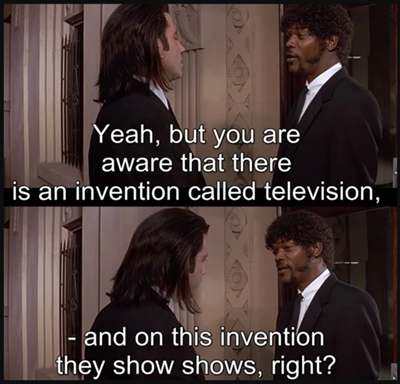
Do you watch much TV these days? As I ask the question, I realize how dated it sounds. There used to be one object in your house with a screen. It was called a television, and at any given time you were either watching it or not watching it.

I’m sure my story is not unusual for people of my age. When I got home from school I would watch old cartoons and sitcom re-runs (Bugs Bunny, Andy Griffith, Gilligan’s Island, Hogan’s Heroes). After dinner, my father would switch on the national news (always NBC). After that, there would be a few hours of prime time entertainment courtesy of the three major networks.

“We don’t have a TV” used to be a faux-careless bragging point, much like mentioning your most recent marathon time. It was easy to throw it into a conversation, a virtue signal for the brown-rice and Birkenstocks set. “Hill Street Blues? That’s a TV show, right? We don’t have a TV at our house. Also, my kids will get into a much better college than your kids.”

If it was too much of a stretch to say you didn’t own a TV, there was a fallback position: “We do have a TV, but we only watch documentaries.” The full version goes like this: “I have a disassembled black and white TV in a box under the bed. When there’s science documentary I want the kids to see, I rebuild the set for one night and then tear it down when the show is over. Also, my kids will get into a much better college than your kids.”

Now people are watching less and less TV, but still spending loads of time looking at screens. Distributing bragging rights and shame is so much more complex! For instance, I can say in all honesty that I cancelled my cable subscription two years ago, and I might go for weeks without turning on my TV. But it’s a misleading statement. I subscribe to multiple non-cable sources of video content (Netflix, Amazon, AppleTV). I watch a lot of YouTube videos. And even though I have a nice TV on my living room wall, for some reason I prefer to watch shows and sporting events on the iPad in my lap.

Everything has to be qualified more carefully. Abstinence humble-bragging requires more specificity. “I don’t have a TV and I never use any of my screens to look at any content that could qualify as the kind of thing that used to be on TV. Although, come on, of course I look at the cat videos that friends send me.”

True abstinence from screen time seems almost like an impossibility now. You’re more likely to feel shame or envy these days because your friends are much better curators and reviewers of high-quality binge-watching than you. “I don’t often binge watch, but when I do, it’s an award-winning drama series. And after it’s over, I unplug the cable and groom my alpacas. Also, my kids will get into a much better college than your kids.”

TV is dead. Long live TV!

Bioengineering the World’s Tiniest Cows

Let’s start today’s show with a trivia question. What Lou Reed song is most likely to increase milk production in cows? Anyone?

If you guessed “Walk on the Wild Side”, I’m sorry, but that is incorrect. But thank you for playing on today’s episode of Dairy Island Discs. If instead you voted for “Perfect Day”, then congratulations! The song (and, to be fair, other slow-moving songs like it) increased milk production by something like 3%. If it makes you feel any better, REM’s “Everybody Hurts” would also have been accepted by the judges.

I came across this tidbit while reading about Perfect Day Foods. Even though the Lou Reed anecdote inspired the name for their company, their actual goal is not to make dairy cows more efficient. It’s to do away with them completely. Perfect Day uses a bioengineered fungus to produce milk protein (casein) in the same way that we currently make alcohol: fermentation. These milk proteins can then be used by other companies, like Betterland, to make high quality cow-free dairy products.

Side-stepping the cow is good if you’re a vegan: no animal is involved. It’s also good if you’re lactose intolerant, since Perfect Day makes milk proteins but not milk sugars. But more generally it’s good if you want to decrease the impact that food production has on the planet. Bioreactor tanks require much less acreage (and fart considerably less) than cows.

When we think about moving away from animal food products, it’s often in terms of plant substitutes. Can you make a soybean patty that looks and tastes like a burger? Can you process oats in such a way that you get something resembling milk? Sort of. But your options are pretty limited. Ultimately there’s only such much you can do. Vegetable matter just isn’t the same as animal matter.

In the last few years this story has changed. You can now “teach” microorganisms to produce the exact same proteins made by animal cells. These aren’t sad look-alikes that taste wrong. These are molecular facsimiles. What is meat? What is milk? The important part is not where it comes from. The important part is what it is. And that is, by and large, a collection of proteins. If you can get the right proteins in place, you have a no-compromise replacement food. If you can do it cheaply and efficiently, you’ll disrupt the global food system.

We’re just seeing the first glimmers of this now, but it will only accelerate. We’ll get better at protein engineering, and the environmental costs of animal food production will become more apparent. In short, animals are an inefficient way to make the proteins we care about. They use too much land, they take too long, and they generate too much waste. Up until now, there was no alternative pathway to create these proteins. You want casein? You need animal milk. But now a door has opened, a lower energy pathway to achieve the same end. The first examples won’t be perfect. Incumbent industries will protest and lobby to protect themselves. Picky or nostalgic eaters will initially be unimpressed. But the change is coming. It’s coming because it’s possible and because it’s necessary.

Can you hear that sound? It’s the sound of a tiny herd of fungal cows coming to a dairy aisle near you. No word yet on how they feel about Lou Reed.

Parameterized Design on Demand

Here’s the scene. You’re at a friend’s house doing a little innocent bookshelf-snooping, when you spot something special. Oh my! It’s Wittgentstein’s Tractatus Logico-Philosophicus! At that moment, you realize that you too must have this book. Assuming you don’t want to steal or borrow your friend’s copy, you just need to note the title and author, and you can order it when you get home. But we live in a modern and impatient age. There’s a faster option: Open up your Amazon app, scan the barcode, and order the book instantly. It’ll probably be at your house before you’ve finished tomorrow’s lunch.

So the sequence goes like this: see, scan, order.

This routine is old hat for books. But it doesn’t take a genius to see that everything is going in this direction. Amazon is already using image recognition to help you identify things you might want to order. You can take a picture of your friend’s stapler, his egg timer, or his melon baller, and the Amazon app will do a credible job of helping you buy an exact copy.

What comes next? It seems pretty clear that before too long, everything will come with a unique digital identifier in the same way that every book comes with a unique bar-coded ISBN number. People don’t necessarily want visible bar codes hanging off their staplers and melon ballers, but near field communication and embedded IDs should make that unsightly problem go away.

So now you’re at your friend’s house, and you spot a side table that that would look great in your house. Your phone’s NFC chip reader tells you it’s a Tor side table from Model No. furniture. You can even order one right away, though you won’t get it instantly, since it’s generated on demand. So far, so good. But this is just the book story again, only about a table. But wait! Since it’s parameterized and generated on demand, you get some flexibility. It turns out your friend’s living room is larger than yours. If you want that table, it needs to be smaller. And you would prefer it in mauve. Conveniently, the Tor design, being parameterized, has a configurator that lets you make the necessary changes to its dimensions. You make it a little smaller in width and depth and place the order. The parameterization is built right into the unique model number.

What size table do you want?

The sequence now goes like this: see, scan, tweak design, order.

And in fact, modifying the Tor side table design is a real thing that Model No. furniture does, according to this article: Parametric Design and 3D Printing Deliver Custom, Sustainably Manufactured Furniture. Although, newsflash, this article is a year and a half old, and it appears that Model No. doesn’t do design customization anymore. But still, this is an idea whose time has come.

Drawing on ideas from the software world, it’s not hard to imagine an ecosystem of open-source furniture. Scanning a coffee table might take me to a GitHub-style page where I can find a list of suppliers who can print it, along with a configurator that lets me modify the design. Maybe I want to change the parameterization. Let’s say I want to make it so I can modify the height in addition to the depth and width. I can fork and refactor the configurator, verify the suppliers can still print it, and bam! I’ve added value for all subsequent purchasers of the table. Maybe I’ll even throw in an augmented reality model for simulation in my virtual living room model. This lets me anticipate how the final product will look in my house at every hour of the day.

Once design and manufacturing become amenable to consumer-driven digital inputs, a lot of fun things can happen. Refactorable parameterizers, procedural parameterizers, collaborative decorators, open repositories, renderers, simulators, AR walkthroughs, digital twins. All these things are on the way.

It’s going to get a lot easier to benefit from the good taste of your friends. But you’re never going to read that Wittgenstein book. Trust me.

Grinding Along the Lifeyness Curve

When I hear someone use the phrase “I have no life,” I always wonder what exactly they mean. What makes a life a “life”? They breathe and they eat like everyone else, and yet there is something, let’s call it lifeyness, that they lack. What is it?

I sometimes imagine such a person at the hospital, hooked up to various machines with tubes and wires. The doctor examines his chart and remarks “Hmmm. Temperature, blood pressure, pulse, everything looks good… except, my god, this lifeyness level is in the toilet!

If lifeyness is a score card, then what are the checkboxes to tick? What moves you up and down the lifey ladder? What makes something lifey?

I think that, conventionally, people who make this joke are referring to things like relationships, children, travel, quality time spent with family, hobbies. These are often the kind of things that will sound good at your funeral. She was always there for you. He was kind to dogs.

Now, in contrast, consider the person who has no life. Why do they lack lifeyness? Maybe they have no close relationships. They don’t go on vacations because they never take time off. They only think about one thing. They are no fun. Often this is because they work too hard.

So let’s say low lifeyness levels often correspond to obsessive grinding.

But there is an escape clause in this calculus of conventional lifeyness, in this vernacular karma. If you work obsessively and ignore your family, but you become famous and rich, you can still get a high lifeyness score. Your funeral will be crowded. This is because we always forgive geniuses and billionaires. They maintain robust lifeyness even if they are miserable bastards.

Maybe you disagree. Maybe you think billionaires shouldn’t be in the lifey club. Sorry pal. I don’t make the rules. I just muse about them ironically.

I think this comes down to what Steve Jobs called “denting the universe.” If you succeed in making a noticeable difference, in denting the universe, then you are rewarded with lifeyness despite the fact that you may have labored away in friendless monomania. There’s an old joke that nobody’s last words were ever “I wish I had spent more time at the office.” Everybody nods and smiles like this is obvious. But suppose all that time at the office brings you fame and glory. Now who’s laughing?

When viewed through the lifeyness lens, obsessive grinding is a high-risk, high-reward game. Maybe you’ll make it safely through the dental divide and into the glorious lifey uplands. Just remember, most people don’t! If it’s lifeyness you want, it’s a lot easier to be nice to dogs and sing beer-flavored songs with your friends.

The MacGuffinator Startup Warren

Have you heard about my startup incubator? I call it the MacGuffinator. And when I say incubator, I really mean it. We’re not going to do much more than get you out of the maternity ward. But if you’ve ever dreamed of a sweet exit strategy (whether or not you actually have any business experience or even a credible idea for a business), then we can help you find the big venture capital payout you deserve. You don’t need a vision. You don’t need ambition. You just need to pay me $25,000.

The Pez was a lie.

Here’s the secret. To make money, you don’t need an idea. You just need a story. And the story doesn’t really need to be true. Did eBay’s founding really have anything to do with Pez dispensers? No! Did Post-It notes come about because of Art Fry’s choir practice? Please. That’s just candy for the gullible masses. What you need is a story that is memorable and plausible. Plausible to a business journalist, anyway, which let’s be honest, is not a high bar. And get this: the story isn’t even about the idea. It’s about how you got the idea. With this in mind, we’ll give you a random MacGuffin when you arrive. A cat toy. A juice box. An old View-Master. Then our skilled storycrafters will work with you to start tuning your pitch: “I’ll never forget that moment when a bowling ball fell on my girlfriend’s toe, and I realized that everyone needs a …” Nobody will even pay attention to what comes next. They’ll be too busy reaching for their checkbooks!

In addition to a story MacGuffin, you’ll need a nonsense Internet name. For this, we have a bag full of Scrabble tiles. Pull some letters… ZazzPix, Funtasm, NeoSpork, NonSentrix, Lamovator, ZazzPix (did I say that one already?)… and bang! You’re good to go. You’ll get a stack of cheap business cards with a logo designed by LogoTron, our automatic logo generator. Your logo will have some colorful boxes and arrows, because that’s all LogoTron can do at this point. Fortunately, it’s all you need!

NonSentrix. “It’s something about your business needs, probably.”

Now you just need a place to write your business plan and start your journey. This is why each startup gets their own garage and a stack of cocktail napkins (or diner menus or dry-cleaning bills, depending on your preference). As soon as you have an idea for a business plan, quick! note it down on the napkin. Preferably with some arrows and boxes. Even if you don’t have an idea for a business plan, you should probably draw some boxes and arrows. The drawing will come in handy in case you actually do have an idea.

Next we’ll get pictures of you in your garage, one of dozens in the GaragePlex Startup Warren on our central campus. If you imagine yourself to be in software, we’ll get you hunched over a laptop. If hardware, you’ll be holding a smoking soldering iron, looking back over your shoulder at the camera. Please don’t shave on the day of the photo shoot! Our expert photographer will make sure the photo is grainy and poorly framed.

Finally, there’s a graduation ceremony where you are presented with your MacGuffin, a framed picture of your garage, and the original napkin sketch. After that, you really need to move on. There’s not much more we can do for you.

The MacGuffinator: It’s not about helping founders start a company. It’s about helping founders start the mythology of starting a company. The rest is easy.

Cornelius Vanderbilt and the Unseeable New

We can’t see our culture very well because we see with it.
– William Gibson

Joseph Banks was the naturalist who came along with Captain James Cook on his voyage of discovery in the HMS Endeavour. When, in 1770, they first sailed into what is now known as Botany Bay, Banks was to write of the natives “Not one was once observd to stop and look towards the ship; they pursued their way in all appearance intirely unmovd by the neighbourhood of so remarkable an object as a ship must necessarily be to people who have never seen one.” The Europeans weren’t actually invisible to the native Australians, but they were so far out of the norm that there was no mental landscape in which they belonged. They could be seen, but they didn’t fit. Being dislocated in mind, they were rejected in place. In this extra-ordinary sense they did not yet exist.

Seeing is not merely physical. You can’t see something that doesn’t fit in your eyebox.

This beauty was called the Mastodon

I recall this story whenever I think about looking at objects across time. We have to remember always that we see the new with old eyes and the old with new eyes. For example, we can’t look at a picture of a steam locomotive and see it as the new thing it once was. For us it is a quaint and ancient object, forever static, black and white. You can’t see it with 19th century eyes, not for what it was then. To some it was smoke and noise to no good purpose. To others it was the equal of a supersonic jet, the most incredible piece of high-tech machinery on the planet. Sleek and novel and speaking of worlds to come.

Some people are better than others at grasping the implications of the new. I recently finished a book, The First Tycoon, about Cornelius Vanderbilt. Vanderbilt was America’s pre-eminent baron of steamships and railroads. He was able to see, with remarkable clarity, the leverage points of the new industrial economy. In Vanderbilt’s time, people had a hard time thinking about corporations as independent from the people who owned and ran them. Stock ownership was new. The amounts of capital and debt in play were unprecedented. The relationship between public good and competition was understood in a very different way. If competition from a new company wiped out the value of an older company, the sympathy was often with the older company, with the loss of that value. Many people decried this unbridled, value-destroying competition. But the new world was upon them and there was no turning it back. Cornelius Vanderbilt had an intuitive grasp of the new thing, and on it he built an empire.

Yep. That’s him.

We see a similar pattern with others who followed. John D. Rockefeller, Henry Ford, and still later, Bill Gates. They saw the new thing, and they steered straight for it, making bold bets at every step. Most of the rest of us can’t make out what’s happening, because we don’t have their eyes. We see them stepping onto clouds. We rub our eyes and say, “That can’t be right.” How strange to think, in a few years those same clouds will be our sturdy mountains, obvious to all.

What is emerging now that we can both see and not see? What is obvious but invisible, because it lacks a mental mail slot? Cryptocurrency, non-fungible tokens, quantum computing, metaverses? What do we see when Cook’s floating island first swims into our Botany Bay? Maybe it’s an unfocused blob. But we’ll see it soon enough, and when we do, we’ll lose the art and the memory of not seeing it.

Air Conditioning the Winter

I like the slogan Electrify Everything.

The idea is to replace things that make direct use of fossil fuels (like gas-powered cars and natural gas heating) with their electric equivalents. Then you can work to make your electricity as clean as possible. I have an electric car, an electric lawn-mower, an electric induction stove top, and recently we bought two new heat pumps to keep the house warm. The natural gas furnace is still in place in the basement, but I’m hoping we won’t need it. Winter is upon us, so we’ll soon find out.

Those little legs are to keep it above the snow.

I was raking leaves this afternoon. It was a cool day, and I happened stroll past my new heat pump. I felt a gust of icy air coming out of the machine. Now I’m used to air conditioners dumping heat outside on a summer day, but since I have less direct experience with heat pumps, this caught me by surprise. But of course, by moving heat from outside to inside, my heat pump was reversing the summer scenario. It was effectively acting as an air conditioner for the world. On a cold day, it was exporting coldness. Selling ice to Eskimos. Sort of like propping open the door in the summertime, only it’s not summer. It amused me to think that I was air-conditioning the winter.

The last thing I have to electrify at this point is the water heater. Heat pumps are stepping up to that challenge to, so maybe there’s one more heat pump in my future. Then I need to get going with the solar panels.