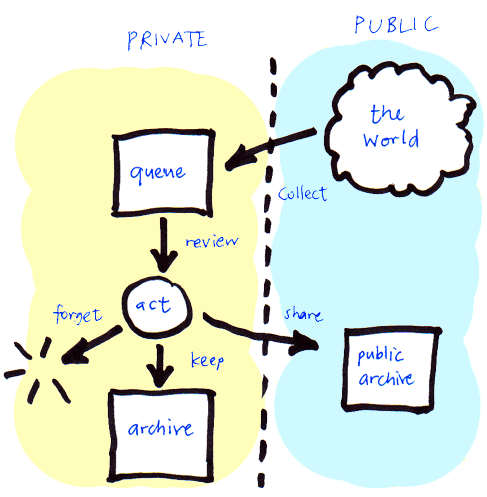
Latering and the Universal Later Feed

When you record something on television to watch it later, you’re time shifting. That’s the fancy term for what might be called “latering.” I can’t watch this now. Let me watch it later.

Time shifting was a big deal when the first video recorders were introduced. It seemed almost magical at the time, since video content flowed like a river, never to return. Since then, technology has opened up many more possibilities.

These scenarios have the same basic time or place-shifting premise in common.

  • I’m at Starbucks and I hear some music that I’d like to play for my wife at home.
  • I’m checking Twitter on my iPhone and I see a reference to a New York Times article that I don’t want to read on my tiny screen.
  • My brother recommends a book that I want to check out next time I’m at the library.

All of us have evolved tools for dealing with scenarios like these, from pen-and-paper lists to spreadsheets and specialized web services. I manage a bunch of these lists with a variety of tools. I keep books that I want to read on an Amazon Wish List, but books that I’ve read get added to my archive on LibraryThing. I use Shazam to identify music and then I listen to it with Rhapsody. I use iTunes to keep track of podcasts, but getting the podcasts into iTunes can be tricky. Individually these systems are powerful and convenient, but taken together they can befuddle. It was Instapaper that made me realize the value of something more universal. Instapaper lets you mark any URL with the magic words “read it later”. It then gets added to a queue that you look at later. That’s simple enough. The cool part is that so many other applications have added an Instapaper “read it later” hook. So I can route things to Instapaper from any device, any application (almost).

One of the nice things about Instapaper is that it’s platform agnostic. It’s not trying to keep you in its own ecosystem, the way Apple or Google might. Here’s an example of what I mean. While at my work computer, I happen across a YouTube video, and I want to tag it for watching on my AppleTV at home. But Apple has no interest in playing nicely with Google, so they make it painful to watch YouTube videos. Wouldn’t you rather watch one of *our* videos instead?

I want a universal “later” button that lets me add any resource to a single feed and then lets me sort and filter later in a way that’s appropriate to that device.

Here’s a more advanced scenario to illustrate how it might work:

  • In a tweet someone mentions a video of a good conference talk. I add it to my “later feed.” In my car, I open my music player which can see my feed. I filter for videos and select the option to play it back with audio only.

This sort of thing isn’t hard, but it should be much much easier. Plenty of smart people are thinking about this. So tell me: what’s the right vocabulary here? General Systems Theory people call these stocks and flows of information. They’re related to Twitter feeds, Google+ Circle streams and Facebook activity feeds. Until someone tells me the canonical nomenclature, I’m going to refer to it as Latering cool stuff to my Universal Later Feed.

Cheap fusion at Helion

A few months ago I posted a hopeful note about the fusion research going at the National Ignition Facility at Lawrence Livermore Laboratory in California. I was impressed with a speech I’d heard by lab front man Ed Moses. He’s very slick and tells a good story. But since then I’ve spoken to a real honest-to-goodness fusion physicist from MIT who painted a convincing picture that Moses is more snake oil salesman than prophet. The only thing likely to come out of the NIF, he says, is bomb research. Sigh. Get your hopes, and see what happens? Fusion is still 30 years away, as always.

Still, it’s an interesting topic. Most physicists acknowledge that, while we find it difficult to manage now, it should become workable at some point (more than 30 mythical years from now, presumably). There’s no magic to it. So we really should keep plugging away at it.

The other day I was lucky enough to get a tour of the fusion reactor at MIT, and the work they’re doing is impressive. I had no idea you could do so much nuclear fusion in the middle of Cambridge. But the people working there don’t have any illusions about cheap fusion power right around the corner. The big new fusion reactor in France called ITER won’t even start doing serious work until well into the 2020s, and it’s still a science machine (as opposed to something that a utility company can buy).

The real problem seems to be the capital-intensive nature of the work. This has plagued nuclear fission too. When even the smallest experiments cost insane amounts of money, you become extremely cautious. Many good ideas never get tried, because you have to put all your effort behind the one idea that is considered most likely to succeed.

Given all this, I was amazed to read an article in Popular Mechanics about a small company in Seattle called Helion Energy. These guys are doing real fusion research in a small company setting, and they appear to be completely legitimate. What they’re doing now is research, and nobody expects it make any big breakthroughs anytime soon, but it’s very encouraging to know that all our bets don’t have to be big.

The era of the irrepressible teacher

Blogs were supposed to be the medium that empowered citizen journalism. Much digital ink was spilled pushing this idea back and forth:

“You bloggers are self-absorbed and undisciplined!”
“Oh yeah? Well you journalists are arrogant and out of touch with the real world.”

It was all pretty silly. I can see how a journalist might feel threatened these days, but whatever is destroying journalism as a career, I promise you it’s not bloggers.

I think when we look back on this era, it will be clear that the most important category of amateurs unleashed by the web wasn’t wannabe journalists but wannabe teachers. You probably know the story of Salman Khan and his startup academy. He’s an extreme example of a gifted teacher who started teaching over the web in his spare time. He’s doing it full time now, and he’s making a huge difference in the world. Khan has done a lot to capitalize on the merits of the web, as opposed to simply repackaging the instruction you’d see at an institution.

I keep running into these sites now, really high quality instruction provided for free by someone who has the teacher bug. It’s remarkable and encouraging. Want to learn quantum computing? Michael Nielsen has a series called Quantum computing for the determined. He uses a format for which he credits Salman Khan as inspiration.

My favorite new site is Kalid Azad’s BetterExplained. I first came across his quick guide to Git (Git is a software management system). Of more general interest is his Visual, Intuitive Guide to Imaginary Numbers. He launches his discussion by reminding us how weird negative numbers are. And so they are. Good stuff.

Why is Kalid doing this? Because he can’t be stopped! I find it interesting to think of the web not as something that empowers natural teachers, but as something that removes the weights that have been around their shoulders. It’s sobering to think how many great teachers there are that have been thwarted by the pain of teaching as a career path. But that was then. Now is their time. Sit back and enjoy the show.

Getting help from people like me

I want to let you know that I appreciate all the work you do for me. You write Wikipedia articles for me, you buy my crap on eBay, and you solve my computer problems. You’re so good Time made you Person of the Year back in 2006. Remember that? Your mom was so proud!

The big thing I notice in a post-Google world is that when I need help, I almost never get it from the pros. Not from the vendors or the documentation writers. Not from the technical support staff. I get my help from you.

I’ve been saying this for a while, as in this invited piece I wrote for Desktop Engineering last year: MATLAB Central Has Answers to Share. The same principle applies at PatientsLikeMe.com. The big idea is that nobody understands my pain like someone who shares my pain. If someone is paying you to think about my pain, that’s never going to be quite as good.

Here’s a recent example that spurred me into writing about this topic one more time. I was using Word the other day and added a horizontal line by typing <dash-dash-dash-dash-return>. Did you know you could do that? You get this nice line that stretches right across the page. It’s pretty cool… until you want to get rid of the line. You can’t delete it. You can’t backspace over it.

These days I know not to waste time worrying about what to do next. Looking at the Microsoft documentation is a fool’s errand. Don’t bother! Instead I went to Google and typed in these words: I can’t get rid of the annoying horizontal line in Word. The first item solved my problem. Naturally, Microsoft would never refer to the line as “annoying.” But that’s one of the words that led me straight to my solution.

(By the way, it turns out the line is the border of an invisible table.)

Wendy swims the Charles

Boston has long been known for its dirty water. Boston Harbor, the “dirtiest harbor in America,” was a campaign liability for 1988 candidate Michael Dukakis. It’s hard to change a reputation, but the harbor is actually very clean these days. Just today the Globe had a story on a massive holding tank to prevent sewage outfall during heavy rains, calling it the last big piece of the Boston Harbor cleanup.

The Charles River, which as we like to say here, empties into Boston Harbor to form the Atlantic Ocean, is also famous for its filth. But wait! Here’s a picture of my wife Wendy (she’s on the right) with another Watertown swimmer, Katie O’Dair. And what are they doing? Why they’ve just finished swimming a mile-long race in the Charles sponsored by the Charles River Swimming Club. The FAQ for the site doesn’t pull any punches: “the short answer to the question of whether the Charles River is swimmable is, quite simply, ‘no.'” But happily we learn, “the Charles River Swimming Club has put a number of measures into place to ensure that the race can be conducted in a safe manner.” Like the obligatory tetanus shots before and after the race. Kidding! I’m kidding! Just look at the smiles on those kids. They’re the best evidence of the improving fortunes of the Charles.

Although I still think the organizers missed a great opportunity to call the race the Up-Chuck Plunge.

But I ordered the Dissostichus eleginoides!

One of the interesting side effects of cheap DNA sequencing technology has to do with your dinner plate. All your food comes to you with detailed identification in the form of DNA, but you didn’t have any way to read it. As that changes you’re going to have a much much better idea of what you’re eating and where it came from. That may be a little disconcerting.

Mammal and bird meat comes from carefully managed farms, but fish is the last remnant of Man the Hunter-Gatherer, Homo grab’n’eatum. This is slowly changing with the increase of aquafarming, but it still amazes me that so much of the world’s protein is sourced with such an ancient pre-agricultural technique, sticking it to the Tragic Commons on the unregulated high seas. The technology has improved over the years, but even so, we don’t come off looking very clever.

Recently Oceana, an ocean conservation group, issued a report called, wait for it, Bait and Switch. This report shows that much of the time the fish you are being served, even in fine restaurants, bears no relation to the fish you ordered. That red snapper? It might be any of a rogue’s gallery of bottom-of-the-boat rabble.

This report got a lot of press, and the outlook was generally gloomy: you’re being duped by the corrupt seafood industry. But I think this is great news. When you turn on the lights in your kitchen and see cockroaches, it’s disturbing. But those roaches have been dancing on your dishes every night. At least now you know about it! Now you can do something about it. Cheap DNA machines are turning on the light, and now we can start to do something about it. Soon you’ll carry a DNA Barcoder on your belt. Begone bogus Bass! Sayonara crappy Crappie!

And, oh by the way, what’s this D. melanogaster doing in my soup? I hope it was locally sourced.

The great solar ka-BOOM!

Did you hear a loud CRACK in the sky about three days ago? That would have been the sun having the worst case of indigestion we’ve ever observed.

Here’s a remarkable movie assembled from instruments aboard three different NASA observatories: SDO, the SOHO, and STEREO.

The sun looks like it’s been wacked by a Q-36 Explosive Space Modulator. The thing that amuses and amazes me is that you can see fragments from the explosion falling back into the sun and catching fire. So help me, if I saw that in a movie I would complain about how ridiculous it was. Don’t those solar special effects people know anything?

I also like how, when things go to hell on the sun, I can take comfort in the fact that humans didn’t screw it up. Sure, we’ve sterilized the seas, bleached the coral, scorched the earth, and poisoned the air. But the sun? Hey buddy, that’s not my shift!

Sapir-Whorf: the Coriolis force of language

Did you know that Eskimos have 20 words for lame linguistic analogies? Do you suppose this shapes their view of visiting linguists? I understand they can distinguish among many subtle variations of the Sapir-Whorf hypothesis, or the Isumannaallisaavigissavaat meeqqap angajoqqaaaminiit taakkua piumasarinngisaannik avissaartitaannginnissaa hypothesis, as it is known in Tuktut Nogait.

Amateur linguists (hey that’s me!) are easily seduced by linguistic relativity, also known by its cocktail-party name, the Sapir-Whorf hypothesis. It’s very appealing, this idea that the language you speak shapes the thoughts you can think. George Orwell played on this with his imagined Newspeak language in 1984, the notion being that politically incorrect thoughts become impossible so long as you think only in Newspeak.

Among language professionals, linguistic relativity has lost much of its charm. The so-called “strong form” that Orwell described has been discredited. Just because Germans have the word schadenfreude and we don’t doesn’t mean I can’t take pleasure in your misfortune. And, watch this, if I like the word schadenfreude, I can just appropriate it by removing the italics. Boom! It’s mine now. Eskimos (Inuits) really do have lots of words for snow, but it’s only because Inuktitut is an agglutinative language. So when they say qanik, it means falling snow. Qanittaq is recently fallen snow. Qannialaaq is light falling snow. And so on. They just mash all them little word blobbies together. It’s not like I can’t describe the same snow with my mealy non-agglutinative English. Oh look! I just did. So is that a profound linguistic insight or merely a somewhat interesting distinction between two languages?

But even among the pros, a weaker form of linguistic relativity is on the rise. Here’s a Scientific American article by Lera Boroditsky called How Language Shapes Thought. I recently listened to a Long Now lecture by Boroditsky on the same research. She’s pretty pumped up about relativity, but I came away with the sense that Sapir-Whorf is the Coriolis force of language. The Coriolis force is the thing that supposedly makes the toilet swirl counter-clockwise (in the northern hemisphere). Here’s the thing: the Coriolis force is real. You can measure it. But at the scale of your toilet, it’s tiny. It’s completely swamped by a dozen other larger forces. As a result it’s almost never the actual reason your toilet swirls this way or that. Similarly, you can do fascinating experiments that show there really is something to linguistic relativity. Russians really are measurably better at distinguishing between shades of blue than you are. It’s true! But do these effects happen at a scale that really matters, once they smash into all the other forces that influence human behavior? I doubt it.

Good stuff for a cocktail party though. By the way, did you know that pigs’ tails curl the other way in New Zealand?

Kickstart Craig and save the world

My brother-in-law Craig is an artist who spends a lot of time thinking about shelter as part of his work. As a sculptor, he’s created a variety of artworks that play on the notion of dwelling. But he’s also done the work of an architect in creating well-designed livable spaces, including one that he lived in: the Octagonal Living Unit, or OLU.

Motivated by a desire to create cheap and affordable housing for those in need, Craig has adapted the OLU design and re-imagined it with novel high-tech materials. The result is an OLU for the 21st century, a small house that is inexpensive, easy to build, well-insulated, and much more lovely than a lumpish haul-in you might find in trailer park lot. It hath, as Vitruvius might say, commodity, firmness, and delight.

Here’s what Craig has to say about it.

Are you sold? Are you ready to put some money behind it? Here’s the Kickstarter page where you can sign on as a supporter. Tell ’em Ned sent you!

Rational optimism and the apocalypse that wasn’t

The appointed hour came, but the heavens didn’t cooperate. End-times prophet Harold Camping may be disappointed, but he’s got his game face on. Now he’s saying that the world will actually end in October. Working in the software industry, I can appreciate this kind of thing. It happens all the time. It’s just a slip in the schedule. Somebody in Rapture Quality Control found a serious problem with the Fire and Brimstone Sequencer, and they just need another six months, okay? So just chill out people. It’s not like it’s the end of the world.

As a prophet with bad timing, the Reverend Camping can take comfort in one thing: he’s got plenty of company. During the mid-nineteenth century, America was riddled with End Timers and millennialists. The most prominent of these were the so-called Millerites, and when October 22nd, 1844 passed mildly into October 23rd, the result was known as the Great Disappointment. A curious name, considering the world didn’t end, but there you go.

It all put me in mind of a book I recently read called The Rational Optimist by Matt Ridley. In it, Ridley takes everything you’re worried about, global warming, peak oil, killer bees, toenail fungus, and lays out the case that the situation isn’t nearly as dire as you’ve been led to believe. In fact, it’s pretty good. I appreciate the fact that Ridley just goes for it. He doesn’t shuffle his feet or qualify his words. No, in a loud voice he says that irresponsible people are making you feel terrible because humans in general and journalists in particular have an insanely powerful negative bias. Bad news is good business. But if you look at the facts he’s assembled, a few things jump out: almost everything you can name is getting better and cheaper, we’re really terrible at predicting the future, and we are secretly thrilled by the thought that the world may end on our watch. If history is any guide, we do not live at a pivotal moment in history, even though it’s fun to think so.

The book is good, and I also enjoyed this conversation with Stewart Brand over at the Long Now Foundation. Ridley is not a crank, and he is often persuasive. I find it hard to believe that we shouldn’t be so worried about global warming, but Ridley can point to a long list of disasters that never happened. And in any event, his thesis is not that we shouldn’t try to solve the problems we face; rather we shouldn’t be so damned gloomy about our prospects.

Perhaps his influence will cause us to stop trumpeting about Peak Indium, Peak Platinum, and Peak Peanut Butter. Perhaps we are already Post Peak Peak.