You Were Never Broken

My wife died earlier this year. Five years ago, there was cancer in her pancreas. We tried to cut it out, but some of it relocated to her liver. With treatment, she lived in that state for several years, several good years. But eventually the cancer blocked her bile ducts. No longer able to process food, she starved. “Died of cancer” means many things, but for my wife, it meant starvation.

In her case, there was a fairly rapid transition from coping to starving. She went to the hospital one day for a regular appointment, and they looked at her liver numbers and said “We’re admitting you to the hospital right now.” She didn’t even feel that bad, but the numbers weren’t lying. Things were breaking down, breaking down for the last time. They weren’t going to get better.

I want you to know that we were very fortunate with medical care. We live close to an excellent cancer center. Insurance was not a problem. The medical professionals we worked with were all you could hope for: compassionate and competent. They did what they could to help my wife. But this last stay in the hospital was driving her crazy. She wanted to come home. She wanted to come home even though she knew she was very very sick. She wanted to see the flowers in her yard. She wanted to be with her cat.

She knew what the score was. She had been living under the heavy stone of this disease for more than four years. And she had spent the last two weeks in a noisy, shared hospital room, losing sleep, unable to eat, and getting increasingly bad news. She had had enough. At this point she had a serious argument with her doctors. She said I want to go home. They said we can’t let you leave. She said I’m going to walk out. They said: Of course you can, but you will be doing it against medical advice. You are too sick to leave.

It was tense.

I want to stress this: the doctors at the hospital were very good, very helpful. They were committed to making their patients healthy. But for my wife a return to health was no longer an option. Now all of their instincts were somehow wrong-footed, misaligned. They were suggesting short-term interventions that no longer made sense, because they would be painful and expensive and they couldn’t possibly bring her even one more day of health.

Image by Midjourney

This is when hospice entered the scene. And everything changed. The exit door, the door so recently blocked by stern, disapproving professionals, swung wide open. Discharge was fast and easy. It was so strange to leave the hospital knowing that you were not, under any circumstances, going to return.

Here is the basic premise for hospice care: they’re not trying to fix you. They’re trying to make you comfortable. The hospice staff set us up at home, and the hospice doctors visited. And I realized that I had gotten accustomed to doctors looking with alarm at everything related to my wife’s medical situation. Good lord! Look at these liver numbers! These platelet counts! This x-ray! Not good. Not good at all. You start to feel broken all the time.

Under hospice care, we moved from doctors who were always alarmed to doctors who were calm. We would hear numbers, and I knew these numbers were terrible. I knew they represented desperate brokenness. But the hospice doctors weren’t alarmed. They were calm. This is what their calmness said: you aren’t broken. You are here and you are whole and I am here with you. You were never broken.

It meant so much to me. Even for those of us living without serious disease, it’s easy to feel broken most of the time. You’re off the path of health. You’re making so many mistakes, so many poor choices. And yet here is this radiating calm. It is a profound shift, a shift from constantly feeling broken, off the path of health, to being on the path that binds us all. The path which must, after all, be life itself. You are not broken. You are on the great arc. You are part of the tapestry, perfect and endless. You were never broken.

One day you will die. And you won’t die because you break. You will die because that is what happens to all those who live. The lucky. You were never broken.

Catching Bad

When someone close to you dies, people want to offer condolences. Lots of people. The notion is of course that those who comfort take care of those who grieve. But if you’ve been in the unfortunate position of navigating loss, you know it doesn’t always work that way. Sometimes those who grieve need to take care of those who comfort.

What are the rules for condolence? Our shared secular culture doesn’t offer much guidance. Many people are at a loss. They feel awkward. They don’t want to cry, and they don’t want to see you cry. They want to say something, but the words feel false. They want to fix something that they know cannot be fixed. In short, they need to be let off the hook so they can move quickly out of the danger zone.

“There are no words.”
“I don’t know how you manage it. I couldn’t do what you’re doing.”
“If there’s anything I can do for you, let me know.”

All words of comfort are welcome, but sometimes you see people floundering. This is where counter-consolation can be helpful. “Thanks. I appreciate it. You’ve done enough already.” You can see their relief as they move away, as they merge back into the traffic of life.

Recently I’ve had time to ponder the nature of this awkwardness. Is it simply the case that our happy-success culture doesn’t give people the grounding they need to embrace suffering? That’s part of it. But I think there’s something else going on too.

I think people are afraid of catching bad.

We all have an innate understanding of infectious disease: don’t loiter with the sick lest you sicken. Similarly, deep in our psyche is a less rational notion of infection, that being around bad things can make you susceptible to them. That’s what I mean by “catching bad.” It’s uncomfortable to be around people who are under a cloud, because that cloud might rain on you.

Image by Midjourney

I can relate. When my wife was sick with pancreatic cancer, I met a man whose wife had died of pancreatic cancer. He was willing to talk to me about his experience, but I didn’t want to hear it. My wife was still alive. I didn’t want to catch bad.

Seeing things through this lens makes some behavior more clear. Let’s say I’m trying to comfort you, and I say “I don’t know how you manage it. I couldn’t do what you’re doing.” What I’m really saying is something like this: “You can handle this, and God knew that, and so he sent this malady to you.” It follows logically that I should proclaim that I can’t handle it, thereby keeping God off my case. You’re heroic and I’m not! You’re strong and I’m not! The more distance I put between you and me, the better. Your grief competence is a disaster magnet. My grief incompetence is a shield. It will protect me from catching bad.

I find it useful to think about catching bad, because when you see it, when you see yourself squirming under its influence, you can stop and observe that it’s not really a thing. It’s a superstition based on magical thinking. This lets you settle into more helpful behavior: embrace the awkwardness. Be with the afflicted. Cry and bear witness to crying. Listen more than you talk. We all know you can’t fix what’s happened. But you can sit here next to me and watch the sun set. And maybe tell me a story about that time my wife gave you a ride home from swim practice, and you both were laughing so hard that she missed her turn off Storrow Drive. I would like that.

When Does Code-Breaking Matter?

I recently read a book about the Enigma code machine that the Germans used in World War II (Seizing the Enigma: The Race to Break the German U-Boat Codes by David Kahn). Famously, the British cracked this code and used the information gained thereby to help win the war. That’s the shorthand version of the story, anyway. But the long version of the story is, as you might expect, more subtle. Did cracking Enigma really shorten the war? Here’s a related but little-known fact: The British and US navies often used shoddy encryption that German analysts cracked on a regular basis. Why didn’t that help Germany win the war? Why aren’t there movies and museums about clever German analysts?

It turns out that much of the initial work cracking Enigma was done by some brilliant Polish mathematicians early in the war, before Poland was invaded and defeated. This work was eventually passed on to the British to jumpstart their own cryptanalysis efforts. On the eve of the German invasion of Poland, Polish cryptanalysts were essentially reading the German battle plans and sending them to the Polish high command. Why didn’t it help?

It’s easy to think that accurate information is the only thing that matters. But it’s one thing to possess information. It’s another thing entirely to be able to capitalize on it. The Polish army was so weak relative to the Wehrmacht, that even perfect information about the motives and dispositions of their enemy was ultimately of little use. They lacked the ability to capitalize.

Some information is trivial. You can act on it, but it doesn’t matter. Some information is vast. Knowing about it doesn’t allow you to take action that matters. Only in the small subset between these extremes can you change the world. There is a “Goldilocks Radius” for information. Too small, too big, too bad. It needs to be just right. What do you know that matters, given your ability to act right now?

Boil it down, and you end up with something like Reinhold Niebuhr’s Serenity Prayer: “God, grant me the serenity to accept the things I cannot change, the courage to change the things I can, and the wisdom to know the difference.” The value of what you know depends on the nature of what you can do. Whether you view this with serenity or wretched angst is something else entirely.

Did cracking Enigma shorten the war? It certainly made a difference. But the final answer is more equivocal than you might expect. The most important factor is that Allied force of arms put them in the position for that secret knowledge to make a difference.

My Journey with Sudden Hearing Loss

They say that people like writing where the author reveals vulnerability. I would like to do that, but I just HATE revealing vulnerability. It probably has something to do with my Y chromosome. Deep in my tribal ape chest, there is an instinctive voice that calls out, “Fool! Don’t!” That voice knows what happens next. You’re telling them how to take you down. The alpha chimps will see their advantage, and all will be lost.

I mean, I’m guessing it works something like that. But who knows? The subconscious doesn’t like giving up its secrets. Anyway, I’m willing to admit this approach is not wise.

By contrast, let me tell you how impressed I am with my wife. When something is going badly for her, the first thing she does is talk to her friends about it. This has a number of benefits. It draws her closer to her friends. It helps her process the trouble. It opens doors for things that might help that she wouldn’t have otherwise known about. It helps her heal. I need to learn from my wife. Because alpha male nonsense leaves me ruminating in dark, lonely circles.

So here is my vulnerability. Here is the pain which I reveal against instinct. I was recently diagnosed with something that goes by the sinister name of Sudden Hearing Loss (or more dramatically, Idiopathic Sudden Sensorineural Hearing Loss). Sometime in September, after a shower it felt like I still had some water in my ear. The feeling wouldn’t clear, no matter how much I blew my nose or shook my head. The ENT doctor who saw me a few weeks later only needed thirty seconds to diagnose me. It wasn’t fluid in my ear. It was Sudden Hearing Loss. He put me on a course of prednisone, which sometimes helps if you catch it early and you’re lucky. But I was either too late or unlucky. The condition is almost certainly permanent.

Sudden Hearing Loss sounds pretty awful, right? It can have varying severity, but in my case I have decreased hearing in some frequencies in my right ear. It’s noticeable, but it’s not like it made me deaf. It could have been worse. It can always be worse. But that’s not the end of the story. That lost hearing wasn’t replaced with silence. It was replaced with a high-pitched whine. Or sometimes a hiss. You probably know the fancy name for this: tinnitus. It makes my fingers twitch just to type that word.

And where does Sudden Hearing Loss come from? What causes it? Shrug. Nobody knows. They kind of guess, working backward, that it’s probably a virus. No idea which one. This scene pops into my head. There I am, showing a policeman my house. The attic has been ransacked, and a cruel wind is whistling through the shattered window. “Yep,” says the policeman. “You’ve been robbed.” He closes his notepad and makes for the door. I call out, “Wait! What are you going to do about it?” He says, “Nothing to do.” Following him, I persist: “Who do you think did this?” He puts on his hat and shrugs as he gets into his cruiser, “Maybe a virus?”

I’m so tired of viruses.

So now I’m trying to reach an accommodation with this unrelenting phantom noise. It is not fun. It tends to amplify other stress and rumination cycles. Which I don’t recommend, but there it is. The good news is, I’m told by other sufferers that things do get better. Over time. So that’s where I am. Letting cool time wash over my abused ear and vibrating brain, that it might bring lasting peace. May it be so!

That leaves me here, face to face with you, dear reader, dear friend. I have always disliked solicitous pity. I have always wanted to be the strong one, the non-broken one. Who doesn’t? But this is where I am. This is my vulnerability. Whether you sympathize, help, or just listen to my story, it’s good for me to share. If you have experience or recommendations regarding Sudden Hearing Loss or tinnitus, drop me a line! I am, as they say, all ears.

Making Robots That Matter

The phrase “home robot” famously makes people think of Rosie the Robot from the Jetsons. Rosie is a humanoid drop-in, a one-for-one replacement for a competent human housekeeper. That’s what people want. But they’re not going to get that anytime soon.

Rosie can do it all

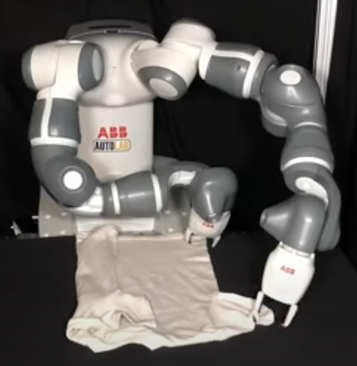
Rosie is too ambitious for the real world. Consider one basic task: folding a t-shirt. From a robot’s point of view, this is nightmarishly complex, something that only a dedicated expensive research robot can manage (see New research helps robots fold laundry faster than ever before).

Willing to pay for this and a dedicated post doc just to fold your t-shirts?

So is the whole field of domestic robotics a bust?

When we look around the corner, we often look too far. What happens instead is generally limited and in a different direction. The good news is that there has already been a successful domestic robot. It succeeded by being just cheap and competent enough at one narrowly defined skill: vacuuming. Roomba isn’t Rosie, but it’s real and it’s here.

The phrase “robot for seniors” also conjures up images of a Rosie-like entity doing many useful things for compromised seniors. But Labrador Systems may have hit on the right mix of useful, not too expensive, and achievable. They sell a robot that is essentially nothing more than an end table that can move itself autonomously between various defined “bus stops” in your house. For someone who is mobile but compromised in their ability to carry, this simple device can make all the difference between independent living and needing expensive in-home care.

It’s just a self-driving table.

Is it even a robot? Who cares? It doesn’t matter if it’s useful.

Labrador Systems deploys its first assistive elder-care robots | TechCrunch.

C-SPAN and Soccer

On an ordinary day, the C-SPAN cameras in the U.S. House of Representatives focus on a solitary speaker behind the podium, droning on about something not terribly interesting. If the camera did bother to show the floor of the House, you would see that it was almost empty.

But these are not ordinary days. The process of selecting a speaker has the place in disarray, and the C-SPAN cameras are off the leash, panning across the floor like a sports arena.

When I saw this video of Jim Jordan’s conversation with Kevin McCarthy, it occurred to me that these guys aren’t used to conferring on camera. Not when the sausage is being made. C-SPAN has put us in, as Hamilton says in the musical, the room where it happens.

Kevin McCarthy chats with Jim Jordan

Maybe Kevin and Jim should take a tip from athletes that confer on field. Soccer players know: cover your mouth when you’re discussing whether that next kick is going left or right.

The lads from Glasgow Celtic have a chat

I’m no lip-reader, but I’d say the next play in the House is going right. Just a hunch.

Charge Your Car Wirelessly

Every time I get rid of a wire, it makes me happy. My home has become steadily more unwired over the years. The rat’s nest of cables around my computer has become much more manageable since my mouse, keyboard, headphones, and printer all went wireless. But of course that’s just for the data signal. The printer still plugs into the wall, and the others need batteries. Wouldn’t it be nice if we could dispense with power cables too? We’re already used to wireless charging for electric toothbrushes and phones. How long until we’re scarecely using wires at all, whether for power or signal? It’ll probably be a while, but one item in particular surprised me by how much progress it’s made.

An electric car is the highest power electric device you’re ever likely to own. It draws, let us say, significantly more juice than your Apple watch or your electric toothbrush. And yet the clever folks at Witricity are convinced they have an efficient way to charge your car wirelessly. I’m partial to Witricity for a few reasons. For one thing, they’re based in Watertown, Massachusetts, my hometown. And they’ve taken a wise approach to popularizing their technology. Rather than trying to be the only vendor of new and unproven tech, they’ve worked to establish an automotive industry charging standard (SAE J2954) that anyone can license. It’s a strategy that seems to be working. They recently secured a bunch of new funding (WiTricity Raises $63 Million In New Funding Round (With Video) – CleanTechnica). As the owner of an electric car, I wish them luck! Every time I get rid of a wire, it makes me happy.

I’ll close with this video from Matt Ferrell’s excellent Undecided YouTube channel.

The Wicked Problem of Obesity

Here is a statement with a lot of truthiness: if you eat fatty food, you will get fat. What could be simpler, right? Lard goes in the piehole and then the tummy gnomes paste it to your thighs. It seems so obvious that it’s hard to believe that it’s completely wrong. But biochemistry is not straightforward, and it’s insanely difficult to work out the relationship between what you eat and how much weight you gain. Things that have been asserted for years as dogma turn out to be not so well supported.

Gary Taubes, author of Good Calories, Bad Calories, knows this beat well. I enjoyed this podcast interview with him by medical podcaster Peter Attia: Bad science and challenging the conventional wisdom of obesity. Part of what makes Taubes an entertaining character is his background studying pathological science. Having written a book on cold fusion, he knows bad science when he sees it. And, in his telling, the science of nutrition is full of it.

The scientific gold standard is Popperian falsifiability. You always want decisive experiments with clear outcomes. If I announce a new comet in Sagittarius, then within a day or two astronomers in Berlin, Bangkok, and Bratislava should be able to confirm or refute my claim. But what if there’s no good way to test my claim? Suppose the people in Bratislava think my telescope has comet-shaped spots on the lens, and I in turn refuse to endorse their obviously defective non-comet-spotting telescope. How can we resolve our dispute?

Debates like this happen all the time in science, and they can take years to unravel. The surprising thing about the obesity story is that the question being debated is so fundamental that it feels like two physicists arguing about which way is up. In the interview, Taubes and Attia muse about whether ANY feasible experiment could break the deadlock between competing nutritional camps. It’s almost as if the problem of obesity lives in a shadowed region beyond the reach of science.

If that sounds incredible, then I agree. That’s why the interview is worth your time. Science is hard. Truthiness, on the other hand, is like a Cool Ranch Dorito. It tastes so good, but it can be bad for your health.

The Coming Age of Mechanical Savants

By now you’ve likely seen images conjured up by DALL-E2 or Stable Diffusion. These are neural networks that can draw pretty much whatever you want. As far-fetched as this sounds, it seems to be true. You want teddy bears shopping for groceries in 19th century Japan? No problem.

Courtesy of DALL-E2

The list of outrageous prompts and resulting images is endless. It is at once exhilarating and exhausting and terrifying to see how well it works. You may enjoy browsing through the various related subreddits.

As remarkable as these tools are, the funny pictures are distracting us from the bigger story: we will soon be adding a natural language layer to EVERY user interface. Certainly everything that is generative. It’s going to be transformative because deep technical competence tethered to natural language will release you from the shackles of craft. Let me explain.

DALL-E2 is a graphical tool, but the key thing is how you talk to this graphical tool. It’s really more of a language tool. You’re carving pixels with words. It’s as if you’re talking directly to Photoshop. But that’s still not quite it. It’s as if you’re talking to a brilliant digital artist, and they do all the pixel pushing. Click once on the mountain top and say “Put a castle here.” And it will instantly happen. You might then say “No, I’d like it to look less like Neuschwanstein and more like Carcassonne.” And it will happen instantly.

Do you see? The new thing here is not a castle-making tool. It’s the ability to talk to a skilled digital artist about anything at all. You no longer need to spend years getting good at Photoshop. The new thing here is the ability to talk to an always-on expert in ANYTHING. What we’re building is a generation of mechanical savants. You talk to them with natural language. They don’t talk back to you in natural language. They have deep knowledge of a subject area, and their reply is a concept that they think matches your prompt.

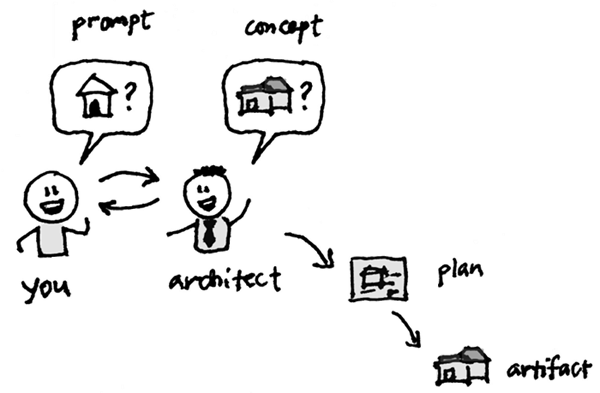
Here’s an example of what I mean. Let’s imagine you want to build a house. You have a vague idea what you want, but you need to talk to an architect. They’re the ones with the expertise needed to turn your hunch into something realizable. You give them a naive prompt and they reply with a realizable concept. It’s not quite what you wanted, so the two of you go back and forth. Over time you develop intuition about what you like, what can be built, and what you can afford.

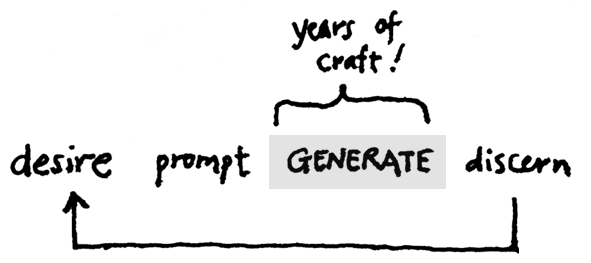
The problem is that architects are expensive. Only rich people can afford to play this game. But the game is changing now, because you can replace the architect with a mechanical savant. In the diagram below, you’re the one with the desire and the initial prompt. But now your prompt goes to a machine, a mechanical savant, to generate the concept. The bot has deep knowledge that frees you from years of studying a craft. You don’t need to go to architecture school. You don’t even need to hire an architect. You just need to discern the bot’s latest concept and modulate your next prompt.

Your key competence here is your relationship to the savant-bot (since it’s the one doing all the generation). Your competence is in the articulation of desire and discernment. Your new craft is iterative prompt refinement. This is the skill that you must never trade away. Knowing what you want, and knowing that you know what you want… these will be the instruments of power. All else is leverage, getting cheaper every day.

The Titanic Sinks, In Realtime!

I don’t know how YouTube got the idea to recommend it to me, but I was recently introduced to a video genre that I never knew existed: realtime sinking ship videos. Specifically, there are videos of the sinking of the Titanic in which one minute equals one minute. You see a steady annotated video of the events from iceberg strike to final plunge. Here’s one example.

I am reminded once again that everything about the Titanic conspires for storytelling perfection. The unsinkable ship! The plutocratic passenger list! The calm, cloudless night illuminated by desperate flares, and of course the band playing until the Atlantic lapped at their cellos. And incredibly, the whole thing took place in one cinematic sitting, something less than three hours. Usually movie drama is compressed, turning the accomplishment of many years into an hourglass, as Shakespeare observes. But in this case it’s already there, pre-packaged in the hourglass.

What the realtime video does is strip away all the fictitious drama. What you’re left with is an inconveniently long and slow-moving story, something that couldn’t have existed before YouTube. All the drama is provided by the actual events at the rate they transpired. No editing out the slow bits. It would be boring if it wasn’t so spellbinding. Details are layered on top of the video. You hear the actual Morse code communications at the moment when they occurred. You hear the music that would have been heard. It must have been hard for the players to make Alexander’s Ragtime Band appropriately jaunty.

This video trend will continue, I’m sure. There are already realtime videos about the sinking of the Britannic and the Lusitania (which went down in a mere 18 minutes). It’s interesting to think about how modern media gives us new ways of thinking about time. There was a Twitter account, for example, that did realtime accounts of World War I one hundred years after the fact. What’s next? A three day video of Realtime Gettysburg? Or the final few decades of the Fall of Rome?

My question for you is this: Is the modern attention span growing or shrinking? Narrowing or broadening? In this era we have hyperfast editing that will give you ADHD whiplash. But now we also have slow-moving, focused video like the RMS Titanic Realtime Sinking (and the Apollo Saturn V Launch Camera E-8). I think it’s a welcome trend.