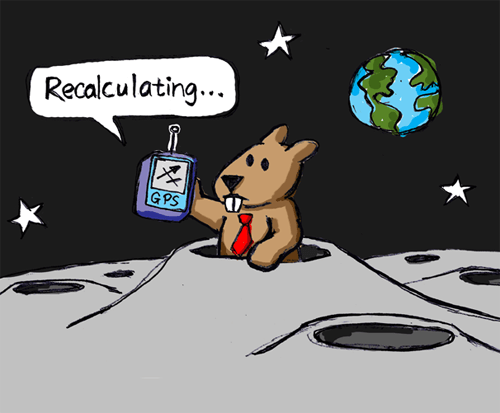
“How far can you drive into a one mile tunnel?” goes an old riddle. Answer: Only half a mile. After that, you’re starting to drive out again. Mr. Groundhog rides shotgun on our cross-quarter day between winter and spring. From his vantage, he’s supposed to tell us something of the subjective experience of the winter that remains. But we know what he’s really telling us. Whether or not there’s weather or not, the the winter tide is slack and now must ebb. And ebb she will.
I love the Language Log: smart people having entertaining discussions about how words work. The nice thing about the site is that the discussions are often observational and non-prescriptive. The writers are naturalists, not prudes. They wander through the living world with a butterfly net and a notebook. Language is a thing that happens, the Académie française notwithstanding. Language rises and merges in mesmerizing patterns.
The prissy righteousness of rule-o-philes makes me crazy. Grammatical taxidermy can put a moose head on the wall, but it misses the moose. So I was glad to see this article point out that language fetishism slows down communication and makes us stupid:
Show me the moose! And remember, if you can’t datum, join ’em.
—-
ERRATA:
1. The word ERRATA appearing in this post appears in error as there is only one entry in the list of errata. It should be replaced with the word ERRATUM.
2. As there are now, in fact, two items on the list of errata, the first erratum is in error and the spelling should stand.
There are a number of things that make saving energy difficult. One is that people who can afford to be comfortable don’t like to be uncomfortable. Another is that people often have no idea what really drives energy use in their home. Turning off a few lights really doesn’t compensate for the fact that your new digital video recorder stays busy 24 hours a day.
If you want to help people save energy at home, make it convenient and comfortable to curtail wasted energy. We spend an awful lot of energy heating air and water. If you want to be comfortable, you can’t avoid doing a fair amount of this. But I’ve always thought it’s a particular shame that we pay to heat water for showers and shaving and then we immediately send it down the drain and out of the house. Sure enough, there are people who think about graywater heat recovery, but that’s still (relatively) capital-intensive and far from mainstream.
So what are some ways to simply use less water and still be comfortable? Low flow faucets and shower heads are good. But here’s a brilliant idea that I came across on Indiegogo the other day: the Bonsai shaving tool. I don’t know if they’ll meet their fundraising goal, but I love the idea. Men tend to leave hot water running while they’re shaving. Every last one of them realizes this is wasteful, but the alternative is just too inconvenient. This Bonsai widget is a shaving mug that keeps the razor clean by shooting a jet of water through it. No need to have an open faucet.
Because I am sensitive to the waning of the sunlight in the winter, I am always happy to welcome its return. Most years I use this space to call out the day of the year on which the sun sets the earliest. This usually happens around December 9 at my latitude. If you’re wondering why it doesn’t happen on the shortest day (the solstice, December 21st), I tried to explain it carefully last year.
I’ve always felt this day, being special, should have a special name, but I could never come up with anything I liked. So I was amused to see that someone else with strong feelings on the subject has proposed just such a name. A Dr. Richard Wilk, in a letter to the Philadelphia Inquirer (philly.com), proposes that we call the day Seculus, where the name suggests that it has nothing to do with religion. What do you think? I’m game. I like the notion of Seculus as a god who refuses to believe in his own existence. And for this act of reasoned restraint, we give him his own saint’s day. The blessings of Seculus upon you!
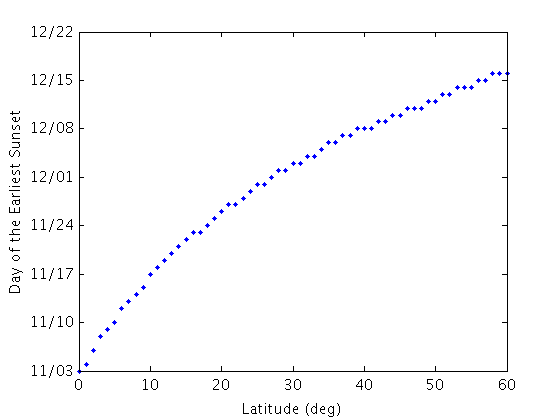
Now the interesting thing about Seculus is that it varies by latitude. The farther north you go, the later it occurs. As such it provides a sort of perpendicular counterpoint to New Year’s Eve. Because everyone on a single meridian celebrates midnight at the same stroke, we are conjoined in longitudinal fraternity. Seculus, on the other hand, unites us with our latitudinal brethren. Are you on Latitude 42? If so, you are my Secular Sibling, and December 9th is our festal day.
Accordingly, last month I wanted to illustrate exactly when, by latitude, the earliest sunset occurs but alas I didn’t get my act together in time. But now, with the help of some code from the U.S. Naval Observatory I can present a chart that is still timely: the latest sunrise by latitude.
The latest sunrise occurs on the far side of the solstice, as you might suspect. At my latitude it happened about a week ago. Since I am not a morning person, I propose no special holiday for the latest sunrise. But you seasonal affective early risers may disagree.
And here, to complete today’s story, is the Seculus Succession, being a chart of the timing of that noble and moveable feast.
It’s easy to see why Rep. Richardson is getting air time. He has a perfect lightning rod of an argument, seductive to one side and enraging to the other. But I don’t want to take the rhetorical route here. It’s easy, but without data it’s a pointless descent into mud wrestling. The point I want to make is that data can be brought to bear here. My belief is that there is plenty of data that shows that giving guns to the “good guys” results in net harm, not net safety.
I hope we are moving in a direction where we can appeal to data in situations like this. We saw a nice example of this recently on Fox News, of all places. Megyn Kelly grilled Karl Rove about math you do as a Republican to make yourself feel better. If that election taught us anything, it’s that hallucinatory math has real consequences.
CNN will continue to interview the Dennis Richardsons of the world. They make for good ratings. But I like to think the appeal of magical thinking in the face of hard data is going to wane. More to the point, I think we have data that this is actually happening.
Earlier this year I read a book called You Are Not So Smart by David McRaney (I discussed it briefly here). The book steps you through various psychological fallacies that all of us fall prey to at one time or another. Things like confirmation bias and anchoring effects and so on. As you read, you are constantly hammered with the message given in the title: you’re an idiot. The research is interesting, but the premise gets a little wearying. I get it! I’m not so smart.
Much of the research presented in the book is the work of Daniel Kahneman and Amos Tversky. So David McRaney must have been a little disappointed to learn that Daniel Kahneman recently published his own book on our psychological shortcomings. The book, Thinking, Fast and Slow, comes from the veritable horse’s mouth. In it, Kahneman describes the arc of his career developing and promoting the school of behavioral economics. Kahneman’s book, as you might imagine, is more thorough but also much more readable and humane. I particularly enjoyed the fact that Kahneman shows great respect for the rapid and intuitive decision-making apparatus that humans rely on. It sometimes causes spectacular problems, but usually it works incredibly well.
If you study genetic diseases for a while, you start to think that genes exist to cause disease. Similarly, if you make a detailed study the failures of intuitive thinking, you can be forgiven for thinking that intuition is disaster-prone mess. But if it were, how could you possibly be so successful and good-looking?
Turns out you’re pretty smart after all. But you already knew that, right?
As a pre-Christmas gift, I got the new Kindle Paperwhite. I’ve had the previous generation Kindle (now it’s called the Kindle Keyboard) for a while and liked it, but the Paperwhite is head and shoulders above it. The Paperwhite is smaller, but between the higher screen resolution and the fact that you don’t have to give any space to a physical keyboard, it doesn’t feel like you’re giving up any reading area. The physical keyboard is replaced by an onscreen virtual keyboard, which is much more pleasant to use. I also prefer turning the page by touching the screen rather than by pushing special buttons on the side of the unit. This is all old news… what I wanted to describe was how nice the automatic synchronization was.
My old Kindle was Wi-Fi only. Getting the 3G phone network option (called WhisperNet) seemed expensive and unnecessary. To download books via Wi-Fi, you only had to be in wireless range with a friendly network. This was no hardship. Since the wireless service burned up the battery, I just switched it off between book downloads and everything was ducky.
But that stopped me from enjoying a nifty feature. Kindle software runs not only on their readers but also on iPads and iPhones and various other devices. So you can pick up reading on one device exactly where you left off reading on the other. It’s surprisingly pleasant, but of course it only works when both devices are on the net. So even though I had the Kindle device, I couldn’t take advantage of this feature because I would always turn the Wi-Fi off right away.
The bottom line is that I wouldn’t have chosen the Paperwhite 3G for myself, but since it was gift, well, there it was. And having always-on connectivity let me take advantage of book synchronization. Now, if I have a few extra minutes while waiting in line somewhere, I can keep reading a book on my iPhone even when the Paperwhite is at home. It’s a simple enough feature, but one of my favorites of the whole Kindle environment.
Yowza! I’ve seen the Museum of Bad Art (I’ve even seen it in person, since it’s in Somerville). And I’ve seen mediocre art by famous people like Richard Feynman. I’ve seen the primitive folk art of Grandma Moses. But I’ve never these things all rolled together into one magical package. Until now…
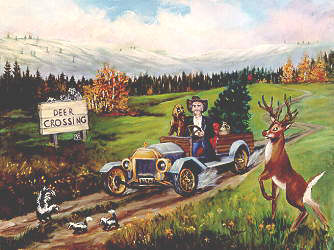
This evening, on the advice of my friend Kevin, I happened to be reading up on some classics from the 70s. This took me to the Kindertrauma page on The Horror at 37,000 Feet. Improbably, it was on this page that I made the big discovery. Buddy Ebsen, the talented dancer and actor, is also a bad primitive tasteless famous artist. Just look.
Friend, if Ebsen’s Welll Doggies doesn’t cheer you up, I don’t know what will. And this being the holiday season, you might want to drop $900 on Christmas Cheer. In lieu of a docent talk, I will include the gallery’s complete description of the painting below.
Jed and Duke have been up to the timber line to fetch a Christmas tree. Happily headed home they had forgotten about the deer crossing until they see Rudolph the Red Nosed Reindeer fixing them with an indignant glare. Jed brings the truck to a sliding stop, to give Rudolph the right of way and incidentally avoids a tangle with a family of skunks whose opportunist mama can apparently read signs.
Mr. Tompkins, a banker with an interest in physics, takes a nap after seeing a lecture on relativity. He awakens in a strange world. Bicyclists moving past him are pinched and narrow. When he decides to go cycling himself, he notices the street he’s riding on has gotten very short. But short as it is, he doesn’t seem to be making much progress. When he remarks about this, a fellow cyclist says “What difference does it make anyway, whether we move faster or whether the street becomes shorter?”
What’s happened to poor Mr. Tompkins? Here’s what: he’s landed in a world where the speed of light is so slow that the effects of relativity are obvious and dramatic.
The story of Mr. Tompkins was written in 1940 by the physicist George Gamow. His goal was to make special relativity a little more human-scaled and approachable. The speed of light is so unimaginably fast to us that it’s hard to picture what it must be like to move at relativistic speeds. To build insight about the process, you need to domesticate it.
This is the same essential insight of a game from the MIT Game Lab.
By walking around in a world with a ridiculously slow speed of light, you experience not only the Lorentz transformation of space observed by Mr. Tompkins, but also the Doppler effect, the searchlight effect, and time dilation. And maybe, just maybe, you’ll build up some intuitive understanding of the crazy world of the very very fast.
As I was about to get into the car on Saturday afternoon, I noticed a funny rainbow-like smear on the windshield. At first I thought it was something greasy on the windshield, but I looked up in case it was reflecting something in the sky. It was.
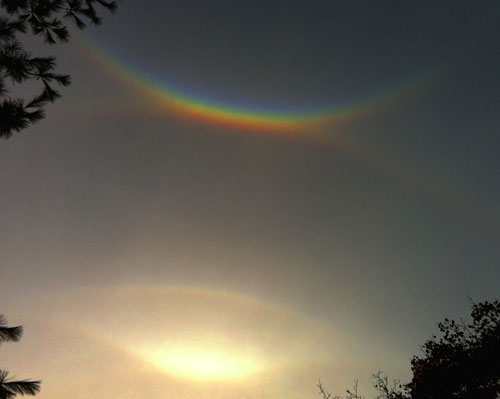
Above me, in the weirdest location and orientation, was a rainbow. Weird because there was no rain — it was a clear afternoon — and because it was upside down. Its feet were in the air! I’d never seen anything like it.
This is what I saw.
My first (incorrect) notion was that it was a glory. But you see glories when you look away from the sun. Furthermore, this was a whole constellation of delicate curves and colored arcs. I couldn’t stop looking at it.
I tweeted that anyone in Boston should go outside and look up. My friend MechanicalTim, an erstwhile physicist, sent a quick note back. It turns out he’s spent a fair amount of time thinking about the physics of rainbows, and even he was stumped. But he was able to track down a name for the phenomenon. That upside-down rainbow is a rare ice-crystal halo called a circumzenithal arc. You can tell it’s rare by its unlovely name. The high-altitude hexagonal ice crystals that put on the show were driven there ahead of Hurricane Sandy’s approaching bulk.
So Tim identified the circumzenithal arc, but what about the rest of it? In particular, what about the graceful gull-wing curve below the arc? A little more research put me onto the Ice Halo page on the Atmospheric Optics website. What a treasure of strange solar fauna! From my pictures, I worked out that I had seen the aforementioned circumzenithal arc, the supralateral arc, the upper suncave Parry arc, and the upper tangent arc. Not to mention the more common 22 degree halo and its hovering parhelic hounds, the stately Sun Dogs. In one fortunate sky, I’d bagged the whole menagerie. A veritable crepuscular jackpot! Rare and beautiful things with fancy names! It all made me very happy.

 Rambles Blog at Star Chamber
