Grounding Day

Happy Grounding Day! The editors of the Star Chamber would like to remind you to enjoy this special midsummer holiday, first described in this space last year. Mischief is afoot, the summer is at the top of its arc, and aliens are abroad. And if there aren’t any aliens here on Earth, well then, we’ve sent our own to Mars.

By the way, careful readers of these pages will recall that we scooped the movie Contact with a tale of our own on these pages about beaming bad TV across the galactic void. Of course the book Contact came out years ago, but we will gently step over this fact by noting that we never took the time to read it.

In the meantime, for the admirers of that noble verse form, the double dactyl, we herewith include a humble example of our own


Life on Mars

Pathfinder, Sojourner:
Where are your pictures of
Martian inhabitants
For us to see?

Is it because of some
Extraterrestrial
Pusillanimity:
Fear of TV?

So in honor of Grounding Day (and before it’s too late), why not avail yourselves of the pleasantries of summer? Fix yourself a martini concocted with iciest gin, juiciest olive, merest hint of vermouth, sit on the back porch and read A Midsummer Night’s Dream one more time. Or better yet, pull up a chair and consider with us the curious tale of Ellery Fox.

Birth Sky

Comet Hale-Bopp has finally left our evening skies, and while I managed to see it a good many nights, I never did see it perched in a truly dark sky. This is a great pity, as you will know if you were lucky enough to do so.

I did have the good fortune of being in a place with very dark skies just as comet Hyakutake was making its appearance. I was on vacation in Costa Rica, and two nights before, I had gone looking for the comet without success. Finally on the last night of my trip, I saw it almost by accident during a late night walk. Here is what I wrote down the next morning:


Saw comet Hyakutake last night! It was sitting just near Arcturus after the moon had set. It was ghostly with a long streaming trail — at first I thought it was a search light shining from something in the sky — a helicopter? Then when I realized what it was it was just an incredible sensation of awe and mystery. Of course it was silent, but somehow its powerful silence is what I remember most vividly, as though something so dramatic should roar like a waterfall. But it sat quite still and looked at me, like the ghost of Hamlet’s father. I wanted it to announce itself, but it just stared back, its ragged coattails streaming in the wind.

This is the same sort of sensation excited by eclipses of the sun, or by the titanic smashing that comet Shoemaker-Levy gave Jupiter last year: something obvious is going wrong in the sky. A good reckoning of the heavens is the first great accomplishment of any civilization, associated with the rise of agriculture, so when something so weird happens in the sky, it can be disturbing at a very deep level. You can begin to see why both comets and eclipses have caused (and continue to cause!) such fear and disruption.

For me, comet Hyakutake underscored the fact that we are not projected onto a backlit screen. We are solid creatures that literally fit into an encompassing three-dimensional cosmos. During an eclipse, the point is driven home that I am here, and the sun is there, and the moon is there. The three of us have come together in a way that suggests the sun knows about me — for an instant an invisible axis, a spindle, passes right through me. It tells me that these celestial bodies are enormous actors that shape and inform the rocks we stand on. This is not a painted backdrop or a great big screensaver. These celestial wanderers write our rules, and any minute a giant rock may tumble from the sky and carve a jagged hole in our planet.

During eclipses, people react strongly. Some are stunned to silence, others are overcome by giddiness. Why? The shining sun was here and then it was blotted from the sky. This is the difference between knowing and knowing. I know that the earth waddles around the sun with moon in tow. But slide the moon between the me and the sun, and by God, I KNOW it.

But moving beyond the physics, we count on the regularity of the sun to fill the great void, and when the sun vanishes, the void beckons. Science cannot fill the great void! The void is an empty spot behind your eyes beyond the reach of reason. The raw reptilian brain that understands this is comforted by the richness of the creatures that live in our sky’s imagination. Show me Perseus and Pegasus!

That night in Costa Rica, I felt the weight of Hyakutake’s eyes on me. It was watching me. The experience took me straight to the place where our forebears and forelizards spent their entire lives, a place where the heavens were animated with living presence. The event reminded me how close the skies are, and how much they matter. How much we owe them and how much they own us.

So now, if I told you that I could reconstruct for you exactly the configuration of the planets and stars on the day you were born, would you be curious to see the result? This is the kind of thing that astrologers claim to do all the time, but astrologers have, by and large, fallen out of the sky, which is to say they have lost the connection the actual relationship between the stars and the planets. Their zodiacal signs are tokens, which, like Tarot cards and tea leaves, are as useful for divination as anything else close at hand. But the astrologers do not speak for where the planets were actually swimming when you were born. The horoscope is out of step with the sky on two counts: the signs have been shifted by precession and their width has been regularized.

The earth is a spinning top, and as it spins through daily rotations, it also nods very slowly first this way, now that way, inclining its head toward successive members of the zodiac. Precession is the name for this lazy nodding. Though too slow to notice in one person’s lifetime, it has added up to a very noticeable difference since our constellations were defined some 3000 years ago. For example, the first day of spring used to occur when the sun was in Aries, but it now occurs when the sun is in Pisces. Some time in the next century or so the first day of spring will occur when the sun is in Aquarius, and the age of Aquarius will at last have begun in earnest.

This is a representation of the sky at the very moment I was born (see if you can work out how old I am!). I find it strangely satisfying to look at. It uses symbols familiar to astrology, yet it is an altogether accurate diagram of where the planets were relative to the stars in the constellations of the zodiac.

If you were to see this model, this birth-sky, for your own birth date, what would you think? An astrologer would use it to read omens, but I think that any of us, even the most hard-hearted, would be inclined to behave like all pilgrims do at the end of the journey: we would look around and say, “Hmmm. So that’s how it was.” Somehow, it matters enough to be worth knowing.

Learn more about the Birth-Sky diagram.

Solstice musings

As the sun winds its way toward the summer solstice, permit us to pause for a moment and recall that the StarChamber has been operating since
April 16th of last year. The first anniversary of that date slipped by with little fanfare.

This illustration shows the configuration of the planets in the sky on that very date. Look closely and you’ll see that Venus was lounging in Taurus, Jupiter was hanging out by itself in Saggitarius, and wow! look at that crowd around the sun in Pisces. It’s enough to make you think some kind of harmonic convergence launched the StarChamber. Sound like astrological voodoo? Maybe. But this is an honest-to-goodness image of where the planets were in the sky on April 16, 1996, no matter what interpretation you attach to it: A sky chart for the StarChamber’s birthday. And every week since then, for more than a year, we’ve been listening to the music of the spheres and putting up the content.

Bobo would be proud.

Mr. Saturday

Ransom shook his head and replied:

I’ll tell you how it was that I came west. It was nothing like that. I left the very next morning after old Mr. Saturday came to visit. Mama Haynes always said: “Send dreams not mischief, Mr. Saturday.” Now I know what she meant. I can see Mama Haynes now, chuckling. “Everybody sees him once at least,” she would say.

I was in the study with Enrico rebuilding (for the fifth time) the sprocket wheel guide on the orbital track mount. We had been working obsessively on the orrery for over two months neglecting hygiene, nutrition, friendship and sleep — our house was a foul-smelling unhealthy place and we were by this time arguing bitterly over every gear and pulley.

tophat.gif

Responding at last to loud knocking I opened the front door, and he walked in smiling, all white teeth and white eyes, not saying a word. I had never seen Mr. Saturday before, but there was no mistaking him, a thin dark man wearing a shabby top hat, bowtie, and an old soot-smeared black suit. He glided straight past an open-mouthed Enrico to the kitchen and sat down at the breakfast table. The table was still littered with dishes, crumbs, and the Sunday paper. He sat right down, with his thin hands folded in his lap; with his bloodless car-accident smile and his wrinkle-creased suit. I can tell you it sent a chill right through us. We followed him into the kitchen and stood in front of his chair.

The left corner of his crooked disapproving mouth twitched twice. There was a wheezing rumbling sound like a distant avalanche which we realized came from his stomach. He looked directly at me. Mama Haynes had told me many times that Mr. Saturday has a big appetite, so I offered him the remains of the congealed macaroni and cheese. He gobbled it down with such alarming speed that I feared for my fingers. We opened the refrigerator and gave him more. He ate greedily, appearing to get hungrier, to accelerate, as we fed him: Enrico’s old lasagne, the last of the Cap’n Crunch, some moldy orange-flavor beef from Szechuan Garden. We kept the food coming, and the detritus clung to him. Crumbs from stale cranberry muffins stuck to his white-whiskered chin stubble. Viscous globules of Thousand Island salad dressing dropped onto his stained jacket. Bacon grease glistened on his thin fast-moving fingers.

Toward the end, we began to realize that he would swallow anything: a box of peppermint teabags, the entire spice rack from the ground Jamaican ginger to the Hungarian paprika along with the salt and pepper shakers. I began to worry about what we were going to do when we ran out of everything remotely edible.

It was Enrico who hit on the idea of feeding him books after we saw him gobble up the Sunday paper. Presently we were bringing everything off the bookshelves: textbooks, fieldguides, religious tracts, all 17 of O’Brian’s sea novels. They all went down at a quickening pace, though he slowed down briefly as he chewed through the Bible, the Tao Te Ching, and Luck’s Arcana Mundi. Once the shelves in the apartment were empty of books, we pulled the maps and posters off the walls. I fed him mom’s old ukelele and both of my concertinas. He devoured my small collection of CDs in one abrupt jaw-popping thrust. With each slobbering mouthful he seemed to grow larger and more threatening, until in heartbreaking desperation we began to feed him our precious machine. First the blueprints, then the spare brass gearworks, and at last the entire nearly-complete orrery. Finally I brought him the old broken-glass charm that Mama Haynes gave me before she died.

At this, he paused and appeared to think for a bit. Then he leaned back suddenly in the squeaking chair, his hands rubbing his bulging belly. A long wet gurgling belch bubbled out of his food-smeared lips, filling the room with a sickening odor of fish heads, WD-40, and bleach. He cleared his throat, preparing to speak.

His dry clotted voice rattled: “Tell me what he sees. Like it or not. No time to lose. Tell me what he sees.”

There was a long pause before he continued “A big bear wearing a bright red cap balances on a sagging blue ball. A small maiden in sequins dances on the back of a galloping horse. A toothless leopard old before her time paces in a filthy circus cage. Crack goes the ringmaster’s whip: the bear waddles to the left. Crack goes the ringmaster’s whip and the bear waddles to the right. Crack! goes the whip; now the bear steps off the ball and rushes past the ringmaster into the crowd. The bear rips at the canvas walls of the circus tent, pulls down the poles. The tent falls into itself and is crushed from sight. The bear, alone, looks up at the sky. Tell me this: what does he see?”

Now his eyes were glowing match heads stubbed into dark sockets. “No time to lose. Like it or not. TELL ME WHAT HE SEES.”

three-of-swords.gif

We had no answer, but he leaned back, apparently satisfied for the time being. He plucked an ivory toothpick from his waistcoat and picked at his shiny teeth so violently that one of them popped from the back of his mouth and rattled across the floor, stopping next to my foot. Undistracted, outstretched palm toward me, he considered his thick yellow corrugated fingernails, pursing his lips. Then his eyes sparked and he flashed a carnivorous smile. He stood to leave, thumping his hat onto his head. On his way out the door, he put a bony forefinger to the brim of the hat and said: “See you later.”

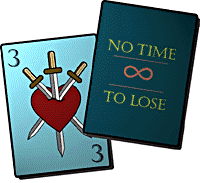
Where he had been sitting there was a dogeared playing card face down. On the back, the words “No Time To Lose” straddled a sideways figure eight. I turned the card over: three of spades. Three of smiles. Three of teeth. Mama Haynes used to say: “Everything Mr. Saturday says, he says verbatim.” How true.

Temporal occlusions and the flow of time

The flow of time is much on the mind of Paracelsus of late. Charting an optimal course down the river of time is a seductive goal, but how does one really pull it off? The cryptic conversation of the two Chinese sages on the bridge is entertaining, but it just doesn’t go far enough.

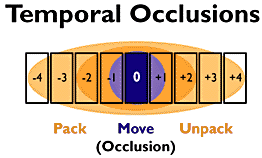
Paracelsus is moving from House 1 to House 2. Moving from House 1 to House 2 is a great big hairy pain. He recalls the Minister of Central Dogma waxing eloquent on the topic of moving. He also recalls the theory of temporal occlusions previously discussed in this location. As applied to the current situation, consider the effects of temporal wind. Packing and unpacking should be symmetrical activities on either side of the move itself. This gives a pleasing bookend appearance to the diagram below.

temporal-occlusion1.gif

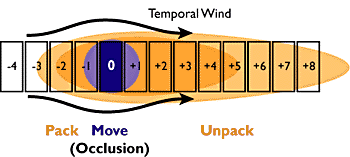
But including the effects of temporal wind yields a harsher picture. The act of moving is a temporal occlusion: it cannot be moved and so blocks the flow of time. The packing and unpacking activities, on the other hand, are softer and so can be swayed downcalendar by the breeze. As a result, all packing takes place in last-minute lungsucking cyclone, while the unpacking is smeared across weeks (perhaps months) in the lazy lee of the occlusion. All symmetry vanishes.

temporal-occlusion2.gif

Paracelsus writes to you from the unhappy swirling center of the pre-move cyclone.

So if time is indeed something that flows, then how much does it resemble other fluids? Pausing to savor a martini seems to stop time for a twinkling. What are the limits of this effect? What other beverages might exhibit similar behavior? Inspired by the Coffee Czar’s eponymous example, we consider the assertion “You can stop the flow of coffee or of time, but not both; the sum of these quantities is conserved.”

Baaa Humbug

Scientific progress seems to accelerate the very pace of time itself. The arrival of Dolly, the cloned sheep from Scotland, proves this beyond any doubt: two shakes of a lamb’s tail now requires half the time it used to. Dolly has entered the record books as the first mammal in history to be a perfect gene-for-gene copy of another animal.

Much is being made these days of the ethical dilemmas that await us once we begin to clone humans. Is your clone a child or a sibling? Should you get into Stanford just because your clone did? Is it okay to gorge on chocolate ice cream as long as your clone stays thin? Will the Elvis impersonators get along with the Elvis clones? That sort of thing.

nervous-sheep.gif

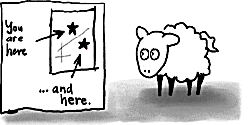
Vexing as these questions are, consider that from a sheep’s point of view, the ethical dilemmas are already here. I confess that when I first heard about this cloning trick, like many others I thought to myself: Clever bastards, choosing sheep like that. Much simpler to pull off than cold fusion; who can tell the difference between two sheep? Talk about pulling the wool over our eyes. It made me wish I had scooped them last week by holding a press conference in which I presented two identical fruit bats to a stunned world. Both named Barney.

The passage of time, however, has revealed that these Scots are not charlatans. They have actually xeroxed a sheep. I began to puzzle on this. First of all, sheep have a pretty hard time of it anyway. Easily frightened and famously dim-witted, they contribute the word “sheepish” to the language. You’ve just got to figure that the clone of a sheep is going to have some serious self-image problems, perpetually living in the shadow of another sheep. I picture her in therapy with some expensive uptown shrink, nervously inspecting the sheepskin diplomas on the wall. Perhaps she might be soothed by news of her lasting fame. After all, we well remember what’s-her-name, the first test tube baby. It will be far tougher for the cloned sheep that follow Dolly. But then again, I guess that’s what sheep do best.

What’s really interesting is how similar, philosophically, the cloning process is to copying software. Dolly is a perfect copy of another sheep’s most intimate details. The next century will bring a head-on collision between computer science and biology. Intellectual property and livestock will come to be much the same thing. Let your neighbor walk your prize-winning dalmatian, and you might just find the neighborhood crawling with a hundred and one exact copies next week. Cattle-rustling becomes cattle-piracy. I envision animals shipping with license-managers and other copy protection measures (Question: “Waiter, what’s this keyboard doing in my soup?” Answer: “The backspace?”). When wool meets code, softwear becomes software (“In order to receive technical support for your new sweater, please return the enclosed registration tag immediately”). Paradoxically, as animals become more like software, software comes to resemble animals. Advances in genetic algorithms on computers may mean that you’ll pay a stud fee some day to let your copy of Excel 56.2b enjoy a blissful rut with the latest Lotus 1-2-3 down at Kip’s Happy Spreadsheet Kennel.

llama.gif

In the meantime, the future beckons. What other animals should we duplicate? If cats already have nine lives, it hardly seems fair to clone them. I’d say they’ve got an unfair advantage right out of the gate. I vote for cloning dogs instead. They’ve got that whole one-year-equals-seven-years thing to deal with. But we might just find the most intriguing possibility of all high in the Andes. What are the religious implications of cloning the Dolly Llama? Maybe the Tibetans prefer a Dolly Yak instead. As Saint John might have remarked in his Gospel text, “Behold the Lamb of God. Both of them!”

Still, I tire of the shrill voices of pundits who claim that science is eroding the foundations of our society, speeding us along too fast for our own good. No, I won’t lament that we are playing God. But it does make me want to graft a slightly more prosaic ending onto William Blake’s poem, “The Lamb.”

Little Lamb, who made thee?
Dost thou know who made thee?
Gave thee life, and bid thee feed,
By the stream and o’er the mead?
Well, it was Dr. Ian Wilmut
And a team of researchers at the
Roslin Institute near Edinburgh, Scotland.
Full stop.

Festina lente

Aldus Manutius, a Venetian publisher from around the time of Christopher Columbus, chose as his motto the phrase “Festina lente,” or “Make haste slowly.” When the hectic pace of technological change starts to spin your head around, it’s comforting to recall these words. The centuries that separate Manutius from us have done nothing to improve the practice of sitting down with friends and sharing stories and drinks.

Aside from the invention of the martini, of course.

Up Top: Adventures in the Grand Canyon

Deep in the Grand Canyon (and if you’re right on the Colorado River that seems like the only way to describe it) on the second day of our grand adventure, Claire, our longbeard sage and veteran river guide used an expression new to me: Up Top. When you live on the east coast, California is found Out West. If you’re in California, then everything from Kansas to the Atlantic is Back East. The words are mildly pejorative, as in: “It sounds crazy, I know, but that’s how they do it Out West” or “I was stuck for two hours with these three uptight bankers from Back East.” And it was easy enough to see that Claire used the words Up Top in more or less the same way. Someone asked Claire about the real world, and he quickly replied, with his good-natured growl, that this IS the real world. It’s Up Top where everything is messed up. But when you’re down here, it all makes sense. Claire estimated, when pressed, that he had made some three hundred trips through the Canyon, so if anybody is qualified to make a statement like that, he is. After a few days of dropping steadily into this huge cleft in the earth, of watching the world and the heavens climb away from you, I can attest that Up Top seems immeasurably distant. That’s when you really feel like you’re Down Here. Down Here is close to the earth, next to the river, and far away from absolutely everything else.

Day Zero

We were due to meet with the rafting crew at McCarren International Airport in Las Vegas at 2 PM. We were both hungry and extraordinarily grumpy. Here is a simple observation about McCarren International Airport: there is no fast food to be found. Don’t look for it, don’t expect it, and certainly don’t plan on it. Hungry, tired of carrying enormous heavy packs, and afraid of missing our connection to the Grand Canyon, we stomped around looking for something to eat. Eventually, we cornered and trapped two greasy sandwiches in a bar, after which we stumbled quickly downstairs to the appointed rendezvous point. There we saw a motley crew of people sitting on the floor. “Are these our people?” I thought. I puzzled over the fact that these people were either going to remain utter strangers or become my well-known and perhaps well-regarded fellow-travelers. I puzzle often over such things. Still, we needed to make sure we were at the right place so as not to miss our flight, so I asked: are you on the Moki Mac trip? To my surprise, all of them were. A lot of people, maybe twenty. I was mildly disappointed; you’d get much closer to ten people in six days than twenty people, but there you go. I immediately did my best to form snap judgments about everyone on the trip. What fun, I thought, to look back from a more informed future and see how good I am at snap judgments. Never overlook the chance to calibrate, I figure. (It turned out that I am damn bad at making snap judgments, but that’s another story)

The cheerful woman who organized us, we came to discover, was not in fact from our rafting company, but rather from Aluminum Foil Airlines, the company that was going to fly us out to Marble Canyon and the start of our trip. And no, oh no, we’re not flying from McCarren International Airport. We’re going to get in vans and drive to the Boulder City Podunk Airport before we get in the little tinfoil airplanes that will transport us. Outside, it is hot. Hot like opening an oven, peeking inside, admiring the scenery, hopping inside and closing the door behind you. Hot. The vans we are to take have no air conditioning. Once we are on the highway, we learn they have a number of other ailments as well. At 45 MPH straining to get over the pass on the way to Boulder City, the woman driving the other van calls out to ours: “Stay behind me! The van is acting up, and I don’t want to get stranded!” “These vans, it’s a wonder they don’t fall apart,” our driver remarks to no one in particular, shaking his head. We have just discovered that he is also going to be our pilot. Heh-heh, I joke with the driver of our van, it’s a good thing they take better care of the airplanes, huh? “Oh they take great care of the airplanes,” he says, without missing a beat. Heh-heh.

The flight is long, and though the scenery is fantastic, many of us are spending more time thinking about our uncertainly digesting lunches. And so it goes for a good two hours: loud, hot, close, and depending on your temperament, extremely nauseating. At the same time, I can’t help but think: what a great way to start an adventure vacation. This is the part of the voyage where we distance ourselves from what came before. Drone groan drone groan says the engine. We cross over the Kaibab Plateau at a surprisingly low altitude, low enough to make me pick up my feet to keep from scraping the trees, and once over the top, we follow the contour of the terrain straight down to Marble Canyon. Though our altitude above ground changes very little, I watch the altimeter spin around at a truly amazing rate

Day One

We’re up just in time for our free breakfast at the Sweaty Pillow Motor Lodge in Marble Canyon, and then we take a quick van ride down to Lee’s Ferry. Sorting out who’ll go on which boat is a surprisingly haphazard affair, and before long we’re drifting down river with riverguide Bill. “How is your head?” I ask him, having seen him absolutely smash it into part of the trailer on the van while retrieving luggage. “It hurts,” says Bill. He’s been living in Phoenix trying to get a nursing degree. This is the only river run he’ll do all season. Hmmm, I think to myself, is this the man I want to trust with my life? One trip all year, a big disorienting welt on his head, and (according to him, at least) out of shape? The twin spans of the Navajo bridge drift over us. Bill is definitely knowledgeable. If you ask, he’ll keep the information coming: this is the Kaibab formation, visible throughout the entire trip. Here is the Coconino limestone. There, if you look close, is the beginning of the Hermit Shale. He takes us through our first good sized rapid, Badger Creek Rapid, with great comfort and easy unmistakable skill. Bill is a good guy; he looks awkward as a stork, slightly goggle-eyed. He is quiet, but good-hearted, and he rows like a master. “How is your head, Bill?” I ask, with genuine sympathy. “It hurts,” he says.

Day Four

I had hoped we would get to be close friends with some of the people on the trip, but everyone seemed content with going to sleep early in general. But tonight at our Carbon Creek camp Beth, a print buyer from Atlanta, offered some after-dinner solace to WJ in the form of a little Jack Daniels. WJ was in need of solace because she had received a nasty bite on her ankle from a red ant; in fact, this is the only kind of bite they are capable of delivering. When I saw that bourbon was forthcoming, I found I was in need of solace too, so we all trooped back down to the riverside with Fresca, liquor, water, and a great big bucket for WJ to soak her ailing ankle in. It was here in the dark by the streaming river that Beth revealed, as she smoked a cigarette, the shocking secret of her vacation: it was financed by stolen goods. As a senior at Auburn, she and a sorority sister had discovered an old dusty marble bust in a disused room, and as part of a zany college prank they took it back to her room. Since then she had carried with her it for years from place to place, not through any great love of its style and form, but simply because well, there it was. Only in the last year had the idea crept into her mind that it might actually be worth something, and you can imagine her surprise and delight at having it appraised to be worth exactly one all-expenses paid trip to the Grand Canyon. Beth is no fool: she inquired in June and here she was on the river with us in early August. Are you troubled by guilt? we wanted to know. Well, yes, she admits: if her sorority sister ever finds out she’ll claim half the loot.

Day Five

Highlights: evening thunderstorm, the inner gorge, huge rapids, the Vishnu Schist (which sounds to me like the Indian equivalent of Montezuma’s Revenge, but what do I know). Toward the end of the afternoon we pull off just above Clear Creek for a day hike. This will just be a short hike, but the climb out of the gorge is steep and stony, and by now everyone is used to the fact that short hikes are actually quite long, so a number of people hang back with a riverguide named Whaler. Whaler never goes on hikes; instead he sits in his raft under an enormous umbrella and rolls the cigarettes which he smokes one after another. Whaler once told us he has a little cat that will give you a high-five. He said it with such evident glee that we had no choice but to believe him.

The walk is beautiful though, and a thunderstorm that threatens to soak us never does. The granite and schist are fantastically weird compared to the sandstone and limestone we’ve shared the last four days with, and it’s very satisfying to hike over it and hold onto it. We end up in a little grotto with warm water jetting into something like an enormous jacuzzi. On the way back, I hike next to Catherine and we talk for some time. Where did you first learn to run rapids? I ask. Right here, she says. And the amazing truth of the matter is: this is her first season on the river, and the very first time she ever went down the Colorado, she was paddling a baggage boat. She moved to Flag, which you’re allowed to call Flagstaff if you’re sufficiently cool, and she began pestering river runners relentlessly. And the final part of the secret is this: she works for free, presumably through the generosity of her father. River running is not the most profitable business, and none of the guides will get rich from it, so the temptation to let a neophyte drive the baggage boat on no pay must be great. So if you’ve got time and desire, you can jump in on the ground floor and go.

Day Seven

Back in Las Vegas, we can only conclude that Claire was right about the locus of the Real World. Las Vegas is Up Top, Over the Top, and Beyond Bizarre. It is the least real place I have ever witnessed, and it’s particularly jarring to see it after six days on the river. The ancient, forgiving Colorado pays Las Vegas’ rent. It gives her water to drink, it spins the turbines that electrify her neon. But I don’t think the river minds too much. The river that carved the canyon can afford to wait a century or two for this insane city to dry up and blow away. We had a fun in Las Vegas, but it’s the canyon we remember.

Taking the cake

December is a dangerous month

My birthday is in December. If your birthday is too, you may already be shaking your head sadly, thinking of me, your brother, whose birthday like yours is yearly tainted by its proximity to the most destructive holiday on the calendar. Indeed, Santa’s pitiless steel-shod boots can already be heard crunching the frozen earth as they come stomping our way, his chuckle a dry-throated rattle. Every holiday has a certain negative effect on nearby birthdays, but who can dispute that Christmas, both figuratively and literally, takes the cake?

If your birthday is not in December, you may be thinking “Quit your bitching,” or perhaps “You poor sad loser.” But listen to this: you may not know that even among us Sagittarians, there is an enormous difference between celebrating on, say, the 11th and the 20th. Do we share a bonding camaraderie? Hardly. My day of days is the 16th, so to me the 11th hardly counts. Hah! The 11th? That’s like in August as far as I’m concerned. I used to lay awake at night and dream about being born on December 11th. If your birthday is on the 11th, then don’t come crying to me, because I’m not having any of it.

atomblst

It so happens that a Very Good Friend of mine (and contributor to the Star Chamber), Damiana, was born on the 20th. When she whines about how close HER birthday is to the 25th, naturally my reaction is “You poor sad loser.” I snicker quietly to myself and think about how much closer I am to the Fourth of July. Why it makes me want to buy sparklers and squirt guns for my birthday party. Nevertheless, it was Damiana who brought to my attention a particularly penetrating analysis of the true effect of Christmas on birthdays.

Based on this analysis, here is an illustration of part of the December calendar with some tabular annotations regarding the traumatic effects of Christmas on nearby birthdays. For this research, we have borrowed from some studies previously considered unrelated to this topic.

nuclear-december.gif

A. Vaporization Point

100% Gift Occlusion

Everything is vaporized by the Christmas blast.

B. Total Destruction

90% Gift Occlusion

All birthday party activities above ground are destroyed. The “Happy Birthday Song,” if attempted, is completely inaudible. Third-degree Duraflame ™ burns have been reported among would-be celebrants.

C. Severe Blast Damage

50% Gift Occlusion

Birthday party survivors report buffeting and bruising. Though gifts are reported at this distance, they are generally simply subtracted from projected Christmas presents for a zero net change from the non-birthday baseline. This is known as X-mas radiation.

D. Heat and Wind Damage

15% Gift Occlusion

At this distance, little or no sympathy is reported among bystanders. The diminished Christmas winds can still extinguish the candles on a cake. Party hats secured with a rubber strap, though likely to remain on throughout the celebration, look quite silly (that is, sillier than usual).

Notice the plume of destruction falls mostly to the left of Christmas. This is an example of a counter-flowing temporal wind, or anticipatory time eddy. Most events, particularly unexpected events like earthquakes and hurricanes, experience a prevailing temporal wind and so influence later events more heavily than earlier ones. This is the more typical down-calendar causative flow. But nothing on the entire calendar, not even tax day on April 15th, is more anticipated than Christmas, hence the reversal of the normal temporal forces. Don’t you just know some jackass on the 26th will say: “Only 364 more shopping days till next Christmas!”

All this raises the rather interesting question of when the BEST POSSIBLE time is to have a birthday. Simple holiday avoidance would likely put it in the middle of August, the only month of the year completely devoid of national holidays. But August, alas, is often battered by family vacations, and Pandora (another Very Good Friend of Paracelsus) reports that family vacation birthdays can be angst-ridden occasions in their own right. Just try lighting birthday candles in a canoe in the pouring rain three hundred miles from home.

Do you have good birthday timing? Let us know. Bad birthday timing? Even better; send us a message. In the meantime, be kind to the Sagittarians in your midst. More than most, they are victimized the most vicious cultural vortex our society offers. Duck and cover, hop in a fallout shelter, put a candle in a cupcake and wish them well. And as long as you’re out of harm’s way, you might consider staying down there until the new year. It’s a dangerous time to be outside.