Do you like the taste of beer?

Here’s a good one that Doug passed along. It’s amusing on its own merits, but it’s also a stark illustration of the coming power of statistics. OkCupid is a dating site. There are thousands of dating sites out there, but this one was founded by mathematicians. So not only do they have tons of interesting data on coupling, they’ve also got the math skills to extract some pretty fascinating conclusions.

In a recent blog post, The Best Questions For A First Date, they posed this question. Is there an innocuous question you can ask early in a relationship that yields the same information as the rude question that you’d rather ask? That question of questions, “Will my date have sex on the first date?” turns out to correspond very nicely with a much much safer question: “Do you like the taste of beer?” According to the wizards at OkCupid,

whether someone likes the taste of beer is the single best predictor of if he or she has sex on the first date.

Why? That’s the beauty of statistics! It doesn’t matter why. I’m telling you that it works. Isaac Newton had much the same problem when he tried to explain his law of gravity. “I have no faith in this gravitational law of yours,” they would say, “because you can’t explain how it works.” To this day, nobody understands how gravity works, but Newton’s law is darned useful all the same.

Similarly, we’re a long way from understanding human nature. But the statistics you shed every day are now being stockpiled and distilled, and they reveal an invisible hand shaping your every move. There’s a lot more of this on the way. I suspect that first dates in the near future will start to sound like spies encountering each other behind enemy lines.

HE: The otter is shy but friendly, don’t you think?
SHE: Yes, but would you agree that it is better to be invisible than to fly?
HE: True, but tell me this… do you like the taste of beer?
SHE: >> SLAP! <<

Broken looms and IBM machines

I don’t know about you, but watching Watson demolish his human opponents in Jeopardy last week got me thinking about wooden shoes. Called sabots in French, these shoes were flung into weaving machines during the Industrial Revolution by angry workers. Clogs in cogs save jobs, or so went the reasoning. Ineffective at stopping automation, sabots nevertheless had a lasting impact on the English language. Sabotage became our word for the subversive use of footwear (and other implements of destruction).

I always tut-tutted at those misguided laborers for shoe-flinging in the name of job security. Who were they to stop progress? But watching Watson, I felt a pang of sympathy for the Luddites of the 19th century. Because as a knowledge worker, Watson is starting to work on my side of the street, and my reptile brain is not very happy about it. The speed with which mechanical brains are improving is intimidating. Even so, it’s easy enough for my non-reptile brain to calm down and be grateful for progress. I remind myself that it was ever thus. Progress has been intimidating humans since the invention of the pointed stick.

It was with these thoughts that I got a note from Jay Czarnecki pointing me to Adam Gopnik’s essay at the New Yorker, The Information: How the Internet Gets Inside Us. It’s a smart smart piece about the overwhelming wonders of the Internet. He divides Internet pundits into three categories: the pessimistic Better-Nevers, the Pollyanna Never-Betters, and the equivocal Ever-Wasers. As he says:

One’s hopes rest with the Never-Betters; one’s head with the Ever-Wasers; and one’s heart? Well… one’s heart tends to move toward the Better-Nevers, and then bounce back toward someplace that looks more like home.

We humans can never escape the feeling that that which frees us enslaves us. I wonder how Watson feels about it.

The Honda UX-3 Not-A-Segway

My dad sent me this. I missed it the first time around… it looks like this first hit the news about a year ago. Honda has made a nifty little indoor Segway-like thingy. Here’s their corporate marketing piece for it. Cheesy but informative. Below is a test drive video from Engadget.

It looks like a good idea to me, but I can imagine that Honda is scared of making too much noise and pulling a Segway. The Segway was supposed to be the device that everyone would want, but instead it became the device that, having spent $5000 for the privilege, makes everyone look like a dork. Do a Google image search for Segway dork and you’ll see what I mean.

The obvious market for the UX-3, despite the lovely young models in the marketing video, is seniors. And Japan has a bumper crop, so I’m guessing this and products like it have bright future in elder care. And for some reason it’s not as dorky as a Segway. The sideways zooming is cool, but I think the main thing is that you don’t have to wear a helmet. The Segway makes you stand on a little platform and wear a helmet, and that combination just destroys your dignity. Segway polo is the sport of rich geeks. But indoor UX-3 polo would be excellent.

L-5 in 1995

Were you ever an idealistic young space geek? If you’re old enough, you might even remember some of these space station images from when they went by the first time. Boing Boing has put a bunch of them in a gallery: Totally Awesome Space Colonies.

In the mid 1970s there was a bloom of space colony utopianism that grew under the leadership of Gerard K. O’Neill. NASA funded some significant studies, including this one from 1975: Space Settlements: A Design Study. The idea was to build a giant space station out between the earth and the moon at a place called the L-5 Lagrangian libration point. Enthusiasts coined the slogan “L-5 in 1995”, because surely only 20 years would be required to launch our first colony in space. There’s a lot of work in that study, but probably the most significant thing they did, from a PR point of view, was hire Rick Guidice and Don Davis to do the gorgeous paintings featured on the Boing Boing page. I remember staring at those images as a kid. And dig this scene from the study:

Stopping for a mug of Space Blitz on the way back to your apartment you happen to catch the Princeton-Stanford ball game on television from Earth and learn that, to everyone at the bar, the three-dimensional ball game played in the central hub is much more thrilling. You find that … the liberating effects of low gravity and the Coriolis accelerations make all shots longer, faster, and curved, thus completely changing the rules and the tactics of the game.

Mmm… Space Blitz. Is that like Schlitz, I wonder? Anyway, space optimism began to wane in the late 70s as oil crises and Iran crises and the endless wait for the Space Shuttle took their toll. Senator William Proxmire, he of the Golden Fleece award, captured the sentiment about the space station proposal thus: “it’s the best argument yet for chopping NASA’s funding to the bone …. I say not a penny for this nutty fantasy.”

Space enthusiasm seems to be at a low ebb now too. Perhaps space exploration is so boring and commercial now that it will actually happen.

The leggy hamster ball

Matt Ridley, author of The Rational Optimist, likes to talk about how human culture encourages ideas to have sex. He means this in a good way, but the idea in this video is clearly the love child of two ideas who met in a bar and should have known better. But they were drunk and lonely, and it seemed like a good idea at the time…

The two ideas in question are the venerable hamster ball and Theo Jansen’s astonishing walking sculptures as documented on his Strandbeest site. The deranged match maker/master mind behind this odd couple is the inimitable Crabfu. (Spotted on BotJunkie.)

Happy Groundhog Day!

If you hold my blog up to your ear, you can hear a great fat snowstorm pacing up and down outside my house. Things are quiet right now, but she’s going to get mad again real soon, and then there’ll be nothing to do but shovel, shovel, shovel. So on this Groundhog Day I’m thinking about warmer places. Maybe our favorite prognosticating marmot is too.

In honor of this special occasion, I encourage you to indulge in the grand groundhoggian tradition of pulling down the Christmas decorations that your neighbors still have in their yard. If a surfeit of snow prevents this, you can amuse yourself with this old story by Paracelsus from our first year of operation: At the Sign of the Scarf and Bolt. It was inspired by the bar and restaurant where the Star Chamber first convened. Also from the same week, don’t miss the Treatise on the Natural Limits of Self Publishing in a Web-based Medium. It’s worth slogging through just to read the Errata page.

More Colorful Language

Another quick note on Alan’s colorful writing. He got an article on linguistic color references published in Language magazine.

“Language” has a fancy Flash-powered web-as-magazine interface, complete with flippy paper sounds. I can’t link you deep into it (which I suppose is how they want it), so you’ll just have to open it up and turn to page 30. Take a look here: Alan Kennedy’s “Colorful Language” in Language magazine.

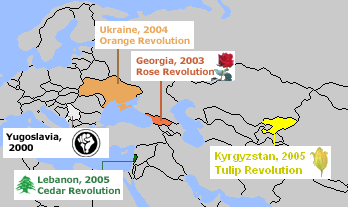
Also, apropos of the orange discussion and the Orange Revolution in Ukraine, I heard someone today describe the unrest in Egypt as a “color revolution.” The term was new to me, but not to Wikipedia. According to the article, it describes places where “massive street protests followed disputed elections or request of fair elections and led to the resignation or overthrow of leaders considered by their opponents to be authoritarian.” Just how colorful will this map get before the dust settles?

Fusion Power After All?

The standard joke about clean power from nuclear fusion is that it’s about 30 years away and it always will be. Given this state of affairs, I had pretty much given up on the fusion story happening this century. This made the gloomy prognostication about our ravenous energy future and its attendant carbon burden all the more depressing. Then Matt turned me on to this Long Now talk on fusion research at Lawrence Livermore. In it, Ed Moses of the National Ignition Facility talks about the remarkable progress being made toward a net positive fusion burn: Clean Fusion Power This Decade. Give it a listen. I found it very encouraging.

One decade… Maybe at last we’ve gone from fusion energy being forever 30 years away to the exciting prospect that fusion energy is instead forever 10 years away. Still, that’s progress!

Plenty of nothing: the Anti-Gift Certificate

As we emerge from our post-holiday hangovers, here’s a nice green gift idea to keep in mind: the Anti-Gift Certificate. For that special someone who could use a little more less.

I first saw this on BlogLESS. The artist who designed it is Christopher Gideon, and he’s happy to let you download a copy for free. It’s a nifty turnabout: a positive gift of a negative thing.

It’s always surprising to me how much it can shift your thinking when you flip around a mental model. Here’s an example of what I mean: we mentally assign an active power to vacuums. They suck things towards them. But that’s not what’s happening. Physically what vacuums are really doing is nothing. They’re not pushing back while something over there (say, atmospheric pressure) pushes harder. But it’s practically impossible to avoid the feeling that vacuums pull you in the way a magnet does.

There are all kinds of everyday concepts that seem intuitive but are actually strangely non-physical. Osmosis sucks water into a cell. Cities suck people from the countryside. These visualizations can be helpful as long as you keep in mind what’s really going on.

Once you get the hang of it, you can do these mental gymnastics on purpose. For instance, suppose I’m trying to keep myself from eating some greasy tasty treat (mmm… doughnuts). If I dwell on not being able to eat it, I’ll suffer and whine. But instead of not eating anything, I can think of myself as eating nothing. That is, I’m making a positive choice to eat the thing called nothing. It’s a small hack, but it helps.

One of my favorite mental flipflops comes from the noted conservationist Amory Lovins. In his talk Winning the Oil Endgame, he observes that whenever we save a barrel of oil, we’re actually creating what he calls a “nega-barrel”. By improving the efficiency of cars alone, we’d uncover a huge reservoir of nega-barrels – the Detroit Formation. In fact, we’re the freakin’ Saudi Arabia of nega-barrels! As he says, “we can use less oil faster than they can conveniently sell less oil.” That’s putting a good spin on it, eh?

It’s a small hack, but it really does help.