I’ve noticed a pattern lately, a happy pattern in some of the renewable energy news that I read. There are multiple examples of technologies and skills originally developed for the oil and gas industry that are becoming directly applicable in renewables.
Example 1. Fervo is a energy company that drills not for oil but for heat. Geothermal energy is useful stuff when it’s conveniently located near the surface. Picture boiling hot springs next to Icelandic volcanoes. Heating water is easy when the hot water is already right there. But if you drill deep enough, you can make your own geothermal party just about anywhere. The trick is being able to drill deep and cheap and fast. It turns out this is not so easy. But as luck would have it, the fracking revolution of the last few decades has developed exactly the skills we need to go bobbing for hot rocks. Houston-based Fervo is now moving out of their initial proof-of-concept period with solid evidence that they’ll be able to sell geothermally-generated electricity at a reasonable rate. Even if the current batch of news coverage is optimistic, it’s still satisfying to see fracking tech put to low-carbon use. It’s like watching a con man raise money for the orphanage.
Example 2. Solugen, also Houston-based company, makes chemical products, chemicals that would typically be created from petroleum feedstocks. One of its two founders had a background in the industrial chemicals industry. The other one brought the biological know-how. They’ve built something called a Bioforge that looks like a petrochemical refinery, but instead of starting with petrochemicals and warping them at high temperatures and pressures, they start with sugars and use specially engineered enzymes operating a low temperatures and pressures to create their end products. As they scale up their technology, they’re able to build on properties and skill sets originally developed for the chemicals industry, but creating much less waste and greenhouse gas emissions along the way.
Image by Midjourney
Example 3 Ørsted is a Danish company that makes sea-based wind turbines. To do this, you need fleets of ships specialize in towing, positioning, and securing enormous steel structures in the middle of the ocean. Once again, this is not easy. But Ørsted has been doing this kind of thing for a long time. Only, back in the day, they used to make oil rigs. But around 2008, Ørsted started building offshore wind farms. Since then, they have fully transitioned from being a fossil-fuel company to being a renewable energy company. Everything they learned sucking oil from the seafloor they can now apply to pulling electricity from a passing breeze.
There is an insane amount of money, talent, and expertise in the oil and gas industry. Rather than making enemies out of the people in that field, how can we give them a playbook that puts them, their skills, their capital, and their equipment to work in a newer, cleaner energy industry?
My friend Jay Czarnecki has made multiple contributions to this blog over the years. See for example, his 2022 piece on birding during the pandemic. Jay and I first met because we were both majoring in aerospace engineering, so it’s only natural that we should share a fondness for all things aviation. In Jay’s case, you might say that the fondness runs from biology right through to literature: birds as aviators and aviators as poets. Here he muses on the latter.
Image by Midjourney
Aviation Poetry
by Jay Czarnecki
We all know now that one of the great joys and great pitfalls of our age of ubiquitous information is the way you can pull one little thread of intriguing fact and uncover a whole world. Falling down the rabbit hole, we call it. I fell down one recently. In an article marking the 100th anniversary of the British Broadcasting Corporation, passing reference was made to one of the founding employees (Cecil Lewis) who was a former World War I fighter pilot and poet. My attention snagged on that combo: poet aviator. That’s an unusual mashup, I thought. Or is it?
Far off, far down, some fisherman is watching As the rod dips and trembles over the water, Some shepherd rests his weight upon his crook, Some ploughman on the handles of his ploughshare, And all look up, in absolute amazement, At those air-borne above. They must be gods!
Reading this, one could imagine the scene is from Kitty Hawk in 1903 with the amazement directed to the Wright Flyer, with Orville Wright. But no: it a passage from the poem “The Metamorphoses” written by the Roman poet Ovid in roughly 10 A.D. describing the even older Greek myth of the doomed flight of Icarus. If the role of the poet is to help us understand how to be and live in the world, then maybe the role is needed even more urgently when that world is changing and expanding. So when the ancients’ dream of human flight became real at the beginning of the last century, perhaps it was no surprise that the poets were not simply observing on the ground – they were right there in the cockpit. Because the pilot’s new airborne perspective changed how to think about the world and ourselves.
The airplane has unveiled for us the true face of the earth. For centuries, highways had been deceiving us … we been making our way along the winding roads. Roads avoid the barren lands, the rocks, the sands. They shape themselves to man’s needs.
This observation is from one of the first aviators whose time in the skies inspired philosophical writings on life, Antoine Saint-Exupéry, best known for the beloved fable “The Little Prince” with its pilot-narrator and his newfound young friend who hitched a ride with a flock of birds to traverse the heavens. Saint-Exupéry (Saint-Ex to friends) took a notebook with him on long solo flights to capture his reflections in real time. In the book “The Right Stuff”, in its early chapters a chronicle of the culture of the early test pilots, he’s mentioned in passing, reverently: “The good Saint-Ex! And he was not the only one. He was merely the one who put it into words most beautifully and anointed himself before the altar of the right stuff.” As the Little Prince departs, he bids his new friend that to find him to look to the sky at night where “there is sweetness in the laughter of the stars.”
The boundary between atmosphere, the domain of aircarft, and space, the domain of spacecraft, can be defined in differing ways, and I take advantage of that ambiguity here. In the movie “Contact”, based on Carl Sagan’s novel which imagined a first human interstellar journey, there was great debate on what profession the first traveler should be. Ultimately, a scientist is chosen, but when awestruck upon viewing the grandeur of the cosmos for the first time, she (portrayed by actress Jodie Foster) breathlessly says “They should have sent a poet”, as if to say it’s the poet’s ability to observe and describe that’s needed to convey beauty at such scale and to connect it with what’s known and meaningful to us.
That’s great screenwriting! But perhaps it was inspired by the experiences of real-life astronauts. The Apollo 11 astronaut Michael Collins was the one who stayed behind on the Moon-orbiting command module in 1969 while Neil Armstrong and Buzz Aldrin walked the Moon. Alone in his craft, often on the far side of the moon out of sight and radio contact, he was perhaps the most alone any human has ever been. Afterward he said: “I think a future flight should include a poet, a priest and a philosopher … we might get a much better idea of what we saw.” The phenomenon behind these feelings, often expressed by astronauts seeing the Earth from space, came to be known as the “overview effect”: the way the view of our entire home planet created feelings of transcendence and sense of connection to others.
We may not have yet sent a poet into space, but we have sent poets’ works. The NASA mission called Lucy, launched in 2021, is en route to study asteroids in the orbit of Jupiter. When it’s finished, the spacecraft will remain in a stable orbit traveling between its asteroid subjects and the Earth’s orbit for hundreds of thousands of years … perhaps to be encountered in some far future by humans of that time. Whereas the Voyager spacecraft which journey beyond our Solar System carried recordings meant for the “ears” of distant others to describe our species, Lucy carries a plaque of written messages, some poetic, meant for our own descendants. Of them, I find the words of poet Charles Simic most moving:
I’m writing to you from a world you’ll have a hard time imagining, To a world I can’t picture no matter how hard I try. Do you still have birds that wake you up in the morning with their singing And lovers who gaze at the stars trying to read in them the fate of their love? If you do, we’ll recognize one another.
Finally, I’ll bridge the realm of air and space again, first by reaching back to the era of the mid-century aviators.
In 1941, John Gillespie Magee, Jr of the Royal Canadian Air Force, experienced a sense of euphoria while in an acrobatic test flight in his Spitfire aircraft. But like fellow poet Saint-Exupéry, he captured those feelings while still aloft. A few weeks later, he mailed his writings to his parents, saying: “I am enclosing a verse I wrote the other day. It started at 30,000 feet, and was finished soon after I landed.” After his death in an air accident a few months later, the poem was published and became renown. Titled “High Flight”, it is now the official poem of both the Royal Air Force of the United Kingdom and the Royal Canadian Air Force.
Like many, I did not know of “High Flight” until 1986. Many generations have a specific event, usually a tragedy, so impactful that everyone always remembers exactly where they were and what they were doing when it happened: Pearl Harbor, the assassination of JFK, September 11th. For me, I would add the Space Shuttle Challenger accident of 1986. I remember watching the news reporting and the endless looping video, until President Reagan appeared to console a shocked country. He referenced the poem, memorably closing his address with Magee’s final line.
“High Flight” is considered by many the most famous aviation poem:
Oh! I have slipped the surly bonds of Earth And danced the skies on laughter-silvered wings; Sunward I’ve climbed, and joined the tumbling mirth Of sun-split clouds, — and done a hundred things You have not dreamed of — wheeled and soared and swung High in the sunlit silence. Hov’ring there, I’ve chased the shouting wind along, and flung My eager craft through footless halls of air . . . Up, up the long, delirious burning blue I’ve topped the wind-swept heights with easy grace Where never lark, or ever eagle flew — And, while with silent, lifting mind I’ve trod The high untrespassed sanctity of space, Put out my hand, and touched the face of God.
What is the relationship between excellence and joy?
Is joy the reward for excellence achieved? Or is joy what fuels us on our path to excellence?
I like to play Irish music on the tin whistle. It brings me joy. The other night I decided to go to a traditional music session at a local Irish pub. A session is a kind of open night where anyone can show up and play tunes together. In theory, anyway. But I quickly learned I was in way over my head. The regulars there, some of them professional musicians, played tunes I didn’t know at a blistering speed. I smiled gamely and mostly listened, a mute whistle in my hand. It was painful. Compared to them, I was a crappy player. How ridiculous for me to think I could play with them! For that evening, at least, the joy drained away.
Image by Midjourney
Which would you rather have? Excellence without joy, or joy without excellence?
It seems like it should be an easy question, but it’s not, because humans are exquisitely tuned to social markers of achievement… subjective happiness be damned. Daniel Kahneman is a psychologist who has spent years studying happiness and reward. He has observed that, contrary to what you might think, people don’t seek happiness: “They actually want to maximize their satisfaction with themselves and with their lives. And that leads in completely different directions than the maximization of happiness. Life satisfaction is connected to a large degree to social yardsticks—achieving goals, meeting expectations.”
Yardsticks and expectations. But according to whom? Who are these gatekeepers of excellence? The short, strange answer is that we often barely know or care. We want so badly to be scored and ranked that we are willing to cede this authority to almost anyone. This is bad news when it comes to joy.
“Comparison is the thief of joy,” goes the saying. Seeking excellence won’t make you happy in the short term, but that doesn’t make it a bad thing. But you need to be suspicious of your gatekeepers. That’s the lesson I take away. Trust joy. Develop a sensitive nose for it. There are no gatekeepers for joy. The early signals are often weak, but they are vital. And when it’s time to compare, question the gatekeepers of excellence. Why do you care about what they care about? Why should their expectations be your expectations? When it comes to motivation, it’s remarkable how much of the heavy lifting is actually done by joy’s evil twin, shame. We often don’t pursue joy so much as seek to blot out shame. “I’ll show those bums in the Irish pub when I show up with my gold-plated whistle and my mad skills…” Shame aversion is a terrific way to reach that dubious double crown: joyless mediocrity. Joy is a weaker signal than shame, but a truer friend.
My wife Wendy loved to swim. She was part of a Masters swim team that practiced weekly and had regular competitions. Wendy worked hard at it and she was good. But even after a lifetime of swimming, she was never “great”, never super fast, never in the top ranks. Wendy’s sister Nancy was also a swimmer. When they were both young, Nancy was a state champ, a phenomenon. A paragon of excellence. She was the swimmer you would want to be. But by the time she left college, she was sick of it. Bad coaches had made her miserable. Too much work, not enough joy. Nancy gave up swimming. But Wendy swam for the rest of her life. With or without trophies, it was a source of the deepest joy for her.
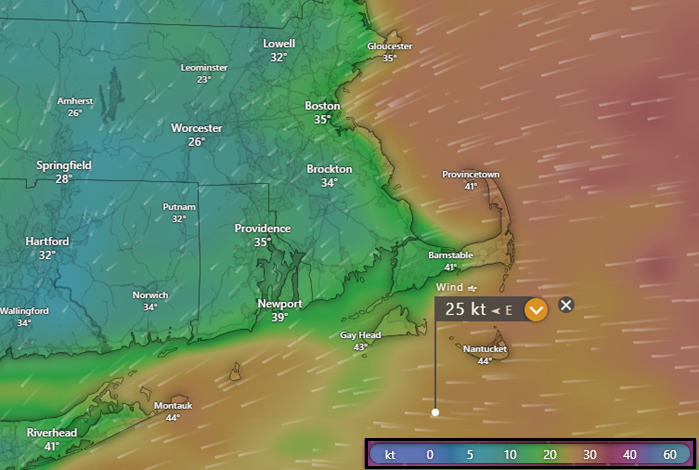
This is a picture of wind velocities around Massachusetts earlier today. What do you notice?
Image from Windy.com
If you answered “Gosh, Ned, it appears the wind blows faster over the ocean than it does over land,” then well done, and ten points for Gryffindor House! If I then asked you where you would want to put a wind turbine to cash in on some of that tasty wind, you might logically conclude “Why, in the ocean, of course.”
Except for the fact that everything is harder in the ocean. On account of all the water. Still, the ocean has a lot going for it. As mentioned, there’s boatloads of wind. Also, nobody lives there. Put it far enough offshore and nobody will even see that unsightly wind turbine (except for maybe rich senators on yachts — more on that later). Since a lot of people live near the shore, you’ll be making electricity satisfyingly close to where consumers will snarf it up. This is not always true for, say, a wind farm in western Iowa. And here’s a funny one: the United States has waited so freaking long to get into the offshore wind game that the technology is by now very mature. There are a lot of reasons for that delay, but for now we can be glad that the figurative winds are finally shifting.
Things don’t change until they do.
I like that quote, because it reminds cynics like me that events can always surprise you. It’s been obvious for a long time that the seafloor off Cape Cod is a good location for a wind farm. The first proposals date back to 2001. But they met with much opposition. Including from Senator Ted Kennedy, who, as luck would have it, happened to have a nice house on the Cape Cod shore. It was difficult to build something in Massachusetts that Ted Kennedy didn’t like. But since 2001, a number of things have changed. For one thing, the good senator is no longer with us. But beyond that, many regulatory issues and environmental concerns have been sorted out, and now the offshore wind industry in the United States is off to a good, if belated, start. It only took 23 years, but as of last Tuesday the Vineyard Wind project is delivering power to customers. Vineyard Wind 1 will eventually consist of 62 turbines, and it will supply power to some 400,000 homes.
I like to remind myself that there are a great many things like this. They’re moving forward slowly, and for a long time they’re hidden from view. Each one represents years of effort and planning and setbacks and determination. Wind farms, solar projects, grid-scale batteries, or maybe research in nuclear fusion.
Things don’t change until they do. But then they do. A few years ago I thought I’d never see a wind turbine off Massachusetts. But look!
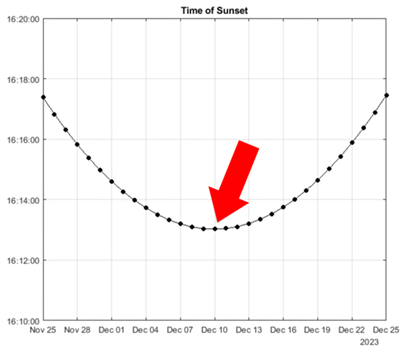
The shortest day of the year is December 21st, but the earliest sunset can be almost two weeks earlier, depending on your latitude. Where I am, today is the day of the earliest sunset: 4:13 PM.
Tomorrow, I’m happy to report, the sun will set a second later than it did today. That’s the kind of progress I can get excited about! That’s why I celebrate Crepusculus.
(That’s also why I made up this holiday in the first place.) The name Crepusculus comes from the Latin for “twilight.” As far as I can tell, the ancient Romans didn’t call this day Crepusculus. But I do.
What made you decide to read this post? Was it a carefully considered decision with a freely chosen outcome? Or was it something that just, you know, naturally resulted from a cascade of genetic, cultural, and environmental influences?
Friend, I am here to tell you it was the latter, even if you think it was the former. That is to say, I am going to pick a fight about free will. That is to say, I am about to fling a rhetorical hand grenade. Catch!
Robert Sapolsky has a new book out, Determined, that attempts to destroy the concept of free will. He’s been doing the podcast circuit to promote it. I enjoyed this interview on the Jim Rutt show. Sam Harris has been working this line for some time, having written a short book called, wait for it, Free Will. I’m pretty much sold on the merits of their arguments. But I don’t like chewing on the results. Because I don’t know about you, but my personal experience is that I DEFINITELY have free will.
Free will is an entertaining topic, because… how dare you tell me I don’t have free will, right? But Robert Sapolsky and Sam Harris will tell you that you don’t have free will. So suck on that.
Free will is an entertaining topic, because… you know you have it, but it’s strangely difficult to define. Knee-jerk certainty about something indefinable makes a combustible combination. It’s no wonder people get lost in the semantic woods.
Image by Midjourney
I find it useful to start by thinking about machines. Imagine you’re using an old mechanical calculating machine to multiply two six digit numbers. You dial up the two input values, turn the crank a few times, and then press the button to make it go. The gears grind and click-clack for a bit, then a bell rings and out spits a number. How did it come up with this number? Did it think about it and make an informed decision? No, it used a mechanically encoded algorithm that, every time it’s prompted with these same numbers, will turn out the same result. Well, almost every time. On hot days the drive rotor will sometimes slip, while in the winter the overflow lever may jam because of inadequate lubrication. Does that make the machine evil or guilty of miscalculation with malice aforethought? No. We would say the machine has certain basic behaviors (like multiplying six digit numbers) that are influenced by environmental conditions (temperature). We might try to take steps that would limit or avoid any errors, but we wouldn’t condemn the machine for lacking the willpower to be a more worthy specimen of its race.
Now, of course I don’t consider myself to be a machine like this imaginary calculator. That would be a gross and indecent simplification of the the universe as I understand it. But it’s quite easy for me to imagine that YOU are a machine like this imaginary calculator. I ask you something like this: “Tell me a number between one and a hundred.” I turn your crank a few times and press a button. After a short pause you produce a number. You may think you deliberated about it in the most free-willish of ways, but from my point of view, you clicked and clacked and then emitted a number. This number resulted from your genetic inheritance, your cultural background, your education, how much sleep you got last night, and what you had for breakfast. A lot of variables, to be sure, and many more besides. But the point is, you didn’t choose that number. That number chose you. It emerged from your cerebral thickets fully formed and ready to fight. If you want to make up a story about how you came to it freely, go ahead. That’s your business. Just don’t bore me with it, you autonomous freak.
We’re all familiar with excuses for poor judgment. I’m under a lot of stress or I had a lot to drink last night can be used to explain why we shouldn’t be blamed for a bad decision. You see, in this case, it wasn’t my free will. It wasn’t me, your honor, it was my brain. And my brain is sadly susceptible to hormones and intoxicants. We understand the brain is a biological entity. Dig out a few dollops with an ice cream scoop and you won’t be so free-willy anymore. The trick is to admit that, with or without the alcohol, it’s biology all the way down. And sadly, I have to admit that if you look like a complicated machine to me, then I probably look like one to you.
People often worry about what this all means for criminal justice. If criminals can’t help themselves, then won’t murderers run amok? Here instrumentality comes to the rescue. If a person who commits a crime, we should definitely do things that are likely to stop them from doing it again in the future. This may still involve jail. Or some other kind of rehabilitation. But it no longer needs to be something to punish them simply for being evil because they should have known better.
Ultimately, the weirdest question to me is this: if you don’t believe that free will exists, then how should you behave when you’re making decisions? And I think the answer is that you really don’t do anything different. The process of deliberation will always feel free. That’s just how those gears work. Don’t worry about it too much. Just stand back and keep your fingers clear of the machinery. Click clack.
Consider your hand: dozens of small precisely aligned bones and the muscles that animate them. More than a hundred ligaments and tendons, not to mention all the nerves and blood vessels that need to be woven together and threaded through the wrist and up the arm. And all of this bound up in one felicitous, functional, compact package. It’s an architectural masterpiece. Where is the blueprint?
Your first guess might be “in the DNA.” Because that’s about the only place we know about where biology stores explicit plans. But you will search in vain to find the blueprint for a hand in your DNA. But if it’s not in our genes, then where is it? Here is the astonishing answer: We have no idea. Ain’t that a hoot? Seems like kind of a big lapse, eh?
You can, of course, zoom into any part of the body and ask the same questions. Everywhere you look, there is incredibly specific and robustly reproduced three-dimensional detail, and yet there is nowhere we can point and say “this is where the plan is kept.” That’s not to say that there is no such place. There must be. But we are, for now, largely ignorant of whole systems of cellular organization and direction.
In the name of exposition, I overstated our ignorance a little. We’re starting to have some inkling of how growth is modulated, thanks to the work of people like Dr. Michael Levin of Tufts University. Levin has been an energetic spokesperson for the idea of bioelectricity as a basis for what might be called cellular cognition. What is bioelectricity? It sounds kind of woo-woo at first, but the notion is straightforward. We all understand that our brain function is based on a network of neurons connected by synapses. It turns out that all cells, not just neurons, have the ability to communicate with each other via electric potentials and gradients. And they’ve been at it for a long time. In a sense, your entire body is a big brain with the ability to manage growth.
It’s not controversial that your brain can use electricity to maintain and reason about a vast set of complex topics. It’s not controversial because you’re doing it right now by reading this sentence. And well done, you! By analogy, it’s not unreasonable that networks of electrically-connected cells can reason on the problem of three-dimensional assembly. And Levin’s lab is starting to turn up evidence that this is the case. For instance, experiments with flatworms (we’re a long way from doing these things with humans) have shown that the same DNA can lead to very different body plans. There is some kind of as-yet poorly understood software layer that mediates physiological assembly. We will eventually understand it, and when we do, Levin predicts that we’ll be in a position to build what he calls an “anatomical compiler.” Dial in how many legs and eyes you want, press the GROW button, and stand back.
The big lesson here is that cognition is old, older than brains. It exists in some form wherever there is life, and it exists at many levels in many systems even in the same organism. It’s fun to watch this research unfold in real time. We’re witnessing the birth of an entire field. If you’re interested in learning more about this work, here are some links.
A lot of discussion about the problems of our world is framed like this: “If an alien visited our planet and saw how much we were polluting it, they would be horrified by how short-sighted and self-destructive we are.” Or something like that. Pick your favorite bad thing that humans do, then have an alien visit and comment on our stupidity.
I understand why people use this framing. If you want to make some critical commentary, it helps to imagine an outsider’s perspective. But I think we need to give those aliens a little more credit. They’re not naive. They’ve seen it all before. To reach a point where they could zoom across the galaxy and pontificate about earthlings, they had to pass through a larval stage similar to the one we’re in now. They may be disgusted by our smell, but I doubt they’ll be shocked.
Image by Midjourney
I suppose there’s a chance they’ll treat us like worms, to be harvested or simply removed, but my expectation is that they’ll treat us with fascination and at least a little sympathy. I like to imagine an alien saying something like this: “Jeez, I remember middle school. Man that sucked. Don’t be too hard on yourself. It gets better.” Or maybe: “Ha! Your languages are just as irregular and hard to pronounce as Vugxshimnhiac! And your government – that bozo reminds me of Herpderp the Vain back home.”
They won’t be disinterested, rational superbeings. They’ll be a collection of the hardworking and the lazy, the conformists and the oddballs. You know, kind of like us. “Why does that weirdo Ixnagulon keep doing butt probe research on these poor natives? He’ll lose his funding if he keeps that up.”
My premise is that people are people, and er… so are aliens. Any sufficiently advanced alien is indistinguishable from your uncle. As a result, they’ll have a good chuckle when they see a lot of our stupid behavior. Of course, they might also say “By the way, give us your lunch money.” But at least they won’t be surprised at our stupidity.
I recently attended my 40th high school reunion. As part of it, a few of us agreed to participate in a mentoring session for the current students. We were asked to give our “Obi-Wan Kenobi nuggets of wisdom” to a crowd of high school seniors in the library. This struck me as inauspicious. These high school seniors did not want to be in that library with us, and I promise you that none of them would mistake any of us for Obi-Wan Kenobi. So the event was actually a kind of panel where a few old people without credibility dumped life-advice platitudes on a crowd of sullen, motionless students. You’d be surprised how well we thought we did after the session was over. It’s a good thing we didn’t ask the students.
Image by Midjourney
I wondered: When does advice make a difference? And why is there such asymmetry between what we want to hear and what we want to say? Nobody wants to hear “When life gives you lemons, make lemonade.” But when called upon to dispense wisdom onstage, we say it all the same.
I won’t excuse myself. I was slinging clichés up there with everybody else. The best opening line came from the guy next to me, a successful dentist and business man: “I hated school. I absolutely hated it.” It was one of the few raw, unpackaged moments. I thought “Oh man, that’s hit the target.” But still there was no flicker of reaction. Tough crowd.
It occurred to me that these platitudes weren’t actually bad advice. You really should turn lemons into lemonade, after all. Platitudes are true enough, if you can hear them and act on them. But so much advice is already downstream of any chance at making a difference. Here’s an example of what I mean: “Set your goals and then work really hard to achieve those goals!” Good advice, yeah? But what if I don’t know my goals are? How do I follow my freakin’ bliss if I don’t know what my bliss is? This is the big question. Before it’s answered, career advice is worthless. After, it is superfluous. If you don’t care, there’s not much I can do to start you, and if you do care, there’s not much I can do to stop you. But where does the care come from?
We love to give advice about how: here’s how to achieve your goal! We don’t give so much advice about what: what is your goal? And it’s probably just as well, because nobody can give you advice about what. I’ve always liked this quote from Schopenhauer: A man can do what he wants, but he cannot will what he wants. You choose actions based on desires, but desires choose you. Your desires are not subject to negotiation, and so they define you more completely than your talents. I keep coming back to this prayer of gratitude: Lord I am grateful for my talents, but more so am I grateful for my interests. Talent can follow interest, but it can never lead. Hard work can make up for missing talent, but neither talent nor effort can make up for missing interest.
Is there anything we can say to high school seniors who don’t know what they want? If I could travel back to that mentoring session, I might say something like this.
Try a lot of stuff to see what sticks
Get quiet to hear the quiet voice inside you that might already know
To do the first, you need to be willing to work hard at something that you might not like. That might be hard, but as long as you think of it as a trial period, as long as you have a plan for rotating into trying something else, it might be tolerable. To listen to the quiet voice, you sometimes have to be willing to take a flying leap into something strange. But if you have that small interest, pay attention! Large desires grow from small ones.
It’s still advice from an old guy who likely seems irrelevant. But I believe what-talk is a better starting point than how-talk. I’d love to find out if that’s true.
My big house clean-out is mostly done. One major task remains. Closets. I still have several closets filled with my wife’s clothes. Dresses, sweaters, skirts, shoes. What do I make of all these clothes?
Image by Midjourney
When the clothes go, it feels like goodbye. Everything else felt easy, in comparison. My sorting algorithm went like this: Photos and letters, keep them. Work notes and textbooks, out they go. Sentimental, keep. Mundane, toss. But clothes are in a special category. When I see this red dress with the small spiral patch, I see my wife before me, wearing it. She is elegant. We are getting ready for a night out. The sitter has arrived, and my wife is leaning in close to the bathroom mirror as she puts on mascara. Always a multi-tasker, she calls out to me: Look up parking near the theater! And check the traffic on Google Maps.
When the red dress leaves, that image, that much of my working memory, starts to unravel. It is a slow, subdued ripping sound in the center of my head.
At the same time, I don’t want to hold on to these things forever. The nice thing about these clothes is that they can still do somebody else good. They can live again. I want them to be out there in the world making someone else sparkle just as my wife did when she wore that long blue dress. Someone else should have a night like the one this outfit calls to mind. It makes me happy to picture these things re-animated, no longer dangling unseen in a dark closet. It’s time to donate them and hope they make somebody somewhere a little happier.
But it’s taken me a while to get around to it. One of the things that makes me hesitate is that, should my wife walk back in the door tomorrow, this is the one thing that would really annoy her.
“Welcome back,” I would say, “I missed you!” “I missed you too!” she would reply. And then… “Wait! what did you do with my clothes? Now what am I supposed to wear?” “I’m sorry, sweetie.”
I think you can see the importance of this consideration. Nevertheless, when pressed, this is what my poor brain offers up as resistance. Some milestones are easy, some are hard. This one caught me in the shin.
I can’t escape the feeling that these clothes, which in a literal sense embodied my wife, still contain something, still house a motive force. They were closer to her person than anything else in the house. When she danced, they danced. They expressed her taste and knew her form, even as it changed. They knew when she was getting thin. So thin. They understood. And they stood by her. With her. On her.
Clothes cling to us, but it does no good to cling to clothes. It’s time. Still, the emptiness is painful to contemplate. I’m afraid she won’t come back now. She won’t. Goodbye, red dress. Goodbye, my love. Goodbye.









 Rambles Blog at Star Chamber