Pictures of the Sun

It’s fun to look at pictures of planets taken by our robotic eyeball extenders. We get to see things that are too darn far away to see with even the biggest earthbound telescope.

But there’s another kind of treat when we look at our own sun with new eyes from here on earth. We’re used to seeing marvelous detail in the moon’s changeless cratered face, but the sun is just a blinding fireball to our eyes.

When I look at a planet, I think “That’s a place.” I can imagine flying over it, or even stepping out of my little tin spaceship onto its surface. But the sun is always just the sun. Not really a place, just a white hole in the sky. My imaginary spaceship never goes there.

New telescopes (and a few space probes) are changing that. The featureless sun is really a charismatic world of curdling fire, boiling magnetic storms, and vast billowing exhalations of solar steam.

These pictures (from the Boston Globe’s Big Picture series) prove that the sun is a place jammed with personality: The Sun – The Big Picture. And if you want to know why they call it “solar wind”, be sure and look at the animation where a strong gust from the sun whips the tail off a comet

Another successful walk

It was a cold and blustery day at Suffolk Downs, but the sky was blue and the walk was a success. We’ve been doing these fundraising walks with Jay since he was first diagnosed in 2001, and they just keep getting bigger. Years ago a nearby park in Cambridge was big enough to host the walk. Now we walk around a horse racetrack with an enormous parking lot out front. It’s a great venue. Those horses have a nice track. Here’s a brief local news clip of what the event looked like: “Greater Boston Walk for Autism” raises over $1 million.

Today there were over 20,000 people walking. This single fact brings obvious good news and bad news. Good news: we’re raising lots of money for autism research. Bad news: autism is a growth market. I’d love to tell you to sell your autism stock, but in truth you should be buying. It’s amazing how many families it affects.

When I ask for people to give money to this cause, I’m painfully aware of how many good causes are out there. You have your favorite charities and I have mine. And if some other evil had touched my life, I would be asking you to help me fight it instead of this one. But this is the one that touched my life. It moves me; I want to move you.

When you live in a house touched by a disability like autism, it’s very easy to turn inward. Most people seem to have it easier than you. There are two mistakes here. The first is thinking that some people get off easy. Every family has troubles, but they are often hidden from view. This leads to the second mistake, which is turning inward, thereby feeling sad and lonely at once. You can’t always stop the sad, but you can stop the lonely. That’s one of the things that’s great about the walk. You achieve a practical goal, raising money, but you also get to look around and say, “My God, look at all these people who have to deal with this.” It gives you sympathy for others, and then, as a kind of bonus, some healing sympathy for yourself.

This is my story. Tell me yours. We have to keep telling each other the stories that matter to us. It’s the only way to get by.

This is a picture of my wife Wendy near the table where she was making inspiration ribbons for the walk. Each one is inscribed with the name of someone with autism.

As a result of her efforts and the rest of our team, including many of you, Jay’s team raised over $7500 and counting this year (it’s not too late to give!).

Thanks.

Alan’s Color/Language Project

Alan Kennedy has written here many times before, most recently about the many color-related idioms that people use around the world. Alan has wonderful vantage point for making his observations: he teaches English to adults who have come to Manhattan from all over the world. He has taken a particular and abiding interest in colorful language, and when I offered to support his research on this site, he was happy to take me up on it.

So I am delighted to present a new and permanent installation on this site, Alan Kennedy’s Color/Language Project. There are three parts to it.

First of all, you can read his short article, Linguistic Facts About Color. I found the Berlin/Kay color spectrum especially interesting: languages always add colors in the same order. Any language with words for only three colors will always have names for white, black, and red. Any language with six color words will add green, yellow, and blue. I was surprised to see that leafy green has primacy over the blue of sky and sea. Even yellow outranks blue.

The next resource for the Color Project is an ever-growing spreadsheet, Color Idioms In Different Languages (if you prefer, you can see that same information as a single Google Spreadsheet page). Look at the color distributions by language. The list is far from comprehensive, but it hints at some intriguing possibilities. Is German bluer than most languages? Is Korean redder? And why?

Finally, and perhaps most important of all, you can add your own favorite expression to this resource using this Color Idiom contribution form. The suggested idioms won’t appear instantly on the list; Alan will review them from time to time and they’ll get added to the published spreadsheet.

So there you have it: a new resource, courtesy of Alan (with a little help from his friends here at Star Chamber Headquarters). Help it grow.

Autism Speaks walk

Jay GulleyThis is a picture of Jay. Jay is my son. Jay is autistic. We wish that he weren’t, because his autism makes life difficult for him and for those who care for him. But there you go. It is a fact.
Given that we can’t do what we desire more than anything else, which is to wave a wand and make his autism vanish, what can we do? We can feel sorry for ourselves. I’ve tried that one a lot. It hasn’t helped (not yet, anyway!). We can hope the world will spontaneously get better, but as they say in the Army, hope isn’t a plan. There’s nothing wrong with hope, but hope plus a plan beats hope any day.

Here’s the plan. I’ve thought about this, and it’s about the only thing that makes sense. We can raise money to be used by skilled researchers to help understand the origins and nature of this baffling condition. Every new scrap of insight they gain is helpful, not least for its value in helping us cope, those of us standing in the long shadow of autism. And with a plan in place, it becomes a little more reasonable to hope that we may be able to make real gains against current cases and prevent future cases of autism.

Here’s how you fit into the plan.

Coming up this Sunday, October 19th, my family will be participating in the Autism Speaks fundraising walk called Walk Now for Autism.

This is the link to my wife Wendy’s fundraising page: Wendy Gulley’s page.

Give!

As usual, I include Wendy’s email message below, for those of you who want to learn more details about what Jay’s been up to in the last year.

Continue reading “Autism Speaks walk”

The Sweet Tea Map

What divides the North from the South? Surely nothing so simple and stark as the Mason-Dixon line between Maryland and Pennsylvania. It should be something that reflects behavior and cultural norms. We might consider what the locals call a small stream. Is it a branch (southern) or a run (northern)? Appropriately, the battle referred to by the Union army as First Bull Run went by the name First Manassas Junction in the Confederacy.

Less obscurely, numerous maps have been made about the Soda/Coke boundary, south of which all carbonated beverages are termed “Coke” (we will pass over the abomination “Pop” with no further mention). As a native North Carolinian, I never called my (non-Coke) soft drink a Coke, so the Soda/Coke line never rang true with me. But I can vouch for the veracity of another beverage-centric line of demarcation: the sweet tea line. In the South, you can always count on being served sweet tea if you ask for “tea”.

The Romans stopped their northward civilizing advance into Europe wherever they could no longer cultivate grapes. It was bad enough being without olive trees, but a life without wine wasn’t worth contemplating. Perhaps Lee’s legions, stopping at a roadside inn near Gettysburg, felt the same way. “No sweet tea, boys. Let’s head on home.”

Imaginary Law Firms, Part 1: Brannock, Foley, and Freeth

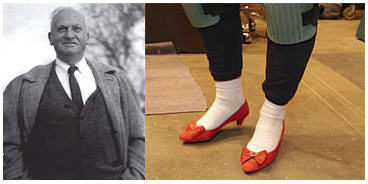
This is Charles Brannock, shown next to his device (not to scale).

brannock.jpg

This is Jack Foley. On the right is a gentleman skilled in his art.

foley.jpg

T.J. Freeth (1819-1904), our firm’s founder, was unavailable when the photographer came around, but this is his nephroid. To the right you see an ordinary nephroid lurking in a coffee cup.

freeth.jpg

You know the ordinary nephroid as the reflected catacaustic of a circle, the involute of Caley’s sextic, and a generally good-natured two-cusped epicycloid. But Freeth’s nephroid is something altogether different: a strophoid of a circle with a double curlicue in the kidney crotch. (Common decency and good taste prevents us from displaying Freeth’s supertrisectrix strophoid.)

For their vision and lasting impact on our society, we salute Messrs. Brannock, Foley, and Freeth.

Behind the CLICK: the anatomy of a camera shutter

Most of us have put away, given away, or thrown away our old film-based cameras. No more 35 mm film canisters… now we have sleek solid state digital cameras. Except that the shutter, as ever, is still a tiny clockwork marvel of gears and levers.

You press the button on top of your camera and it goes CLICK. But what happens during that click is surprisingly complex. It’s especially complex for the shutter on a Single Lens Reflex (SLR) digital camera. For instance, consider this puzzle. How does a shutter mechanism that can only operate at 1/300 of a second nevertheless provide an effective shutter speed of 1/3000 of a second?

Derek Miller of penmachine.com put together a great piece explaining how this is possible along with many other fascinating details. Here’s the post: Camera Works: shutters, flashes, and sync speed. Don’t miss one of the resources that he points to, Jeffrey Friedl’s presentation of some high speed photos taken of a lens-less SLR in action. You won’t believe all the craziness that happens in 87.8 milliseconds every time you take a picture.

SpaceX launches private rocket

On Sunday, a private company called SpaceX launched a rocket into orbit. You remember all the commotion a few years ago about Burt Rutan’s SpaceShipOne. That was a private rocket too, so what’s the big deal now? Well… Burt Rutan’s space ship is definitely worthy of praise, but it only takes millionaires on suborbital joy rides. It’s a tourism game for the Drag-My-Rich-Ass-Up-Mount-Everest set. And you don’t even get that much space time for your $200,000. You can stick your tongue out and lick space at the top of your bounce, but that’s about it.

SpaceX, on the other hand, was designed not to win a competition but to put satellites into space for paying customers. Put another way, NASA is never going to compete with Richard Branson to put tourists into space, but SpaceX is now competing with NASA and every other launch vendor on the planet. And their launch manifest is full.

The launch on Sunday was actually the fourth flight, but it was the first that worked perfectly from end to end, proving once again that space flight is hard. Here’s a great video of the launch. I love the fact that there’s no sound. No countdown, no voice of Mission Control. Just fizz, ka-boom, and off she goes!

The launch site is on the Kwajalein Atoll in the Marshall Islands. Here’s a fun exercise: can you find the launchpad with Google Earth by looking at the shape of the island as you fly away?

Visual music

Stephen Malinowski is a polymath composer/musician/programmer who created something called the Music Animation Machine. What it does is animate music scores in a way that makes their rhythmic and tonal structures really jump out at you.

For example, here is a Chopin Etude (opus 10, #7)

Having warmed up with that, you’ll have fun watching Bach’s Brandenburg Concerto Nr. 4, third movement, presto. Fugues are fun to watch, since the visual patterns help you follow the repeating elements in the music. Here is a piece by Vincent Lo that builds a Bach-style fugue from Nokia’s default ringtone: the Nokia Ringtone Fugue. When they perform that one, do you think they encourage people to turn on their cellphones?

Malinowski has a YouTube channel with several other videos. Of course, since he spent years making this thing, he’d really like to sell you a video about it. It looks like a good deal to me, but the store page is really notable for the shockingly different musical constructions you see from different composers. Go look at it now. It’s mesmerizing. Compare Bach’s braided filigrees with Chopin’s slabs and slashes.

Thanks to YouTube, we all have synesthesia.

Mapping football teams with Parallax

One day as I was flying high above the Earth, as I like to do, I happened across this corner of London (Fulham, actually) wherein I spied a lovely football pitch situated thus:

“Great cows!” thought I, “all those soccer fans and not one scrap of parking! In my homeland this would not be.”

Compare this with the parking on offer at, say, Gillette Stadium in Massachusetts, home of the Brady-less Patriots. It’s a stark contrast, and a good reminder that there’s no need to take public transportation as long as there’s PLENTY OF PARKING FOLKS!

This got me wondering how many fans attend that stadium in London (answer: 26,000 at full capacity). Which in turn made me wonder what team played there (answer: Fulham F.C.). Fulham plays in the Premier League, which put me on to something I’ve wondered about before. I know the names of a number of English football teams, but I have no idea where they are. Okay, Manchester United is in Manchester, but what about Arsenal? For some reason, when I last looked into this, I couldn’t find a simple map that showed what I wanted to know. I’ve since found several, but no matter, because this gave me a great opportunity to try out Parallax.

I learned about Parallax from Ben Hyde. As Ben observes, you should really watch the video to understand what Parallax does, but I would describe it like this: a search engine that carries along piles of intermediate results as you move toward your ultimate aggregated final answer. To pick a simple question: how many presidents went to West Point? It’s not a hard question to answer, but you’d have to visit a lot of Wikipedia pages to get the definitive result. Parallax lets you lasso all the presidents and then pick other questions to ask about the entire set. So we quickly discover that U.S. Grant and Dwight Eisenhower went to West Point. Jimmy Carter is the only presidential graduate of the Naval Academy (John McCain went there too, for what it’s worth).

Back to English football: starting with Arsenal, I continued to the entire Premier League. From there I clicked on Arena/Stadium, and then Show results on map and voilà:

Wow! Now that’s what I’m talking about.