Deep inside your brain, seated on a rocking chair in a special insulated room, there is a tiny Time Minder. Your Time Minder keeps track of your body’s clock, telling it when to wake up, when to get hungry, and so on. When you travel across time zones, you need to let your Time Minder know that the sun will now be setting, say, six hours earlier then it did yesterday. But there’s this maddening problem: you can’t make a direct call to your Time Minder. Think how easy it would be if you could just ring him up and say “Clocks forward six hours, Alfred, if you please.” “Very good, sir.” But no. Because we evolved several years before the advent of jet travel, we have to do everything the old-fashioned way. As advanced as we are, talking to the Time Minder remains slow and painful.
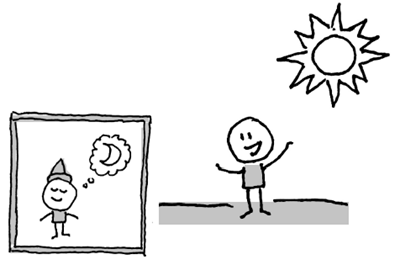
Everyone has their own favorite technique for getting the message through. You want to go to bed at the right time for the new time zone, but maybe you should take a short nap first. Or maybe a nap is a terrible idea, but make sure and eat a big time-zone appropriate meal as soon as possible. Maybe your trick works better when chasing the sun (flying west) as opposed to running towards it. My own favorite trick is (if possible) to observe the setting sun. Because the Time Minder has a special slot for peeking at the sun at sunrise and sunset. It’s not perfect, but I find it helps a lot.
Another strategy is to look at your watch frequently and will yourself into believing the numbers that appear. Some people only set their watch to the new time zone when they reach their destination. This strikes me as madness, because you’re letting yourself believe you’re in the old time zone for the entire length of the flight. I always set my watch to the new time zone as soon as I’m on the plane. But either way, this is like driving off a time-keeping cliff. It’s hard on the Time Minder. Wouldn’t it be better if there was a way to have the time smoothly shift from the old time zone to the new one as you flew? Then there would be no dramatic discontinuities. You’d look at your watch every now and again, and it would be continuously updating so that when you reached your destination it would be just as accurate and time-zone appropriate as when you left.
I’ve long wanted to make an app that does this time-zone blending, but I’m a terrible JavaScript programmer. But now we have AI, so I thought this is a perfect opportunity to build my app with one of my AI friends. I used Claude (which I currently prefer to ChatGPT).
Here’s my first prompt to Claude. You can see that I drew a picture of the app I wanted and I described how I wanted it to work.
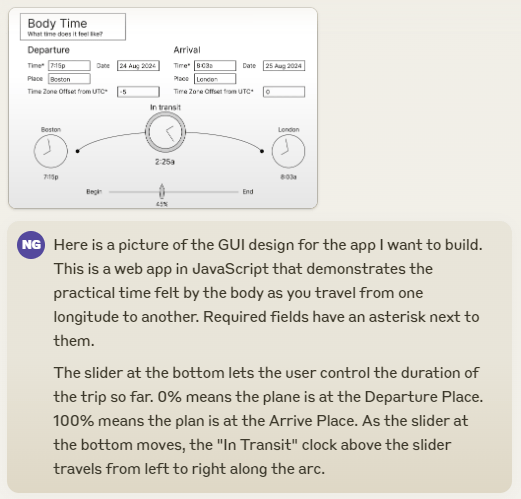
Amazingly, it worked! It took a lot of back and forth to get to the point where I was happy with the app, but I can honestly say I built this app without touching a single line of JavaScript, HTML, or CSS. Here is the result. I call it Body Time, because I think of it as representing the time felt by the body as you travel. In the sample flight, you can see that the clock time experienced on the plane flying from Amsterdam to New York is much slower than real time. This is because, by chasing the sun, we’re lengthening the day.

Follow the link and give it a try: Body Time.
Here it is on GitHub, if you want to see the code that Claude wrote: gulley/Bodytime
If you consult this Body Time clock regularly, your Time Minder will get the message a little bit faster, and you’ll feel a little bit better.
That’s the theory anyway!


 Rambles Blog at Star Chamber