Carolyn Lewis Gulley
Born 4:50 PM, May 8th, 2003.
Author: gulley
A better way to search
You really owe it to yourself to try this out: Dave’s Quick Search Taskbar Toolbar Deskbar
I originally saw this on the Joel on Software site where Joel was touting it as an incredibly cool and useful too. I downloaded it, and sure enough, it’s been the best addition to my computer in the last year. At first it just seems like a quick way to launch a Google search. “But I already have the Google Toolbar” you may say, and a fine tool that is. But the Deskbar goes way beyond that. It has a zillion built-in customized searches, so you can just as quickly and easily search for a book at Amazon or the weather for your zip code or a stock price. There’s also a cool tool-building tool called the Search Wizard that helps you create your own customized searches.
One of the best features is the fact that you can get to it without taking your hands off the keyboard, so you can do quick searches in the middle of other tasks in minimal time. Let’s say you’re on the phone, and somebody mentions the Viola da Gamba. Without missing a beat, you type Windows Key + S followed by “Viola da Gamba!” The exclamation point does a speedy “I’m feeling lucky” search, and voila (I mean viola) you’re looking at the Viola da Gamba Society of America website. There you quickly learn that Viola da Gamba means leg-viol, or violin played between the legs, and not “Shrimp Violin” (Viola da Gambero) as you suspected. Embarrassing faux pas averted… Dave’s Deskbar saves the day.
A model of tRNA
In my last entry, I mentioned that you can print out DNA for viruses and genetic programs. You can, for example, order genes printed to your specifications at Blue Heron Biotechnology. But you can also print out large 3-D models of molecules, avoiding the hassle of those crappy kits from organic chemistry class. Through the magic of rapid prototyping 3-d printing capability, you can make models of an ever-increasing array of interesting molecules.
 This is a picture of my favorite molecule: transfer RNA. I like it so much, I had the people at 3-D Molecular Designs custom-build me a model. You can get your own for $30 these days. I paid a lot more than that because (A) I got mine last year and (B) because I asked for a particular molecule: 1yfg yeast initiator tRNA. You can read what David Goodsell said about tRNA in his Molecule of the Month column. But if you’re interested in understanding the meaning of life and how it relates to tRNA, read my new essay on the topic: The pen of Thoth and the meaning of life.
Synthetic biology
Take a peek at the world of tomorrow. Science News has published an article on synthetic biology: Digital Cells. Synthetic biology does not refer to “inventing life” from scratch. It also doesn’t mean simply simulating life on a computer. It is concerned with starting with a simple model organism and understanding it well enough to bend it to your purposes. As Thomas Knight of MIT says, referring to building genetic circuits on demand, “We want to move away from the situation where you build the system and pray that it will work, toward the situation where you build the system and, unless you’ve done something stupid, it will work.” We will be programming living organisms the way we program computers right now. “Eventually, the goal is to produce genetic applets,” says Timothy Gardner of Boston University, “little programs you could download into a cell simply by sticking DNA into it, the way you download Java applets from the Internet.”
Downloading life from the web isn’t as far-fetched as it sounds. Last summer two scientists succeeded in synthesizing the polio virus from basic chemicals and a file they downloaded from the Internet. As one of them said, “We don’t need any nature-formed template anymore. We just need the Internet to tell us the sequence of a virus. You can make pretty much any virus this way.” Some people have bemoaned the fact that we didn’t destroy the smallpox virus when we had the chance. But now that its sequence is available for download, it doesn’t matter whether we destroy that last physical version. We can always print more.
The meaning of life
Your mother didn’t make you. Who did?
Your mother gave you a warm room and plenty of food. Who made you?
It’s a tricky question. To speak of making implies two things: the thing being made and the one who makes it. Birds make nests. Bees make hives. Carpenters make houses. But mothers don’t make babies. Mothers shelter the construction of babies. You had to make yourself.

From a single cell, you self-assembled, growing exactly as a sprout grows in a greenhouse. One cell became two, two became four, each cell dividing in its turn. The cells grew in precise patterns, ultimately forming bones, sinew, blood, you. Of course, to say you made yourself is not by itself a satisfying answer; you have no idea how you managed it, being very young at the time. So how did the lonely cell you once were become the ten trillion cell colony you are now? The puzzle of biological self-assembly can be reduced to that equally puzzling first step: how does one cell become two? How does a tiny particle suspended in saltwater thrive and beget?
We can think of what happens in our bodies in terms of organs working together: hearts pump, kidneys filter, livers do this and that. It’s easy to picture these organs as sentient entities, businessmen on the phone, talking and coordinating their diverse efforts. But when you get down to the level of the molecules that make up one cell, it becomes harder to keep up this anthropomorphic pretense. Who’s talking and who’s listening? Does a molecule have plans? And if it doesn’t, if there is no planning sentient entity directing the show, then what is?
There are two great mysteries to life: how it began and how it keeps going. The first of these is likely to puzzle us for some time to come, since it happened in the remote past and left few traces. Like an alchemical recipe for gold that requires gold as an ingredient, life as we know it requires life as a starting point. Every living cell we can observe came from some pre-existing cell. But the other great mystery, how life keeps going, how one cell becomes two, is open to our inspection. The broad outlines are already known. To return to the original question: who made you? A bubbling stew of macromolecules built you from the inside out. It’s still unsatisfying as answers go, but we’re learning more with every passing day. A full accounting of the machinery of life is nearer than you might suspect.
The central riddle of cellular construction is the fact that there is no external carpenter to do the work. It must proceed spontaneously, one energetically favorable reaction at a time, according to the laws of chemistry, given whatever supplies happen to be at hand. This is something like saying there are blueprints that can spontaneously turn into houses. How can this be? Molecules bouncing into each other at random sounds like a recipe for chaos. Amid the chaos, there must be hidden order. Some entity is playing the role of carpenter, inspecting the plan and joining the beams. And yet this tiny carpenter must be, after all, simply a molecule (or collection of molecules), not an impish homunculus with a mind of its own. Thus we are picturing something that acts as the bridge between the plans for what is to be built and the building itself, a link between word and flesh. This something is called protein synthesis.
Biochemistry is famously complex, and every statement you can make about it is in some sense a simplification. But the incontestable central engine of life is the general purpose construction process called protein synthesis, wherein the plans packed away in the great libraries of our genes (DNA) are turned into the working molecules (proteins) of the cell. DNA is transformed through a variety of steps into an intermediate message, an order slip for a particular protein, and this order slip (called messenger RNA, or more briefly, mRNA) acts as a template or blueprint for a protein which is then transcribed. Proteins are the worker molecules. Most of a cell’s motion and structure is moderated and directed by proteins. More briefly: protein synthesis made you. But how does it work?
Protein synthesis can be thought of as a translation from the language of DNA to the language of proteins. The messenger RNA order slip that gets sent from the DNA is a message written with an alphabet of four chemical letters called nucleotides. This message is then translated into a protein sequence built entirely from an alphabet of twenty chemical letters called amino acids. So the sequence in mRNA
Adenine-Uracil-Guanine-Adenine-Guanine-Adenine-Guanine-Cytosine-Uracil
becomes the protein sequence
Methionine-Arginine-Alanine
after the protein synthesis apparatus has done its work. This sequence might be, for example, one small part of the protein keratin in your fingernails. A shorthand way of writing this using standard abbreviations looks like this.
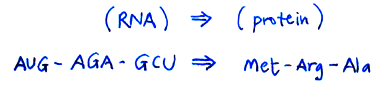
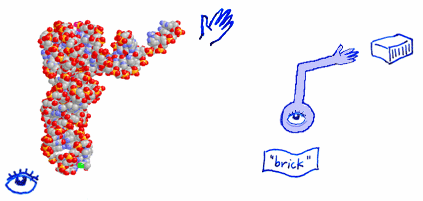
But there is a big difference between these two languages. The one on the left is arbitrary, whereas the one on the right is structural. One is word and the other is flesh. This is not a translation in the sense of going from English to Japanese. It’s a translation from a blueprint to a building. The language of proteins is structural in the sense that the words are themselves the bricks, beams, wheels, and motors of the cell. It’s as if the word for brick on the RNA side is matched up with the brick itself on the protein side.

The RNA side is arbitrary because there’s nothing special about the literal word “brick.” What’s special is that it designates the right thing. The word “dog” is no more magically appropriate than its French equivalent “chien,” and as long as they both refer to the same real-world canine, everything is fine. On the other hand if you change the spelling of the protein, the result might no longer function. Instead of a brick, you might be left with a sponge.
But the really interesting thing is the arrow that connects the word “brick” with the actual brick. What exactly is this arrow representing? Semantically, the arrow says that “brick” means brick. Semantics is typically a vague business at best, but this boils down to crystal clear chemistry. This arrow is representing some entity, our little carpenter friend, that can see the word for brick and then grab an actual brick and put it in the right place. The arrow has an eye on one side and a hand on the other.

What should we call the arrow? The arrow is the thing that maps the message in the word to the real world consequence. The arrow is the translator. The arrow is translation.
Normally when we think of an eye moderating the behavior of a hand, there is a brain in between. But we’ve already seen that at the cellular level there are only molecules. There must be a molecule that, through a straightforward energetically favorable process, accurately translates arbitrary messages into specific and useful consequences. That is, a carpenter molecule must exist. It is the physical bridge from thought to deed, which is to say, this carpenter molecule is the chemical incarnation of “meaning.” And not just any meaning. This molecule is the meaning of life. This molecule (actually a family of them) does exist: it’s called transfer ribonucleic acid (tRNA for short). It has a tiny eye on one side that can read the mRNA order slip and a tiny hand on the other that grabs and positions an amino acid. With its eye it reads the plan. With its hand it builds the world. This little carpenter (or rather an uncountable swarm of them) made you and every living thing on Earth. Here it is.
During the Middle Ages and early Renaissance there was much interest in what was called the original language, sometimes called the Adamic language, since presumably it was the language from the time of Adam and Eve until the great confusion of Babel. This original language was considered a historical fact and it was, so the reasoning went, capable of expressing only truth. Whoever learned it would have great power, because the word for something would be identical with that thing’s true nature. To manipulate the name would be to manipulate that which was named. At the same time, perfect harmony would exist between all who conversed in this language. The defining feature of this Adamic language is the perfect relationship between the named object and the object itself. Though no human language has been found with these magical properties, there is a strong mythological imperative to believe in such a thing: at some deep level we know there must somewhere be a special relationship between symbol and reality. Otherwise, how do symbol systems get started? Otherwise, how could we exist?
No one ever taught you the meaning of this particular sentence, yet your brain decodes it without trouble. Somewhere in your brain there must be a link between the symbols that make up this message and the physical consequences that result. “Meaning” is precisely this map from message to consequence. We are familiar with computers interpreting programs, and with people interpreting language, but both of these exist only because life does. Without the language that life is built on, without the synthesis of proteins and the spinning of words into flesh, we would not be here. Messages encoded in our genes constitute the first language. It is not unreasonable to say that “meaning” had no meaning until something existed to interpret it, until a system to process language existed. Before that the universe was just one damn thing after another, sound and fury signifying nothing. Life was the bringer of meaning, and so our creation mythologies are bound up with meaning and creation. As the Gospel of John says: “And the Word was made flesh, and dwelt among us.”
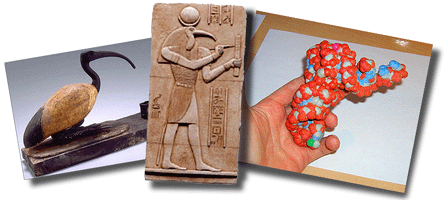
Egyptian mythology gives us a more explicit example. Thoth was the ibis-headed scribe god who invented writing and later gave it to man. Thoth was identified with the ibis because the bird’s curved bill is suggestive of the reed pens that the scribes used. According to a later Egyptian myth, Thoth was also the Creator god. It is instructive that the word-giver should also be the life-giver:
From chaos, Thoth self-created and, existing in chaos, spoke, and his words became covered. Thus began creation. Each word became the thing it signified.
This is the mystical styling of an “Adamic language,” but it is also a reasonable description of the origins of protein synthesis, which is to say it is a reasonable description of the origin of life. This first language self-created and, existing in chaos, spoke. Thus began creation. Each chemical word became the thing it signified, beginning then and continuing to this present moment. Transfer RNA is the pen of Thoth. It is the arrow of meaning, bringing forth the living from the nonliving, busily and daily making the living world around us and within us.
I ride the Segway

Last week a group of Segway engineers came to visit the company where I work. They brought along three scooters and were generous in giving the entire crowd a chance to try them out. Here’s a picture of me riding. I like this picture because all three demo scooters are in view, making it look like a typical downtown scene from the World of Tomorrow where everybody has a Segway. It was indeed easy to control moving forward and backward, but turning was a little odd. There’s something very comical about watching somebody scoot around, which has got to be tough for their marketing department. You spend $5000 and you end up looking like a moderately cool techno-savvy fast-moving dweeb. I was also surprised by the how wobbly I felt once I hopped down off the Segway. Several other people also mentioned this effect. I imagine you’d get used to that if you owned one, but it’s similar to the feeling you get after you’ve been rollerblading for a while. You still feel about four inches above the ground somehow. Still, it was a lot of fun.
If you want to buy a Segway, Amazon is the place to go. They’ve got a surprisingly detailed page that talks all about it. If you’re not going to buy a Segway, you may as well stay here and read this.
The word for today is…
Two friends sent me Wednesday’s word of the day from A.Word.A.Day. The word was, or rather the phrase was STAR CHAMBER, which is defined as “a court or group marked by arbitrary, oppressive, and secretive procedures.” It continues
After the Star Chamber in the Palace of Westminster in London. It was the site of a closed-door court appointed by King Henry VII of England in the 15th century. Notorious for its abuse of power, it was abolished by the Long Parliament in 1641. The chamber was so named because its ceiling was decorated with stars.
The poor vilified Star Chamber originated as a court open to the public, employed by the Tudors as a royal counter-balance to the chaotic common law courts. It was those nasty Stuarts that drove it into the ground and gave it its enduring reputation. As we read in the 1911 Edition of the Encyclopaedia Britannica
Its procedure was not according to the common law. It dispensed with the encumbrance of a jury; it could proceed on rumor alone; it could apply torture; it could inflict any penalty but death. It was thus admirably calculated to be a support of order against anarchy, or of despotism against individual and national liberty. During the Tudor period it appeared in the former light, under the Stuarts in the latter. […] The need for a strong central court directly inspired by the king, which could administer justice without respect of persons, was so great, that the constitutional danger of establishing an autocratic judicial committee, untrammelled by the ordinary rules of law, escaped notice at the time. It was not until much later that the nation came to look upon the Star Chamber as the special engine of royal tyranny and to loathe its name.
Sounds pretty contemporary, eh? One of the morals here is that secrecy and power are a bad mix (Total Information Awareness), but beyond that it illustrates one stretch of the long sordid path the enlightened West has taken on its way to liberal democracy and capitalism. Democracy is often at odds with the defense of individual and national liberty; a strong wise hand is sometimes needed to play the one against the other. Henry VII could pull it off. Charles I could not, and consequently got his head pulled off. Fareed Zakaria of Newsweek writes engagingly on the troubles of nascent democracies in a series of recent articles, with an emphasis on our newfound friends in Iraq. Will they get Henry or Charles? Or will they defy the odds and jump straight to the final stage of an advanced modern liberal democracy? Stay tuned.
A palindrome is born
I have a new niece named Hannah, born only this week, and in honor of her palindromic name I have written an entire palindromic story. Actually I wrote it some time ago, but this gives me a good opportunity to dust it off and toast the new addition to the family. Here’s a bonus Hannah-based palindrome: Did Hannah say as Hannah did? Pretty cool, huh? I have to admit that I found that one over yonder at Jim Kalb’s Palindrome Connection, a.k.a. palindromes.org. While you’re there, you can check out the helpful advice for French movie stars (“Depardieu, go razz a rogue I draped”) as well as the philosophical question “Do geese see god?” (answer: yes, but it’s a sort of goose god).
Nevertheless, you haven’t seen anything (anything palindromic, that is) until you’ve seen my 100% palindromic story, Mr. Nym Goes Adventuring. I have a daughter on the way, and I’m thinking of naming her Yellug so she can be Yellug Gulley. With a name like that, won’t she just be the coolest kid in third grade? How I envy her, so fortunate in her choice of father.
The return of Industry
Mad scientist Mike Onken is back online at his Industry! blog. When asked why he named his blog Industry, he replied that he would have taken Michigan’s state motto Si quaeris peninsulam amoenam, circumspice (“if you seek a beautiful peninsula, look around”), but he was afraid it was copyrighted, so he decided to go with Utah’s. My new motto for this site is going to be “if you seek a clever Latin motto, choose random words from a Latin textbook.” Rident stolida verba Latina.
As a certifiable Mad Scientist for MadSci.org, Mike has answered many science questions over the years. For instance, did you know a typical human has enough iron to make one medium-sized (rusty) nail? One of my personal favorites was this one: why are the short and long arms of a chromosome designated p and q respectively? My web research turned up nothing. Mike’s answer: p stands for petite (makes sense) and q stands for the letter after p. Strange but true. Naming is a funny business.
Timing and the Times
The New York Times has a generous policy of letting you look at the entire paper online for free, assuming you’ve registered, of course. But after a certain amount of time (a week?) all the articles go into an archive mode, and you have to pay to read anything more than a quick summary. For instance, if you’re reading this soon after I post it, you can link to and read this nifty article on the uses of GPS receivers during the war in Iraq:
On the Ground in Iraq, the Best Compass Is in the Sky.
On the other hand, there’s a much more interesting article I wanted to share with you about the relationship between computer gaming, army training, and actual combat. But if you go there now, you’ll just find a lame lead paragraph: More Than Just a Game, but How Close to Reality? I have wondered for some time what will change in the world given the incredible capabilities of computer games, and the effect on the army looks to be enormous. There have been, for example, 800,000 downloads of the U.S. Army-backed computer game America’s Army, a game whose explicit goal is to train gamers in realistic and effective combat techniques. And indications are that people do better in combat who have played, er… been trained on, these games. The reasoning goes like this: By God, if they’re going to play shoot-’em-up games, they may as well be learning how to be good soldiers! It’s easy to mock, but it seems to be working like a charm.
Unfortunately I can’t show you that article in the Times, because I waited too long to blog it. I would swear that the Times changed its policy recently, but I went Googling for news about it and drew a blank. So I’m guessing I’m just getting slower to blog. The moral of the story is, at least as far as the New York Times is concerned, if you don’t blog it fresh, don’t blog it at all. And I have to admit, it’s hard to blame them for wanting to make some money off the site.
 Rambles Blog at Star Chamber