Synchronized reading on the Kindle

As a pre-Christmas gift, I got the new Kindle Paperwhite. I’ve had the previous generation Kindle (now it’s called the Kindle Keyboard) for a while and liked it, but the Paperwhite is head and shoulders above it. The Paperwhite is smaller, but between the higher screen resolution and the fact that you don’t have to give any space to a physical keyboard, it doesn’t feel like you’re giving up any reading area. The physical keyboard is replaced by an onscreen virtual keyboard, which is much more pleasant to use. I also prefer turning the page by touching the screen rather than by pushing special buttons on the side of the unit. This is all old news… what I wanted to describe was how nice the automatic synchronization was.

My old Kindle was Wi-Fi only. Getting the 3G phone network option (called WhisperNet) seemed expensive and unnecessary. To download books via Wi-Fi, you only had to be in wireless range with a friendly network. This was no hardship. Since the wireless service burned up the battery, I just switched it off between book downloads and everything was ducky.

But that stopped me from enjoying a nifty feature. Kindle software runs not only on their readers but also on iPads and iPhones and various other devices. So you can pick up reading on one device exactly where you left off reading on the other. It’s surprisingly pleasant, but of course it only works when both devices are on the net. So even though I had the Kindle device, I couldn’t take advantage of this feature because I would always turn the Wi-Fi off right away.

The bottom line is that I wouldn’t have chosen the Paperwhite 3G for myself, but since it was gift, well, there it was. And having always-on connectivity let me take advantage of book synchronization. Now, if I have a few extra minutes while waiting in line somewhere, I can keep reading a book on my iPhone even when the Paperwhite is at home. It’s a simple enough feature, but one of my favorites of the whole Kindle environment.
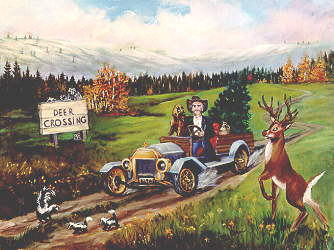
Buddy Ebsen does a Grandma Moses on Jed Clampett

Yowza! I’ve seen the Museum of Bad Art (I’ve even seen it in person, since it’s in Somerville). And I’ve seen mediocre art by famous people like Richard Feynman. I’ve seen the primitive folk art of Grandma Moses. But I’ve never these things all rolled together into one magical package. Until now…

This evening, on the advice of my friend Kevin, I happened to be reading up on some classics from the 70s. This took me to the Kindertrauma page on The Horror at 37,000 Feet. Improbably, it was on this page that I made the big discovery. Buddy Ebsen, the talented dancer and actor, is also a bad primitive tasteless famous artist. Just look.

Friend, if Ebsen’s Welll Doggies doesn’t cheer you up, I don’t know what will. And this being the holiday season, you might want to drop $900 on Christmas Cheer. In lieu of a docent talk, I will include the gallery’s complete description of the painting below.

Jed and Duke have been up to the timber line to fetch a Christmas tree. Happily headed home they had forgotten about the deer crossing until they see Rudolph the Red Nosed Reindeer fixing them with an indignant glare. Jed brings the truck to a sliding stop, to give Rudolph the right of way and incidentally avoids a tangle with a family of skunks whose opportunist mama can apparently read signs.

Travels in Relativity Land

Mr. Tompkins, a banker with an interest in physics, takes a nap after seeing a lecture on relativity. He awakens in a strange world. Bicyclists moving past him are pinched and narrow. When he decides to go cycling himself, he notices the street he’s riding on has gotten very short. But short as it is, he doesn’t seem to be making much progress. When he remarks about this, a fellow cyclist says “What difference does it make anyway, whether we move faster or whether the street becomes shorter?”

What’s happened to poor Mr. Tompkins? Here’s what: he’s landed in a world where the speed of light is so slow that the effects of relativity are obvious and dramatic.

The story of Mr. Tompkins was written in 1940 by the physicist George Gamow. His goal was to make special relativity a little more human-scaled and approachable. The speed of light is so unimaginably fast to us that it’s hard to picture what it must be like to move at relativistic speeds. To build insight about the process, you need to domesticate it.

This is the same essential insight of a game from the MIT Game Lab.

By walking around in a world with a ridiculously slow speed of light, you experience not only the Lorentz transformation of space observed by Mr. Tompkins, but also the Doppler effect, the searchlight effect, and time dilation. And maybe, just maybe, you’ll build up some intuitive understanding of the crazy world of the very very fast.

Sandy’s gift: Ice halos over Boston

As I was about to get into the car on Saturday afternoon, I noticed a funny rainbow-like smear on the windshield. At first I thought it was something greasy on the windshield, but I looked up in case it was reflecting something in the sky. It was.

Above me, in the weirdest location and orientation, was a rainbow. Weird because there was no rain — it was a clear afternoon — and because it was upside down. Its feet were in the air! I’d never seen anything like it.

This is what I saw.

My first (incorrect) notion was that it was a glory. But you see glories when you look away from the sun. Furthermore, this was a whole constellation of delicate curves and colored arcs. I couldn’t stop looking at it.

I tweeted that anyone in Boston should go outside and look up. My friend MechanicalTim, an erstwhile physicist, sent a quick note back. It turns out he’s spent a fair amount of time thinking about the physics of rainbows, and even he was stumped. But he was able to track down a name for the phenomenon. That upside-down rainbow is a rare ice-crystal halo called a circumzenithal arc. You can tell it’s rare by its unlovely name. The high-altitude hexagonal ice crystals that put on the show were driven there ahead of Hurricane Sandy’s approaching bulk.

So Tim identified the circumzenithal arc, but what about the rest of it? In particular, what about the graceful gull-wing curve below the arc? A little more research put me onto the Ice Halo page on the Atmospheric Optics website. What a treasure of strange solar fauna! From my pictures, I worked out that I had seen the aforementioned circumzenithal arc, the supralateral arc, the upper suncave Parry arc, and the upper tangent arc. Not to mention the more common 22 degree halo and its hovering parhelic hounds, the stately Sun Dogs. In one fortunate sky, I’d bagged the whole menagerie. A veritable crepuscular jackpot! Rare and beautiful things with fancy names! It all made me very happy.

The so-called Boston ice crystal halo event was noticed by plenty of people with better cameras than me. In fact, the circumzenithal arc Wikipedia page now features a picture taken from Salem, Massachusetts on the same day.

And by the way, if you want to do ice halos the hard way, Tim recommends Greenler’s Rainbows, Halos and Glories.

All the buzzwords: robot Kickstarter 3D-printed airplane manufacturing for tomorrow!

I like airplanes. I like 3D printing. I like robots. I like Kickstarter. And it’s all coming together these days. There are Kickstarter airplanes, and 3D printed airplanes, Kickstarter robots, and many other variants. The 3D-printed airplane guys are students at the University of Virginia. After seeing their 3D-printed jet engine (an unfueled demonstrator), the Mitre Corporation gave them some money and said “Make me an airplane!” And they did.

This is all fitting into a larger story about American manufacturing that, despite its rah-rah appeal for politicians, appears to be the real deal. Here’s Mayor Bloomberg opening a Shapeways factory in Brooklyn. Shapeways is a company that specializes in 3D printing for the masses. That’s you! That’s me! It’s actually happening. I recommend some jewelry by Bathsheba Grossman. Although I have to say, after sifting through the Shapeways blog, the thing that impressed me most is this video of artist Ryan Kittleson sculpting Success Kid. Now you can have your very own.

MOOCs vs. the Ivies: Paying for your peers.

What does a college education buy you? A solid grounding in the liberal arts? The technical training to pursue a profession? A ticket to grad school? Four years of beer-soaked denial? A spouse?

It’s a complicated question with a lot of answers. Here’s a sharper question. What does a college education buy you that can’t be replaced with a free online education? Free online courses, often called MOOCs (for Massive Online Open Courses), have been making news lately, and for good reason. At first blush, it looks like you could cobble together a first rate college education for no money at all. And this at a time when college costs are skyrocketing. It seems reasonable to wonder if MOOCs are about to gut the Ivy League.

Now for the weird part. A college-level online course requires a lot of expertly assembled content. And who provides this content free of charge? I’ll tell you who: professors from expensive colleges. But wait! Doesn’t that mean they’re competing with themselves? Why should I pay $50,000 to Elite U. when I can watch the exact same instructors teach the same courses for free? Aren’t they in danger of putting themselves out of business?

Well, actually, no.

Colleges don’t worry about putting themselves out of business because they’re not selling an education. It sounds preposterous until you watch them rushing to give away their education. What they’re selling is a degree. They’re selling a brand. You can drink their wine all day as long as there’s a different label on the bottle.

You are welcome, encouraged even, to use Stanford courseware at a community college, but your diploma can’t mention Stanford. One way of thinking about this is the textbook analogy. There’s nothing surprising about using Professor Y’s textbook when you take Professor X’s class. So in the future you might also be using Professor Z’s lectures and exams. But at some point you have to ask yourself “What exactly is Professor X doing for me?” It’s another way of asking what exactly a college sells you. And ultimately you realize that the most important department in the university is Admissions.

You’re paying for your peers. Smart, well-connected, motivated peers that have been vetted by a selective admissions process. It’s the same with a good party. The bouncers make all the difference. You may never meet the hostess. But who cares as long as the place is rocking?

You’re paying to be stratified among your demographic cohort for the benefit of your future employers, and the diploma is the proof those employers will demand. The price is kept high by scarcity. There are only so many Harvard graduates every year. In a networked world, is that scarcity artificial? In a world of online courseware, we might suppose that Harvard could open up the sluiceways and churn out 100,000 graduates. Why not? The ultimate scarcity is supplied by Dunbar’s Number. You really want to get to know the peers that you paid to be with, and to do that, you really have to spend time with them. That will never be cheap.

Where does all this leave us? Will there be a revolution in the academy or not? Despite the prolonged shaking, the system stays largely intact. Elite universities will still be able to charge top dollar. The biggest shift comes in post-graduate continuing education and in pre-college secondary education. Admissions to elite universities gets harder, since everyone will have access to serious college classes before leaving high school. The quality and uniformity of education at all universities will go up dramatically. And the cost of non-elite institutions is sure to drop significantly.

It’s almost all good news for the average student, although we’ll need to watch out for the dangers of an educational monoculture.

Tim O’Reilly at Long Now

A longstanding meme in popular culture is the idea that a sufficiently complicated system or society can “wake up” as a willful super-organism version of itself. The cheery version of this is an Aquarian global consciousness linking us all. The grim version is Terminator’s Skynet.

Here’s Tim O’Reilly giving a talk at the Long Now Foundation on Birth of the Global Mind. O’Reilly starts with some personal experiences from the 70s. As Long Now host Stewart Brand says in his introduction

Global consciousness was a recurrent idea in the 1970s—from Teilhard de Chardin’s noosphere and Omega point (“the Singularity of its day”) to “New Age mumbo-jumbo” such as the Harmonic Convergence.

But O’Reilly is charitable in his treatment of these loopy ideas, focusing on what they got right and the lasting impact of their optimism. He eventually dwells on augmented intelligence rather than artificial intelligence as the real smarts in the global brain.

I’ve been a longtime fan of both Brand and O’Reilly, so to me the best part of the talk is when they chat during the question period at the end. They end up touching on two topics I care a lot about: society-as-flesh and the modern pantheon of Greek-like gods. It’s an entertaining and wide-ranging conversation.

My car, my ride, myself

At Man School they teach you that it’s your job to get the car in the pouring rain so that she doesn’t have to get wet. It’s also your job to drop her off at the restaurant and go find parking in the dark city center. Then make the long walk back. And I don’t mind this so much. But even so, I’ll be happy to hand this work over to my robotic smarty-car. Think about it… from your point of view, every destination will have valet parking. It really doesn’t matter how far away the parking lot is. Mr. Smarty-Car will take himself there while you’re ordering appetizers.

Driverless cars are back in the news following recent legislation in California. Somewhere in the links related to that news item, I came across Brad Templeton’s list of ways that driverless cars can be different from driverful cars. Among his observations are these: range, speed, and acceleration become much less important.

Why is that? I had to scratch my head.

It’s because being a rider is vastly different from being a driver. A rider, particularly one who is reading or writing, wants smooth, predictable comfort. This has a big environmental payoff. A driver, on the other hand, wants… what? Speed. Acceleration. Tight suspension. The sleek lines of a gazelle. A taut, muscular, candy-apple red machine, belching fire, pawing impatiently at the starting line, ready to roar into the waiting darkness.

This is not so good for the environment.

Why the big difference? The big difference is that my ride is just another way to get to work, but my car is a projection of my ego. It’s ME. So if I buy a car, if it’s my car, then it can’t be too wimpy or too pokey or too dull. What would people think of me? But if I can just think of it as my ride, if I can break the link of personal identification, then maybe I don’t need a guzzling muscle car or a tricked-out SUV. Maybe I can buy a share of something more reasonable and think of it as just a ride instead of me. Buying a share of a car sounds like a pain until you consider that the car can ferry itself between destinations. Instead of saying “I need to use the car on Friday night, so you can’t,” you can just arrange drop off and pick up times that fit together. The car doesn’t mind the extra driving.

I think it’s a winning scenario. It’s an example of the hard-to-predict secondary effects of a dramatic shift like a driverless car. Technology is the easy part. What about the culture? To turn the Volkswagen ad campaign on its head: “Riders wanted.”

Jay’s Team walks again

Hey, look at this. This is my son.

That’s a good looking boy, am I right? He is an active boy, restless and noisy. He wakes up much earlier than I like to wake up. He’s thirteen years old. His name is Jay. But he is most defined by the traits that swirl around in the wake of his autism. He can’t talk. He can’t dress himself. He doesn’t acknowledge the comings and goings of his mother, his father, or his sister. Or you for that matter. Sorry, but it’s true.

We’d like to be able to converse with Jay in a direct and natural way. That’s not possible now. But over the years a number of autistic individuals have learned to pierce the veil of their condition and tell us what life is like on their side. Listen as Jay’s mom Wendy describes some of these people in her annual fundraising letter. Because this Sunday is the day we walk with Jay and thousands of others around the Suffolk Downs race track in order to raise money for Autism Speaks. Please give!

Continue reading “Jay’s Team walks again”

Allergies and trolls: we have met the pathogen and he is us

An allergy is panicked reaction to an intruder. THERE’S AN ALLERGEN IN THE HOUSE! OHMYGOD OHMYGOD OHMYGOD! I HATE THOSE THINGS! The immune system gets alerted and promptly freaks out. Like shouting “fire” in a crowded theater, the protective reaction (stampeding for the exit) can cause far more damage than the original trigger (a small fire). The stampede in the body might be something as violent as a cytokine storm or anaphylactic shock. Bad news.

We’ve had millions of years to evolve healthy bodies, and yet immune disorders are among the most persistent, puzzling and difficult to manage illnesses. By analogy, this suggests to me that violent over-reaction is going be very hard to eradicate in human culture.

The video being blamed for the trouble in Libya, Egypt and elsewhere is, of course, not exactly the root cause. It’s an allergen, and sure enough it has provoked a world-class immune response. As with any allergic response, we can solve the problem by removing the allergen or by trying to make the overall system less sensitive. Trolls and free speech mean that an allergen-free environment isn’t going to happen. That leaves us with managing sensitivity. And here we might learn something from internet culture. Online it’s common knowledge that the best way to deal with trolls is not to respond to them. Or, as they say, “Don’t feed the trolls.” A well-fed troll will never go away. The problem is that the aggrieved party has to come to this conclusion on their own, and this can take a long time.

If we consider humanity as a whole, we might even call the current dire reaction an autoimmune disorder. All the cleverness of the species is channeled into harming the species. Autoimmune disorders are particularly nasty because they can deploy the strengths of the body against itself. You can’t just shoot the pathogen, because the pathogen is you.