Thomas Edison, the man who looked like the thing that was needed

I just finished a biography of Thomas Edison called The Wizard of Menlo Park by Randall E. Stross. A biography is either going to improve or degrade your earlier opinion of its subject. Whenever I read about Washington or Lincoln, I always come away thinking, “Wow, that guy really is impressive.” With Stross’s treatment of Edison it’s the other way. Edison comes across as petulant, vain, willful in the extreme, and comically inept at business. His friend Henry Ford called him the world’s greatest inventor and the world’s worst businessman. And Ford was an admirer. Edison is not a sympathetic character when viewed from up close. He tolerated no dissent in his laboratory and hired only the docile and easily cowed. He took credit for the work of his staff. He never admitted to mistakes and clung dogmatically to ideas (like residential direct current electrical power) for far too long. He blamed his users for not knowing how to use his (in fact) slipshod products. He insisted on choosing the music to be sold for his phonographs in defiance of public taste.

But in many respects, his autocratic willfulness was not unusual among self-made 19th century men. A lot them were jerks. That’s not the interesting part of the story. The interesting part of the story is how Edison came along at exactly the moment when Americans needed someone to personify the rapid technological change that was reshaping the world. And he fit the bill marvelously. He had a flair for saying exactly what journalists wanted to hear, and they credulously wrote it all down. Edison’s true great invention was the phonograph, and though he was never able to make money with it, it cemented his reputation. He didn’t invent the electric bulb, but over time we had him invent it for us. As the technologies of modern life became more and more bewildering, it became easier and easier for people to credit them to this one man. Ultimately the only thing of value that remained was his name, which grew in stature out of all proportion to his actual inventions.

Sadly, he believed the flattery and came to think of himself as a gift to mankind. Stross quotes a letter he wrote to someone soliciting money for a local charity. Edison wrote something like this: “I’m not going to give you a donation, because I can put this money to better use for mankind by investing it my laboratory.” But he had long since ceased producing wonders and was in fact in a protracted money-sucking decline. By then his was the need not of a Prometheus, but of an addled and overstretched businessman. But in his vigorous youth, when we needed Prometheus, he was Prometheus, and so he will remain. Because that is the nature of gods.

Tool spinning, task boxing and the trade-off between usability and learning

Some weeks ago Bret Victor made a big splash with a talk called Inventing on Principle. His basic message was about the value of direct manipulation and instantaneous visual feedback. These aren’t new concepts, but Victor’s demonstrations were brilliant. They were elegant and persuasive in a way that words alone would not be.

As impressive as the talk is, there was something about it that nagged at me. I had the feeling that what he was saying and what he was demonstrating weren’t quite the same thing. Mark Guzdial of Georgia Tech is one of the few people I’ve seen to make a thoughtful critique of Victor’s approach, and he articulated my concern. You can read his commentary here: Inventing on Principle and the trade-off between usability and learning (interesting side note: Guzdial’s post drew comments from Alan Kay and Bret Victor himself).

What Guzdial says is something like this: make sure you understand your goal. If you want people to learn something, make sure they actually come to grips with that thing, and not an abstract and airbrushed version of it. Chasing usability (or entertainment) can come at the expense of learning, and if learning is your goal, you will have lost something important.

Guzdial provided an example of some educational software that was supposed to teach the relationship between the math (differential equations) and the physical system being represented (pipe flow). The software let you play around with pipes while the equations changed in real time. What happened? People liked the physical modeling (screwing around with pipes) and totally missed the underlying equations. But the equations were supposed to be the point of the exercise! So the authors had to retune the system to make the math more prominent. Now what happened?

The system became much harder to use.  But now, students actually did learn, and better than students in a comparison group.

Fascinating!

Let’s say you want to be able to play Beethoven’s Moonlight Sonata. The best tool I can give you is a machine with a single button bearing the label “Press this button to hear Beethoven’s Moonlight Sonata.” But I’ve probably underestimated your goal. If your goal is in fact to play the Moonlight Sonata on a piano with your own hands, then my music machine would be worthless to you. I would be guilty of putting you in a teeny-tiny task box. But beware! Now you need to spend years learning how to use the piano, a very expressive but demanding and not terribly user-friendly machine.

Any tool puts you in a box of addressable tasks. Constrained tools have small task boxes. Expressive tools are hard to learn. Finding the optimal balance between expressive depth and simplifying constraint is very tricky.

Now look at this tool that Victor built for using simulation to understand a math word problem.
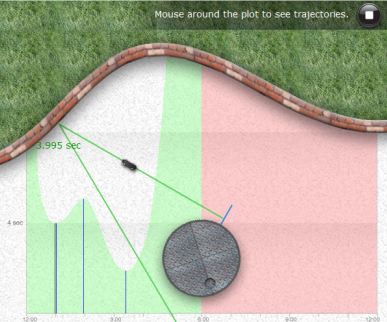
It’s beautiful! And it works well as long as you don’t want to modify the essential parameters of the problem. But Victor isn’t helping us learn the metatools that he uses to create this environment. To be fair, that wasn’t his goal, but as a user, I feel like I’m locked in a pretty small task box. More to the point, it’s expensive to create these interactive gems, and there’s only one Bret Victor.

Victor’s real power is his ability to rapidly create and deploy these tools. In a twinkling he can size up a task that is worth studying, put a box around it and spin a tool. He does this so effortlessly, with such mesmerizing legerdemain, that we lose sight of this meta-skill. What Victor was really doing in his talk was illustrating the power of tool spinning, the rapid creation of customized, context-sensitive, insight-generating tools. Direct manipulation is good, but the nature of direct manipulation changes with the context, and the context can’t always be anticipated.

My preferred goal is to make tool spinning (and tool sharing) as easy as possible. If tool spinning is easy, if that is the expressive skill that we give our users, then small task boxes aren’t a problem. You can always make more tools.

Don’t use the thing Bret made. Do the thing that Bret does.

Flows made visible

Galileo commands us “Measure what can be measured, and make measurable what cannot be measured.” An updated version of this might be “Visualize what can be visualized, and make visible what cannot be seen.”

If you grew up with a globe like this, you can be forgiven for thinking the big blue oceans weren’t much more than big and blue. But even a sailor with direct experience of the sea and its many tides and currents might be surprised by what the folks at NASA have done with a visualization called Perpetual Ocean.

Maximize the window when you look at it. There’s so much to see. The Gulf Stream jumps out, as you would expect. But what about the string of gyres peeling off South Africa? You can see how shallow and relatively calm the Java Sea and Strait of Malacca are, whereas the Caribbean fairly churns. And then there are the spectacular Roaring Forties that chase their own tail all the way around Antarctica. So much to see.

It’s one thing to be shown something new that you’ve never considered, something like the surface of Titan or a giant aquatic isopod. But to suddenly see something that is all around you, to have the mundane made exotic, that can be something of a shock. It’s also worth considering that, as complex as these flow diagrams are, they still constitute only one two-dimensional slice through a larger and still more complex three-dimensional flow field. I guess visualizing that that can wait a few years.

Flow visualizations seem to be in the air these days (heh), because what NASA has done with water, Martin Wattenberg has done with air. Behold his Wind Map. Where does all that wind come from? And where does it go to? A visualization can only tell you so much. Someone older than Galileo had words on the subject: “The wind bloweth where it listeth, and thou hearest the sound thereof, but canst not tell whence it cometh, and whither it goeth.”

While I was watching all these visualizations, I was thinking to myself, where have I seen that before? Then I remembered this little guy that made the rounds a few months ago.

Like I said, flow visualization is in the air. And the water and the stars, I suppose.

It’s 14.3 day in Europe!

Great hovering kookaburras! Pi Day is upon us, and me with my best pi coat at the cleaner’s.

In honor of the blessed event, I like to point people back to the Pi-Ku poetry we made up on this site back in 2007. There still are some great poems in there. My favorite is Chris K’s

Opa! I know a
Greek character to denote
disks’ key ratio

Naturally, haikus also put me in mind of the fit of pangram haikus that we did a while back.

You can see where this is headed. And so I thought to myself… hmmm. Do you suppose we could make a hai-ku-pi-pan-gram*? How about this:

For a quiz I found
vexatious Pi, mystic Greek.
She: jewel, blossom.

There we go. Haiku syllables. Pi letter count. Alphabetic pangrammitude. And the topic is the Queen herself. It won’t win any prizes, but still.

You must do better! Use this.

* Coincidentally, Haikupipangram is also the name of the Minister of Weights and Measures in King Kamehameha’s first administration.

Religion and Atheism

If you have a fondness for epigrams, you should follow Alain de Botton on Twitter. The man is a bon mot machine. One morsel: “What disappears from memory is how much of any moment is spent worrying about the future.”

He’s a sort of Philosopher 2.0, contending with the problems that confront us in the modern world, and rather than simply ranting like most of us, he offers subtle analysis and thoughtful alternatives. I’m a fan. The book that first propelled him to prominence was How Proust Can Change Your Life. Most recently, he’s just completed Religion for Atheists. Tag line: “Religions are too interesting to be left simply to those who actually believe in them.”

Here’s nice quick essay on it over at The Atlantic: What the Secular World Can Learn From Religion – Maria Popova. And since everything has a TED talk, here is his. Interestingly, he takes rather direct aim at the Dawkins camp of what he calls fundamentalist atheism: “They argue not just that religion is wrong, but that religion is ridiculous… I think it’s too easy to dismiss religion that way.”

There’s a lot of religious ferment going on these days. If you’re intrigued, you might also want to look into David Eagleman’s notion of Possibilianism.

Solar electricity – where is the bottleneck?

Funny things are happening in the world of photovoltaics. First there was a big investment boom in solar energy companies. Hooray! But then China started producing solar panels so cheaply that it drove a lot of US companies out of business. Boo! But wait… cheap solar panels are cheap solar panels wherever they happen to be made, so that’s good news, right? Good for the consumer, anyway. Now you can buy a cheap solar panel and stick it on your roof, and… wait. How would you do that? Do you just plug it in, or call up your electrician, or what?

All this drives home the point that the actual bottleneck is now in the installation. Homeowners aren’t yet seeing the benefit of those low prices. Fortunately there is plenty of action on that front, as described in this Reuters analysis: As solar panels eclipsed, installers in limelight.

SolarCity, which specializes in installation, offers packages like SolarLease, where they take care of everything and you just pay a lower bill. They’re taking a hefty cut, of course, but all you have to do is gesture at your roof and say “put it there.” It sounds like a winning strategy to me. Most of us aren’t willing to do a big capital outlay to fund a solar farm. But I bet a lot of folks will sign up for a low-hassle lease. We need large competent companies that specialize in doing exactly that. I hope SolarCity is such a company.

Change comes when the exotic becomes ordinary. Already hybrid cars like the Prius are nothing special. Yawn. And now friends of mine getting solar installations. Maybe next year it’ll be no big deal. Hooray for boring!

Paying for it: Todoist

For the last couple of years I’ve been managing my to-do list with Zenbe Lists. It’s got a lot going for it: it’s simple, it’s free, it runs on my iPhone as well as on the web, it’s got a lovely interface, and it’s simple (did I mention that already?).

It has one big strike against it, though: it’s a zombie. It’s a staggering, stumbling, undead ghoul of a web service.

It’s the weirdest thing. I know companies go out of business all the time, but this has been a prolonged up-and-down drama that kept me on the hook far longer than it should have. I stuck with it through various long outages partly because I hoped someone would come along and buy it and partly because I couldn’t be bothered to move everything to some other app. We keep hearing that it’s cheap to start a software company these days. Zenbe is proof that it’s also cheap to keep them in an unsupported limbo state too. Somebody’s paying the electricity bill, but that’s about it. Nobody is responding to any complaints. The GetSatisfaction forum for Zenbe is a place where people bitch about the service and then trade recommendations for a replacement.

So I finally got the message and moved on to a service called Todoist. And let me tell you, I was happy to pay for the service. The app itself is very good, but not great, but beyond that, I’ve gotten a nice little lesson in economics. I help pay the bills at Todoist by sending them money. Zenbe, on the other hand, got their money from advertisers, and when the money ran thin, it was clear that they didn’t really care much about me.

Marco Arment of Instapaper fame has a lot to say about this. I heard him most recently on the Planet Money NPR program. From his point of view, one of the great things about paid-for apps is that they give him a direct relationship with his customers. Imagine that! Just like in the history books!

There’s nothing very surprising in this story, but I suspect we’re all going to have this lesson driven home over the next few years as all those free web service chickens come home to roost. What’s the phrase people use for this situation? If you’re not paying for it, then you’re the product. It felt downright healthy to pay someone directly for the good service I was receiving. And that’s bound to be a good thing for software developers. It’s proven to be a good thing for me, since I’ve already received excellent support from the staff at Todoist.

Duolingo from CMU – Think like a rain forest

The philosopher farmer Wendell Berry once described modern farming like this.

Once plants and animals were raised together on the same farm — which therefore neither produced unmanageable surpluses of manure, to be wasted and to pollute the water supply, nor depended on such quantities of commercial fertilizer. The genius of America farm experts is very well demonstrated here: they can take a solution and divide it neatly into two problems.

Typically, when faced with problems, we try to mitigate and resolve them one at a time. Each solution has a cost and at some point we run out of money. But sometimes you can work magic by reversing the process described by Berry. Take two or more problems and turn them into a single solution.

Here’s an example adapted from a TED talk given by CMU’s “Mr. CAPTCHA” Luis von Ahn.

Problem 1: Mr. X wants to translate a document.
Problem 2: Mr. Y wants to learn a foreign language.

Both Mr. X and Mr. Y are willing to pay for their respective services. But wait! Would it be possible to have Mr. Y learn Lithuanian while simultaneously translating Mr. X’s document for a client in Vilnius? It’s pretty clear it wouldn’t work as stated, but if Mr. X and Mr. Y are replaced by thousands and thousands of people, it just might. In fact, von Ahn swears that it does work, and his team built a site called Duolingo to prove it. Watch the video to see if you’re convinced.

If it works as well as von Ahn believes, the implications are staggering. Two hungry communities can feed each other, because the waste product from one group is the food of the other. And along the way this could eviscerate the translation and language instruction industries.

Don’t think like a farm. Think like a rain forest.

Image search, or Everything is traceable now

TinEye is a service that flips around the normal image search process. Instead of using a word or a phrase, like fleem or crumhorn, to find a list of images, you use an image to fish for other images like it. This turns out to be particularly useful for answering the question “where did they steal that image from?” Rights-holders can use this technique to police their ownership of images, and anti-SOPA activists can use it to bust pro-SOPA politicians for stealing their Twitter background images.

Recently Matt told me that Google is in the game now, and their image search engine, through the magic of Google being Absolutely Huge, will probably crush TinEye in short order. At any rate, I was intrigued, and so later that day when I came across an interesting image in an article I was reading, I thought I’d try a little detective work.

highway

Here’s the article: Branching and merging: the heart of version control. Don’t worry about the article itself. See that stock photograph of a highway interchange? It’s pretty cool. Where did it come from? Where is it in real life? In the Future, by which I mean now, we will be able to answer these questions with a few serene keystrokes. Watch this.

First, grab the URL for the image and do a search.

So this picture is Image 4848603 available from 123RF Stock Photography for a modest fee. And where is it? It tells us it’s from Atlanta. That’s not a lot to go on, but there aren’t that many large freeway interchanges in Atlanta, and since we live in the Future, we can use Google Earth to fly over the metropolitan area. The background shows it’s in a fairly rural area, and after a brief search, thar she blows, cap’n, off the starboard bow!

It’s the I-285/I-85 interchange near Doraville, Georgia.

I found the whole exercise profoundly satisfying. I could use a cigarette right about now.