What does a border sound like?

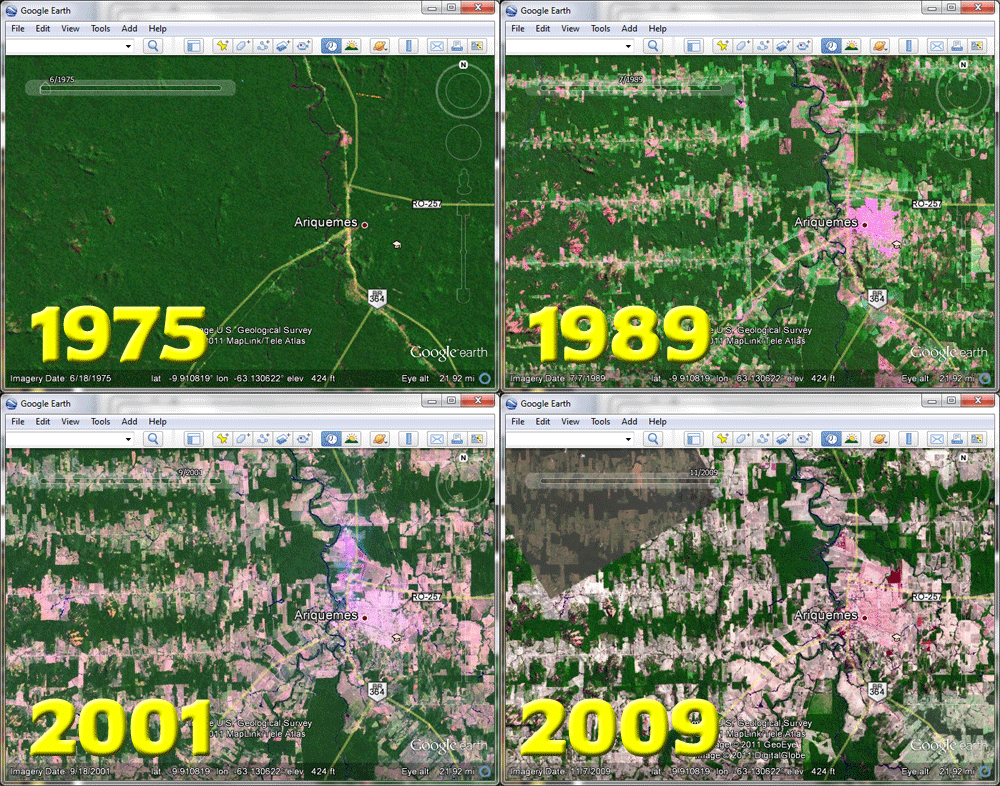
What do borders look like? We know that they are lines on maps and checkpoints on roads and sometimes walls and fences. But can they be seen from the sky? In The Sword in the Stone, T.H. White tells the story of young Arthur and his mentor Merlin flying as birds across the countryside. Arthur comes to the realization that there are no borders at all, that they are social constructs, illusory excuses for warmongering.

Borders are indeed hard to see from on high, but what do they sound like? The Strange Maps blog is featuring a marvelous language map created by Eric Fischer with help from Mike McCandless. It’s based on the languages that people are using when they tweet and the result will make your eyes bulge. Here’s a big version, and here’s a HUGE version.

So many stories here: you can see the French and Dutch oceans splashing together in mid-Belgium. Portugal and Spain are more clearly differentiated than I would have expected, and what’s that country on the Mediterranean coast of Spain? Why that’s no country, that’s the Catalan-speaking region of Spain centered on Barcelona. Francophone Corsica, birthplace of Napoleon, is a stone’s throw from Italian Sardinia. The Greek and Turkish sides of Cyprus are obvious. And wowie-zowie, the division between North and South Korea is even more stark than the Earth at Night photo.

Cruise around that big old map. There’s hours of fun in there.

Makani Power: the windmill that isn’t

I once saw a documentary about skyscrapers where the architect says, “It’s not that hard to make a 100 story building. You just need to make a one story building 1500 feet up in the air, and the rest is easy.”

Sometimes it’s easy to miss where the real work is.

Makani Power is a windmill company that builds only the business end of the windmill. The rest of it, overpaid and redundant, gets chucked. Think about it this way. A windmill (or turbine) is a great big propeller blade that’s being pushed by the wind. You want to build an efficient wind turbine, here’s what you need to do: Make it big (large diameter blade) and stick it in the wind (duh). Now look at the problem we’ve got. The best winds are way up high, and large diameter blades are heavy. So you’ve got to build a massive tower to carry the load of a giant spinning blade.

But wait: we went to all that trouble to put the spinning tips of the turbine far apart and up in the wind. Can’t we just leave out everything else? Then we would only need a tiny fraction of the materials to achieve the same result.

THAT is the thing that Makani Power did. They made the spinning tip of a turbine and almost nothing else. More kite than windmill, it’s actually a tethered airplane with reverse motors. By “reverse motors” I mean they look like regular airplane propellers, but they generate power instead of using it up. Clever, eh?

A clever concept is a small part of the battle. That and a ton of engineering might just add up to something useful. They seem to be making good progress, and I wish them luck.

Here’s how it’s supposed to work commercially, and here’s what it looks like now.

Ned Ludd vs. Watson

The Eleonora Maersk is one of the very biggest ships in the world. At 1300 feet long (the Titanic was a mere 880), it can carry 15000 twenty foot trailers. And how big is the crew for the Eleonora? As explained in this Economist post, the answer is 19.

Shortly after reading this, I happened across another Economist piece called the Luddite Legacy. Here’s the short version: in terms of jobs, automation has always been tough in the short run (obsolete factories shed jobs) but beneficial in the long run (growing economy creates even more new jobs). But this happy story is being called into question, and here’s why: the robots and their concomitant robot brains are getting really good. It sounds like heresy to read such a thing on the Economist website, but there you have it. The piece starts off with this delightful, if apocryphal, story about Henry Ford II.

Henry Ford II [is] showing Walter Reuther, the veteran leader of the United Automobile Workers, around a newly automated car plant. “Walter, how are you going to get those robots to pay your union dues,” gibed the boss of Ford Motor Company. Without skipping a beat, Reuther replied, “Henry, how are you going to get them to buy your cars?”

There you have it in a nutshell. You can fill the stores up with stuff, but somebody has to be making enough money to buy it.

Have we reached a tipping point where whole chunks of the economy can be vaporized by automation? Clearly it’s a theme that’s touching a collective nerve. Many people were creeped out by IBM’s Jeopardy-winning computer Watson.

Megan McArdle over at The Atlantic observes that the New New New Economy may well create exciting new jobs, but lots of people really prefer their crappy old boring jobs. But any job that’s predictable enough to be clearly spelled out is going to go away. It will either be outsourced or automated. As one tech blogger put it, “Unless you are awesome, you will be outsourced.”

But that’s not a problem for you, because you’re awesome, right?

So totally awesome.

Behold the Hexadecacopter

Quadcopters are the hottest thing going in radio-controlled aircraft. Everybody wants one, partly because they’re new and crazy-looking, but mostly because of the insane stuff they can do. Until very recently, our mental image of a helicopter has been a thing with a single great rotor on top. But as it turns out, quadcopters have been around for a long time. Etienne Oemichen’s eponymous No. 2 goes back to 1923, while George de Bothezat in the US made the fabulous “Flying Octopus” in 1922.

I bet the most unlikely quadcopter you’ll see is the impractical but inspiring human-powered helicopter from the University of Maryland. Earlier this year it flew for a total of… wait for it… four seconds. Still! Human-powered quadcopter!

It was Igor Sikorsky who, in 1940, decided to stop the multi-rotor madness. His VS-300 was simple (relative to his competition) and practical. From that day to this, we’ve been accustomed to a large lifting rotor and small vertical tail rotor to counteract the twisting from the big blade. I love looking at those old videos of him flying because his test pilot helmet is always a black fedora. Classy!

But now, with the small robot copters leading the way, people are starting to get back into multi-rotor copters. Check out this video of a man going for a ride in a 16 blade hexadecacopter. It’s a real flying abattoir: ladies and gentlemen, please keep your hands inside the van at all times.

If you went back in time and showed this video to George de Bothezat, he’d say “I told you that’s what helicopters would look like in the future!” Back to the future indeed.

(from Gizmodo via my brother Tad)

High low tech: Rocket stoves

Backpacking is appealing partly because it forces you to simplify. You consume only what you can carry on your back, and for the most part it’s a low-tech experience. But even if you can be pried away from your phone, iPod, and GPS device, there’s a big chunk of the petrochemical industrial complex you take with you: the stove. You’re toting a metal stove and a bottle or two of highly refined gasoline. I suppose a real Bear Grylls wild man could cook over an open fire, but that’s slow, ineffective, wasteful, and dangerous.

Designers Alexander Drummond and Jonathan Cedar were annoyed that camping involved schlepping bottles of gasoline into the wilderness, so they formed a company called BioLite and dedicated themselves to perfecting something called the rocket stove. I had no idea that such a simple stove could burn regular old sticks so efficiently, but check out this BioLite CampStove in action.

The result is still high tech, but it does simplify the camping experience. No gasoline stink, no gasoline danger, and no gasoline weight. What’s especially nice about rocket stoves is their potential to improve the lives of people who do all their cooking on open stoves. The same design that make fancy-pants first-world designers feel good about their camping can be adapted for a Nepalese woman who cooks over a smoky yak dung fire. Highly efficient biomass stoves in developing countries can make a big difference to CO2 emissions, forest conservation, and the well-being of those doing the cooking. It’s a good story all the way around.

(via Steve Crandall)

Is it cheating to violate unwritten rules?

My brother-in-law Joe sent me this one. Pulaski Academy is a high school in Arkansas that punches above its weight when it comes to football. Part of the secret of their success is their unconventional game play. Here’s an example. On September 9th, the Pulaski Bruins played the Cabot Panthers. They scored on their first drive, then did an onside kick, which they recovered. Then they scored and did an onside kick, which they recovered. Then they scored and did an onside kick, which they recovered. This continued until they were leading 29-0. With 8:35 left in the first quarter, the Cabot Panthers had yet to touch the ball. Here’s what the Pulaski Academy sports writers had to say about it. But Kevin Kelley, the coach of this Arkansas high school team, is becoming something of a national figure. Read what they have to say about him over at Sports Illustrated: Pulaski Academy scores 29 points before opponent touches football. Be sure and watch some of the videos.

Our lives are bounded and channeled by rules, habits, and laws. We think of these as explicit, but unwritten rules and cultural norms vastly outweigh any documented guidelines. These tacit, silent agreements among total strangers guide our behavior to a remarkable degree. Eccentrics, the ones who refuse to do what everything else is doing, often get treated as law-breaking miscreants.

I was reminded of Malcolm Gladwell’s excellent New Yorker article, How underdogs can win. Much of his article is about how an unlikely girls’ basketball team wins by flouting convention. Successfully upending conventional wisdom is disconcerting in the same way that an earthquake is disconcerting. Something people had counted on as bedrock is suddenly demonstrably unstable. The typical result: rewrite the rules, codify the convention, and cast out the eccentric. The long term health of any system is often indicated by the degree to which it tolerates eccentrics. I find it encouraging that football observers find Kevin Kelley so inspiring.

Upside down square dancing

I saw this video of dancing quadrocopters, and it made me think of the new sport of synchronized indoor skydiving. Or as I prefer to call it, upside down square dancing.

You’ll notice they got the music all wrong. Just mute the volume on this video and open up Turkey in the Straw in another window with the volume on. Seriously, try it. It’s worth the effort.

All this aerial dancing raises some interesting possibilities. Can we have hybrid quadcopter/skydiver paired air dancing? Will cyborgs cry when the Bulgarian judge crushes them with a bad rating? Will humans cry when they are crushed by the Cylon judge?

I won’t be satisfied with robot dancing, aerial or otherwise, until it’s performed and choreographed by a robot.

The National Recording Registry

Who gets to decide what a classic is?

We don’t often think of librarians as powerful people, but by choosing what to preserve, librarians can stitch history from a grab bag of remnants. Especially if those librarians work at the Library of Congress and they’ve been charged with carrying out the dictates of the National Recording Preservation Act.

Just what is the National Recording Preservation Act? Well, our old friend Alan Kennedy, former music industry insider and musical trivia nonpareil, is here to tell us.

Continue reading “The National Recording Registry”

Rooftop hieroglyphics

In the early days of aviation, airports would paint their name in big letters on the roof of the terminal. Incoming aircraft had few navigational aids at the time, so turning the territory into something resembling a map was a clever expedient.

I like the fact that nobody on the ground ever saw the sign. It was a well-targeted sign, visible only to the eyes that needed to see it.

Now we all have eyes in the sky. We travel by air more these days, but beyond this, Google and other mapping services have given us a permanent seat in the sky. Deskbound archaeologists can discover previously obscure ruins. But what about signage for the Google Earth set?

It’s arrived in the form of rooftop QR codes. Want to know what company is based in that building? Just scan the code. You’ve heard of cornfield mazes. Now meet the QR cornfield. We should carve a giant QR code onto the moon so that approaching spaceships could scan it. But what to link to? Assuming visiting aliens could decipher the message (and why not? they’ve got a freakin’ spaceship already), it would be good to link them to a video of earth music. Perhaps something by Rick Astley.

Autism Speaks walk this Sunday

It’s nostalgia week here at the old Star Chamber. Watching the Red Sox disintegrate over the past few weeks took me back to a time before 2004 when anguish and baseball were essentially the same word here in Boston. It reminded me of an essay I wrote back in 2003: What Being the Father of an Autistic Son Taught Me About Being a Red Sox Fan (and vice versa).

That was eight years ago. The Red Sox have enjoyed some great seasons since then, the sting of recent events notwithstanding. But my son Jay continues to be a challenge. He still has no words to tell us what’s bothering him, whether it’s hunger, a headache, or a terrible sore throat (we learned just today that he has strep and may have had it for a while), so he gets frustrated. We do too. As a growing 12-year-old, he is bigger and stronger, much stronger than he was in 2003. When he gets angry and aggressive, keeping him and the people around him safe can be a terrifying exercise. It’s not an experience I’d recommend.

That’s what the Autism Speaks walk is all about: stopping other dads in the future, other moms, and other families from having to deal with raging choking sobbing face of autism, with the thrashing digging claws of autism, with the enduring biting sadness of autism. This Sunday, October 2nd, we’ll be doing our annual pilgrimage to Suffolk Downs to take part in the 2011 Walk Now for Autism event.

Come join us! Or, hey, here’s another idea. If you can’t make it (and I know how busy you are), then you can have some of your money join us instead. We promise to show it a good time, and then we’ll send it off to Autism Speaks to help kids like Jay. Your money will have fun, you’ll feel good, I’ll be happy. Everybody wins!

Here’s the part where you reach for your wallet and click on a link:

bit.ly/walk4jay

I’ll conclude by adding the note my wife Wendy sent out this year:

Continue reading “Autism Speaks walk this Sunday”