Mindful videos and slow rocket launches

Videos these days are edited for a microscopic attention span. I’d love to see some statistics on the average time between cuts, but it must be getting shorter. A good example of this is videos of rock concerts. There are so many cameras for the video editor to draw from: cameras on stage, cameras on booms, cameras in the rafters, walking steadicams, crowdcams, guitar cams. As a result, we get whipped from camera to camera with neck-snapping speed. If you have, let us say, a particular interest in Eric Clapton’s finger work during the solo, you’re out of luck. You might get a few precious seconds of guitar closeup, but then it’s time for the Dramamine again.

I don’t object to kaleidoscopic spectacle on principle, but there are times when it’s really nice to sit and focus on exactly one thing. Here’s a spectacular example of that. This is a slow-motion film (500 frames/second!) of the very bottom of the Apollo 11 Saturn V rocket as it takes off on July 16, 1969. I’m betting that on multiple occasions you’ve seen one or two seconds of this video. But you’ve never seen the whole thing. Watch it. It features some high quality commentary from Mark Gray of Spacecraft Films.

That’s the real damn deal right there. Those massive hold-down arms clamp the rocket to the ground, and when they let go, they’re the last earthly object to kiss it goodbye. I’m a certified space geek, but I learned a lot watching this. I didn’t know about the flammable ablative paint on the pad equipment, and I had always wondered about the dark skirt of flame that stretches several yards below the nozzle’s yawning bell. Now I know. Mindful, stable video with expert commentary. Yum.

Since I’m on the topic, here’s your Apollo bonus link: Andrew Chaikin, author of A Man on the Moon, tells us something new about Apollo 13. Which do you prefer for your corpse: a cold eternal orbit or the fiery dispatch of a collision with your home planet?
Unseen beauty

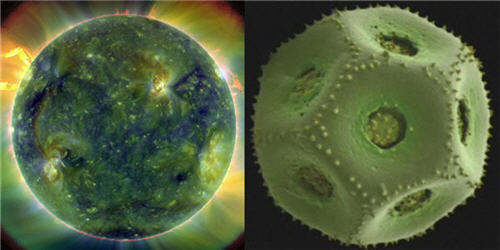
At lunch today I saw a TED talk by Jonathan Drori on pollen. He mentioned that pollen has become extremely useful in forensics because we’re now assembling the pollen thumbprint of every part of the plant-inhabited world. One look at the pollen grains in your shirt reveals volumes about where you’ve been. But really, the thing about the talk is that these giant electron micrographs of pollen grains from various species are displayed behind the speaker throughout the talk and you can’t help but be amazed at how beautiful they are. And they’re floating around us all the time. That thing on the right is a pollen grain for Greater Stitchwort.

Tonight I came home and read about the new Solar Dynamics Observatory, a NASA satellite that specializes in looking at, as you might guess, the sun. But what pictures she sends us, this orbiting eyeball! That image on the left, that’s the sun (sporting a wicked cowlick of a prominence) as seen in far ultraviolet. And there’s lots more good stuff like this on the site. It’s the same sun we see every day, but we’re not equipped to take in the beauty.

Later still, I saw that the xkcd web comic had taken up the same theme. It’s a good thing to remember as a general principle: this beauty that you speak of, it’s everywhere. Sometimes you have to take it on faith. And there’s a good chance it’ll make you sneeze. But still! Crikey!

Capture those stories!

StoryCorps is a nonprofit organization whose mission is to “provide Americans of all backgrounds and beliefs with the opportunity to record, share, and preserve the stories of our lives.” They have professional recording equipment, and they encourage you to book some time at one of their studios so you can come down and interview a friend or family member. It’s all free, including the CD that you get at the end of the process. It’s a great idea, and they’ve been so successful that by now they have a podcast and a couple of books.

The catch, of course, is that you have to be near one of their StoryBooth studios if you want to take advantage of their service. Fortunately, these days it’s not hard to do the same thing yourself. I’ve bought a few cheap digital recorders over the years, and it was always a pain to get the data off the device. Smart phones have changed all that. I have an iPhone, and it’s now trivially easy to get a high quality recording (or a pretty good recording, anyway) of you interviewing someone or just sitting back and listening to that old story that dad tells. You can keep the recording easily enough, but even better, it’s also easy these days to get a good transcription of the recording.

Here’s what I did. You should do it too, or you’ll wish you did some day. First, use your smart phone to record that story. This is absolutely the hardest part in the whole process: going out of your way to say please please sit here where it’s quiet and tell this whole story from beginning to end without interruption. After that, it’s easy. Take the sound file and send it to CastingWords. These guys are awesome and darned cheap. They’ll send you a text version of the story. It’s like magic.

Here’s my dad talking about hitchhiking his way up to the 1939 World’s Fair.

On 220 I didn’t get much leverage, not many rides. Ended up out in the middle of the country. Night was coming on and no place to lay your head. And fine, just about dark, a couple of guys picked me up in an old car.

They had been to South Carolina to buy liquor. North Carolina was dry. They had been enjoying the fruit of the vine. I was sitting in the back seat and they kept passing the bottle to me. No thank you, I am in training for football season. But they weren’t feeling any pain.

On the way to Roanoke, back then the roads were not four lane highways. These were two lane roads through the mountains. A lot of the places you could look over the side and see where you would go if things didn’t go right.

He drove pretty casually and it began to rain; dark, slippery roads at night. He didn’t keep his eye on the road much and I was biting donut holes out of the seat. Soon as I saw the first lights of Roanoke, I said this is where I am going thank you very much for the ride.

It’s easier than you think. Be your own StoryCorps, and your kids will thank you.

Headline copy-editing crash blossoms

Suppose you saw a headline like “Maine harbors concern over Bangor landing.” The story is about an airplane that lands in Bangor and ultimately causes distress among Maine politicians. But you might get four words into the headline with the mistaken impression that someone is concerned about the harbors of Maine. Then you hit the word “over” and stop short… Maine harbors concern over… huh?. You might get all the way to the last word before you fully realize a verb/noun parse error with the ambiguous word “harbors”.

Some headlines are so spectacularly ambiguous that you might read them through three or four times and still have no idea what they mean. As you might expect, the wordheads over at the Language Log have come up with name for this kind of headline parsing problem: crash blossoms. Why? Here is the story behind the name.

At Testy Copy Editors.com, a worthy colleague, Nessie3, posted this headline:

Violinist linked to JAL crash blossoms

(If this seems a bit opaque, and it should, the story is about a young violinist whose career has prospered since the death of her father in a Japan Airlines crash in 1985.)

It’s just a new name for an old problem, of course, but it’s still fun to collect them. Two more from the Language Log.

McDonald’s fries the holy grail for potato farmers. Yum! said Sir Galahad as he licked the ketchup and grail grease from his lips.

This one is not so much amusing as truly vexing to fully unwind: Scottish National Party signals debate legal threat.

Can you add any?

How Books Were Made

A 19th Century dictionary may be the new Rolex.

In the same way that people value fantastically complex mechanical watches ever more as electronic watches get cheaper, people may well come to value expensive hand-made books even as bookstores vanish, shelves get dumped into landfills, and reading becomes a wholly digital experience. The pick-up line of the future may be “would you like to come up to my apartment and see my … book?”

Via Neatorama I learned about Johnny Carrera, the owner of Quercus Press, a printer in Waltham, Massachusetts. That puts Quercus more or less in my back yard, which makes them pretty cool already as far as I’m concerned. Even better, Quercus has published the Pictorial Webster’s, which consists of all the illustrations from the 1859, 1864, and 1890 editions of Webster’s dictionary. Sure, you can buy the Trade Edition for $35, but Good Heavens! wouldn’t you be the man about town with your own hand-tooled Full Leather Goat Binding edition. All yours for $3500.

There’s a great story about how the project came about. Nothing makes me salivate like tasty jargon, and sentences like this just suck me in:

While I was repairing the paper, re-lining the spine, and backing it with an extended alum tawed lining which I used to attach new split boards, and covering the book with alum-tawed goat, a classmate showed me an article about the Merriam-Webster Co.

Alum-tawed goat! This is a man who owns a working 1938 Model 8 linotype machine. And knows how to use it. Now watch this movie, and be sure to at least watch the old Model 8 chugging away at around 1:40. It’s thrilling. It’s horrifying. This is the way the world used to work!

http://vimeo.com/moogaloop.swf?clip_id=5228616&server=vimeo.com&show_title=1&show_byline=1&show_portrait=0&color=&fullscreen=1

Pictorial Webster’s: Inspiration to Completion from John Carrera on Vimeo.

“Hey, babe, want to come up to my apartment and take a look at my Full Leather Goat Binding?”

Thoughtful scientist, colored water

For you scientists out there, I have a question.

When you’re contemplating an Erlenmeyer flask or beaker filled with colored water (as you scientist types so often do), what color do you prefer?

Today we’ll concentrate on orange. Here’s a picture that makes me happy for several reasons.

First of all, it’s picture of a thoughtful scientist holding insight-bestowing colored water in laboratory glassware. These always amuse me, even when they’re absurd stock photo fictions. But this one is real. This is a real scientist who is actually studying orange-colored water (a sugary orange soft drink). And it’s interesting research (high-fructose corn syrup prompts considerably more weight gain than an equivalent caloric load of sucrose). And it’s at my alma mater. And as it happens orange is one of the school colors. Man, what a great shot!

Look at the whole picture and you’ll see they’re clearly having a good time posing for the picture. You can almost hear them planning the shot: “Let’s do one of those colored-water-in-beakers photos!” I don’t know if those purple gloves were necessary for the lab work, but my, they look dandy next to the orange water.

As for showing what lab breakthroughs really look like, I enjoy Derek Lowe’s discussion here:

It doesn’t make for much of a cover shot, but if one of us ever does manage to change the world, it’ll start with a puzzled glance at a computer screen, or a raised eyebrow while looking at a piece of paper. Instead of getting noisier, everything will get a lot quieter. And if there are any purple spotlights to be seen, we won’t even notice them. . .

Pictures of the small and faux small

When you see a close-up photograph, something about it just looks small. Psychologically, what you’re responding to is the severely limited depth of field. Only one band of the photo is in sharp focus, and the foreground and background are both blurry. This happens because the physics blah blah optics blah blah blah.

But once you understand what signals your brain is responding to, the effect is easily faked in photos of much larger scenes. This technique is sometimes called tilt-shift because of how you need to modify the camera optics (blah blah Scheimpflug principle), and the result conveys an uncanny, and misplaced, sense of smallness. For instance, look at this. The picture on the left is genuinely small, a model. The picture on the right is an actual auto show being spoofed as a tiny one.

Once you’ve worked this magic on still photos, you can extend it to videos. You need to monkey around with the timing a little, but the effect can be spectacular. Here’s a video I came across on Ze Frank’s blog.

If you liked that, here’s one from Australia with some lovely music and an actual narrative arc: Bathtub IV.

Micro-Brewing the Bioeconomy

The amount of useful stuff we squeeze out of petroleum is shockingly long. In addition to merely propelling us in various motor vehicles, it takes the form of plastics, lubricants, solvents, waxes, asphalt, synthetic rubber and fibers, flavorings and fragrances, cosmetics, medicine precursors, and on and on. On the plus side, we can be congratulated for eating every last knuckle and sinew of that oleaginous beast. More dispiriting is fact is that, as we consider the already frightening task of getting our fuel from somewhere else, we’ll need to get all those other things from somewhere else too. Where, for example, are we going to get all the plastic we need to hold this place together?

With that in mind, here’s a mildly cheering tale from Rob Carlson’s synthesis blog: Micro-Brewing the Bioeconomy: Beer as an Example of Distributed Biological Manufacturing. His premise is that small-batch biosynthesis of things like plastic precursors is already economically viable. This will supply carbon neutral versions of some of the chemicals we crave, but more importantly it will help us grow the expertise and infrastructure we’ll need farther down the road. To make his point, he considers the beer industry. If it was all about scale, he observes, then we’d all be drinking Budweiser, full stop. But there’s plenty of room for craft brewers. By analogy, there’ll be plenty of room for micro-brewery style biosynthesis startups. Carlson’s best line:

Any technology that is based on cow digestion doesn’t have to be any bigger than a cow.

Microbreweries won’t replace Exxon, not by a long shot. But they’re a critical step in the right direction. I was skeptical too, but Carlson pointed out that companies like Blue Marble Energy are already making money with this approach. Their game is turning algal slime into plastics. Watch the video on their home page.

Heard at the brew-pub of the future: Hey barkeep, how about an amide hefeweizen for the lady, and put another head on this carbon-neutral anhydrous ammonia double bock.

What comes after meta?

Here’s a trailer for a movie that you might see this year. Or maybe it’s a trailer for a movie that you’ve already seen several times in the last year. See if you agree.

This impressive meta-film is the work of the comedy duo BriTANicK.

Meta is in the air these days.

People are getting more and more sophisticated with their media diet. In a world where every episode of Lost is picked over by an army of obsessive fans, and TV Tropes is right around the virtual corner, writers can’t rely on cliché as easily as they used to. But since true originality is as hard to come by as ever, the thing to do is use the cliché and wink while you do it. I know that you know what I’m doing and I’m doing it anyway ha ha. A good example of this is the Scary Movie franchise, the premise of which is to loudly abuse every gimmick in the horror movie book of tricks.

Here’s another example of parody-by-dissection that I came across in the Boston Globe: How to write an incendiary blog post:

This sentence contains the thesis of the blog post, a trite and obvious statement cast as a dazzling and controversial insight.

It’s only fitting to finish with a touch of Python (or Eric Idle anyway). From the musical Spamalot, we have The Song that Goes Like This.

Once in every show
There comes a song like this
It starts off soft and low
And ends up with a kiss
Oh where is the song
That goes like this?

The real question is, in a jaded postmodern world, what comes after meta? More meta or less? How many layers can you add before the parody doubles back on itself, before camp masquerading as sophistication is revealed as naked camp?

The irony bubble may be the next big bust.