What is the new black?

As the world becomes more virtual, the virtual becomes more fungible. It’s sort of a dance. Take color. Once it was a fragile and passing attribute of some real object. We may speak of red roses, but what do we mean? So many reds, so many roses. Nevertheless, in times past, it sufficed to say that roses are red. Sure, a poet may speak of the crackling fire of a rose, but where does that get you quantitatively speaking? Better to say Pantone 17-1463 TCX (a.k.a. #2E492F, the Pantone 2012 Color of the Year). Now that’s a color you can calculate with. That color has a house, a bank account, and a swimming pool. That color smokes a pipe and drives a nicer car than you.

My favorite example of color name transfer is teal. The word teal comes from a duck, the Eurasian or Common Teal (Anas crecca). Now of course, no two ducks have the same color eye stripe (whence the eponymous color). But the color came along and appropriated the name to #367588, which, we may suppose, no duck has ever precisely matched. I like to imagine the color conversing with the duck. Color: “Dude, you’re not teal. I’m teal. You’re some kind of crappy ersatz teal.” Duck (reddening): “Quack!”

Bertrand Russell once said that “everything is vague to a degree you do not realize until you have tried to make it precise.” At least I’m pretty sure that’s what he said. Having gone to the trouble of specifying and objectifying color, what now may we do? We can mine it, manufacture it, trade it, and predict it.

We can send color expeditions to the Amazon to mine and extract colors from the living scene. Not colored things. Not artifacts and objects, but the quantified and distilled color itself, pinned like a butterfly to a specimen case. Color predictions in fashion takes this one step farther. If I’m about to make a big investment in a line of aubergine evening wear, I might want to buy some color futures as a hedge. People are already doing this sort of thing with weather futures, so why not? The sky may look blue, but who knows what it is really?

A Descriptive Camera

When I first read about the Descriptive Camera, I thought, “Smells fishy to me. I’m not falling for that Invisible Camera routine.” The Invisible Camera, you may recall, was an extremely well-made hoax about a “revolutionary” new camera. It was so successful (at least in the spirit of War of the Worlds or the Emperor’s New Clothes) that eventually they had to post a long response to explain why they wanted to trick people. Even when they tried to explain it gently, it seemed like an elaborate cruelty joke. What they said amounted to this: We wanted you to believe so that you could experience a childish sense of wonder and delight. Oh yeah, and when we burst your bubble, you get to experience a childish sense of powerlessness, humiliation, and forlorn aspiration. Ha ha!

Anyway, the Descriptive Camera, as far as I can tell, really exists and really works. Here’s what it does. You push the button and it provides a prose description of whatever is in the field of view. So you might get a snapshot like this:

	-----------------------------------
	| ------------------------------- |
	| |                             | |
	| |   This is a faded picture   | |
	| |      of a dilapidated       | |
	| |         building.           | |
	| |                             | |
	| |                             | |
	| ------------------------------- |
	|                                 |
	|                                 |
	-----------------------------------
 

Is it real? And if so, how can it possibly work? If this was the Flintstones, there would be a little dinosaur in there carving the words onto a stone tablet. The secret is that there is a person inside the camera. The person is provided by Amazon’s Mechanical Turk. Nifty solution! But now I want a prose cam that has various Hipstamatic-style filters. Switch it to Thomas Hardy and you might get this:

	-----------------------------------
	| ------------------------------- |
	| |                             | |
	| |   A Saturday afternoon in   | |
        | |   November is approaching   | |
        | |   the time of twilight, and | |
        | |   the vast tract of         | |
        | |   unenclosed wild known as  | |
        | |   Egdon Heath embrowns      | |
        | |   itself moment by moment.  | |
	| |                             | |
	| ------------------------------- |
	|                                 |
	|                                 |
	-----------------------------------
 

And by the way, the Star Chamber was way ahead of the curve on this one. We had a ProseCam TI-2100 installed years ago. I’ll plug it in again so you can take a look at what it sees.

Newton Family Singers Concert this Sunday

My daughter Carolyn and I are in a singing group called the Newton Family Singers. It’s an intergenerational family chorus, which means that, even though she’s just 8, we get to enjoy the experience of singing together. Like all kids these days, Carolyn stays very busy. We’re always taking her to this or that class or practice or rehearsal. With this group, I like the fact that I’m taking her someplace where I belong too.

All that is by way of saying that our big Spring performance is coming up this Sunday. And I want you to come to it.

Here’s all the info you need to find us, along with a way to buy tickets.

We’ll be performing songs that celebrate the tradition of Pete Seeger and Woody Guthrie. One member of our group, Jack Cheng, wrote an article about Seeger for the Newton TAB.

If he were alive, Woody Guthrie would be 100. Pete Seeger is still going at 93. But are they still relevant? Read this account of how 40,000 Norwegians recently joined to sing Seeger’s song My Rainbow Race. Why? To underscore their commitment to the multi-ethnic harmony so specifically reviled by the mass killer Anders Behring Breivik.

Pete Seeger is still relevant.

The moon is smaller than you think: big moons and big lenses

I just listened to a SALT talk (the little brother of the TED talk) by Jim Richardson, a photographer for National Geographic. In the introduction Stewart Brand said something that is somehow strangely non-obvious: Journalists can write prose from a distance, but a photographer always has to be there to get the shot. Richardson joked that many people, on looking at his portfolio, ask the same question: “Did you really go to all these places?” His well-rehearsed reply: “Well, yes. That’s how it works.”

The National Geographic website has a series called Extreme Photo of the Week, by which they mean breathtaking pictures of people doing really stupid, dangerous things. The kinds of pictures that make otherwise sane people say to themselves “My life is so dull. I should really take up poisonous kayak cliff diving.” I’m as much of a sucker for them as the next guy. Just see if you don’t spend the next fifteen minutes annoying the other person in the room: “Holy crap! Look at this guy! That’s insane! I know I said the last one was insane too, but this one is really insane. Come look. Seriously.”

Since it’s National Geographic, you get this extra benefit of the photographer explaining how they got the shot. So I was pleased to come across this picture of a crazy person dancing on a rope in front of a great big moon. Now the thing that interests me here is actually the big moon and not the crazy person. There are a great many irresponsible moon photos in this world, pictures where a moon has been pasted into implausible or impossible positions, sizes, and phases. And you rarely get the story of how the moon ended up so big (assuming it’s not a total fake job). Ever notice how if you try to take picture of the moon it’s always a teeny-tiny thing off in the corner? The angular diameter of a full moon is around a half a degree, a small fraction of the human field of view. You will never ever seen a scene like this with your naked eye, partly because your eye is incapable of making a moon look this big, and partly because their just aren’t enough crazy people dancing on mountaintop ropes to go around. And the photographer spells it out for you, which is the part I like. He was 1.2 miles away from his human subject, and using a hell of a lens (800mm f/5.6 lens with a 2X doubler).

That’s how you make a giant moon.

Thomas Edison, the man who looked like the thing that was needed

I just finished a biography of Thomas Edison called The Wizard of Menlo Park by Randall E. Stross. A biography is either going to improve or degrade your earlier opinion of its subject. Whenever I read about Washington or Lincoln, I always come away thinking, “Wow, that guy really is impressive.” With Stross’s treatment of Edison it’s the other way. Edison comes across as petulant, vain, willful in the extreme, and comically inept at business. His friend Henry Ford called him the world’s greatest inventor and the world’s worst businessman. And Ford was an admirer. Edison is not a sympathetic character when viewed from up close. He tolerated no dissent in his laboratory and hired only the docile and easily cowed. He took credit for the work of his staff. He never admitted to mistakes and clung dogmatically to ideas (like residential direct current electrical power) for far too long. He blamed his users for not knowing how to use his (in fact) slipshod products. He insisted on choosing the music to be sold for his phonographs in defiance of public taste.

But in many respects, his autocratic willfulness was not unusual among self-made 19th century men. A lot them were jerks. That’s not the interesting part of the story. The interesting part of the story is how Edison came along at exactly the moment when Americans needed someone to personify the rapid technological change that was reshaping the world. And he fit the bill marvelously. He had a flair for saying exactly what journalists wanted to hear, and they credulously wrote it all down. Edison’s true great invention was the phonograph, and though he was never able to make money with it, it cemented his reputation. He didn’t invent the electric bulb, but over time we had him invent it for us. As the technologies of modern life became more and more bewildering, it became easier and easier for people to credit them to this one man. Ultimately the only thing of value that remained was his name, which grew in stature out of all proportion to his actual inventions.

Sadly, he believed the flattery and came to think of himself as a gift to mankind. Stross quotes a letter he wrote to someone soliciting money for a local charity. Edison wrote something like this: “I’m not going to give you a donation, because I can put this money to better use for mankind by investing it my laboratory.” But he had long since ceased producing wonders and was in fact in a protracted money-sucking decline. By then his was the need not of a Prometheus, but of an addled and overstretched businessman. But in his vigorous youth, when we needed Prometheus, he was Prometheus, and so he will remain. Because that is the nature of gods.

Tool spinning, task boxing and the trade-off between usability and learning

Some weeks ago Bret Victor made a big splash with a talk called Inventing on Principle. His basic message was about the value of direct manipulation and instantaneous visual feedback. These aren’t new concepts, but Victor’s demonstrations were brilliant. They were elegant and persuasive in a way that words alone would not be.

As impressive as the talk is, there was something about it that nagged at me. I had the feeling that what he was saying and what he was demonstrating weren’t quite the same thing. Mark Guzdial of Georgia Tech is one of the few people I’ve seen to make a thoughtful critique of Victor’s approach, and he articulated my concern. You can read his commentary here: Inventing on Principle and the trade-off between usability and learning (interesting side note: Guzdial’s post drew comments from Alan Kay and Bret Victor himself).

What Guzdial says is something like this: make sure you understand your goal. If you want people to learn something, make sure they actually come to grips with that thing, and not an abstract and airbrushed version of it. Chasing usability (or entertainment) can come at the expense of learning, and if learning is your goal, you will have lost something important.

Guzdial provided an example of some educational software that was supposed to teach the relationship between the math (differential equations) and the physical system being represented (pipe flow). The software let you play around with pipes while the equations changed in real time. What happened? People liked the physical modeling (screwing around with pipes) and totally missed the underlying equations. But the equations were supposed to be the point of the exercise! So the authors had to retune the system to make the math more prominent. Now what happened?

The system became much harder to use.  But now, students actually did learn, and better than students in a comparison group.

Fascinating!

Let’s say you want to be able to play Beethoven’s Moonlight Sonata. The best tool I can give you is a machine with a single button bearing the label “Press this button to hear Beethoven’s Moonlight Sonata.” But I’ve probably underestimated your goal. If your goal is in fact to play the Moonlight Sonata on a piano with your own hands, then my music machine would be worthless to you. I would be guilty of putting you in a teeny-tiny task box. But beware! Now you need to spend years learning how to use the piano, a very expressive but demanding and not terribly user-friendly machine.

Any tool puts you in a box of addressable tasks. Constrained tools have small task boxes. Expressive tools are hard to learn. Finding the optimal balance between expressive depth and simplifying constraint is very tricky.

Now look at this tool that Victor built for using simulation to understand a math word problem.
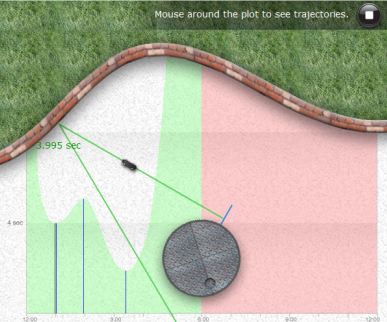
It’s beautiful! And it works well as long as you don’t want to modify the essential parameters of the problem. But Victor isn’t helping us learn the metatools that he uses to create this environment. To be fair, that wasn’t his goal, but as a user, I feel like I’m locked in a pretty small task box. More to the point, it’s expensive to create these interactive gems, and there’s only one Bret Victor.

Victor’s real power is his ability to rapidly create and deploy these tools. In a twinkling he can size up a task that is worth studying, put a box around it and spin a tool. He does this so effortlessly, with such mesmerizing legerdemain, that we lose sight of this meta-skill. What Victor was really doing in his talk was illustrating the power of tool spinning, the rapid creation of customized, context-sensitive, insight-generating tools. Direct manipulation is good, but the nature of direct manipulation changes with the context, and the context can’t always be anticipated.

My preferred goal is to make tool spinning (and tool sharing) as easy as possible. If tool spinning is easy, if that is the expressive skill that we give our users, then small task boxes aren’t a problem. You can always make more tools.

Don’t use the thing Bret made. Do the thing that Bret does.

Flows made visible

Galileo commands us “Measure what can be measured, and make measurable what cannot be measured.” An updated version of this might be “Visualize what can be visualized, and make visible what cannot be seen.”

If you grew up with a globe like this, you can be forgiven for thinking the big blue oceans weren’t much more than big and blue. But even a sailor with direct experience of the sea and its many tides and currents might be surprised by what the folks at NASA have done with a visualization called Perpetual Ocean.

Maximize the window when you look at it. There’s so much to see. The Gulf Stream jumps out, as you would expect. But what about the string of gyres peeling off South Africa? You can see how shallow and relatively calm the Java Sea and Strait of Malacca are, whereas the Caribbean fairly churns. And then there are the spectacular Roaring Forties that chase their own tail all the way around Antarctica. So much to see.

It’s one thing to be shown something new that you’ve never considered, something like the surface of Titan or a giant aquatic isopod. But to suddenly see something that is all around you, to have the mundane made exotic, that can be something of a shock. It’s also worth considering that, as complex as these flow diagrams are, they still constitute only one two-dimensional slice through a larger and still more complex three-dimensional flow field. I guess visualizing that that can wait a few years.

Flow visualizations seem to be in the air these days (heh), because what NASA has done with water, Martin Wattenberg has done with air. Behold his Wind Map. Where does all that wind come from? And where does it go to? A visualization can only tell you so much. Someone older than Galileo had words on the subject: “The wind bloweth where it listeth, and thou hearest the sound thereof, but canst not tell whence it cometh, and whither it goeth.”

While I was watching all these visualizations, I was thinking to myself, where have I seen that before? Then I remembered this little guy that made the rounds a few months ago.

Like I said, flow visualization is in the air. And the water and the stars, I suppose.

It’s 14.3 day in Europe!

Great hovering kookaburras! Pi Day is upon us, and me with my best pi coat at the cleaner’s.

In honor of the blessed event, I like to point people back to the Pi-Ku poetry we made up on this site back in 2007. There still are some great poems in there. My favorite is Chris K’s

Opa! I know a
Greek character to denote
disks’ key ratio

Naturally, haikus also put me in mind of the fit of pangram haikus that we did a while back.

You can see where this is headed. And so I thought to myself… hmmm. Do you suppose we could make a hai-ku-pi-pan-gram*? How about this:

For a quiz I found
vexatious Pi, mystic Greek.
She: jewel, blossom.

There we go. Haiku syllables. Pi letter count. Alphabetic pangrammitude. And the topic is the Queen herself. It won’t win any prizes, but still.

You must do better! Use this.

* Coincidentally, Haikupipangram is also the name of the Minister of Weights and Measures in King Kamehameha’s first administration.

Religion and Atheism

If you have a fondness for epigrams, you should follow Alain de Botton on Twitter. The man is a bon mot machine. One morsel: “What disappears from memory is how much of any moment is spent worrying about the future.”

He’s a sort of Philosopher 2.0, contending with the problems that confront us in the modern world, and rather than simply ranting like most of us, he offers subtle analysis and thoughtful alternatives. I’m a fan. The book that first propelled him to prominence was How Proust Can Change Your Life. Most recently, he’s just completed Religion for Atheists. Tag line: “Religions are too interesting to be left simply to those who actually believe in them.”

Here’s nice quick essay on it over at The Atlantic: What the Secular World Can Learn From Religion – Maria Popova. And since everything has a TED talk, here is his. Interestingly, he takes rather direct aim at the Dawkins camp of what he calls fundamentalist atheism: “They argue not just that religion is wrong, but that religion is ridiculous… I think it’s too easy to dismiss religion that way.”

There’s a lot of religious ferment going on these days. If you’re intrigued, you might also want to look into David Eagleman’s notion of Possibilianism.