Seeing Eye Birds: Parahawking

Guide dogs can see what a blind person cannot: doors, stoplights, crosswalks. Hawks can see what no person can see: thermals. Wouldn’t it be nice if someone flying a glider could keep a hawk on a tether for the purpose of sniffing out flight-sustaining thermal updrafts?

There’s no tether, but that’s the basic idea behind parahawking. The birds fly free but are rewarded from time to time. As it says in the FAQ.

Our birds need to be rewarded for guiding us into the thermals. During the flight the passenger will place small morsels of meat onto his gloved hand, the birds will come and gently land on the hand to take the food, and then gracefully fly away to find the next thermal. A perfect symbiotic relationship.

The video is a little long and same-y, but it’s worth watching to see the birds landing on the customer’s arm for a mid-flight snack. Start about 2 minutes in if you want to jump right to the good stuff.

I can see how this would go down big with the swim-with-dolphins set.

[Spotted on DIY Drones]

How ironic!

Mike Duncan runs a podcast called The History of Rome which I thoroughly recommend. One of the things that makes it enjoyable is oddball digressions like this. You won’t run across a passage like this in a textbook.

In November of 361 AD, Constantius II died and Julian, last of the Constantinians, inherited the empire. It would be an ironic end to the dynasty. At least I’m pretty sure it’s ironic. Sometimes I think that no situation actually fits the technical definition of irony and that the word just sort of hangs out in the linguistic ether singing a siren’s song that’s designed to crash the unsuspecting against the jagged rocks of pedantry. But I’m pretty sure it’s ironic. Constantine began the dynasty by single-handedly launching Christianity to prominence, and his nephew would end it by attempting to single-handedly turn back the clock and bury Christianity. That’s ironic right? It sure seems ironic. But it’s probably just interesting.

That’s from Episode 145, Julian the Apostate. We’re down to the last hundred or so years before the fall of Rome. I have no idea how long he intends to follow events in the east. Could take a while given that Constantinople didn’t fall for another thousand years.

You know what would really be ironic? If… no, wait, suppose that… oh never mind.

The New York Times Paywall

Whenever I’m talking to someone who believes that only chumps pay for digital content (Dude, why do you pay for music?), I think about street performers. Have you ever dropped a dollar in the cigar box in front of that cellist in Harvard Square? Yeah? Well what kind of a dope are you? That guy would’ve kept playing with or without your money. Sucker.

Like a lot of people, I was sad to see the New York Times turn off free iPhone access for all articles, but I had to concede that you can’t really expect a company to give away its primary source of revenue forever. I knew this day would come. I had expected a barbed wire fence to go up around the paper, so I’ve been impressed with the relatively enlightened approach that they’ve taken.

My brother just sent me this article called How The New York Times Paywall Is Working. It does a good job of explaining the difference between a gentle paywall (think “please”) and a fierce paywall (think barbed wire). It’s easy to saunter past the gentle paywall, and a lot of hard core geeks are going to laugh in your face. But ultimately that’s the one that’s going to work. The Times is running a great big experiment to see if the gentle paywall will work. And good for them.

There’s a theory about taxation that says people, on average, will pay what they think they should pay. If they think they’re getting screwed, they use fraud and willful neglect to limit what the government can collect. If they’re getting a good deal, so the theory goes, enough reasonable people will pay up to let the enterprise keep rolling. It may well be that the United States is going through its own New York Times-like convulsion (Dude, why do you pay for government?).

Call me an optimist, but I think enough reasonable people can recognize a good deal when they see one. Transparency serves everyone eventually, but it does take a while for the lessons to come home. As Washington remarked to Lafayette, “It is to be regretted, I confess, that democratical states must always feel before they can see. It is this that makes their government slow, but the people will be right at last.”

I’m convinced that almost all content will shift to this sort of honor system. The New York Times, like the US government, will be leaner, but it will be solvent and functional.

Then again, it might work more like this old Monty Python sketch in which Mr. Ford from the orphanage (Terry Jones) tries to convince a puzzled merchant banker (John Cleese) to give him a pound for charity.

Banker: I’m awfully sorry I don’t understand. Can you just explain exactly what you want.

Mr Ford: Well, I want you to give me a pound, and then I go away and give it to the orphans.

Banker: Yes?

Mr Ford: Well, that’s it.

Banker: No, no, no, I don’t follow this at all, I mean, I don’t want to seem stupid but it looks to me as though I’m a pound down on the whole deal.

Civilization is for suckers.
Managing contact info for couples

I keep thinking there must be a standard way to handle this situation. My contact managers (in the iPhone and GMail) want to divide the world into individuals. But I want to maintain contacts for couples too. That way if they share an address, children, or even (gasp!) a common land line phone number, I see it all in one place, rather than maybe here with her info or maybe there with his.

As a result I end up with three records: one for him, one for her, and one for the two of them. Birthdays travel with the individual, and anniversaries travel with the couple.

It’s a small enough annoyance, but what’s the canonical way to solve this?

Web-enabled mentoring

A lot of the talk about technology and education these days is about changing the classroom or inverting the lecture. These represent ways of rethinking the mainstream classroom, and there are a lot of interesting experiments underway.

But there’s another exciting form of education that’s showing real promise: web-enabled mentoring for deep skills.

The old school model goes like this: you sit in a big classroom and learn your basic skills. Then, if you’re good and if you show promise and if you have the wherewithal, you travel somewhere to apprentice directly with a master craftsman. This kind of one-to-one apprenticeship can be extraordinarily valuable for certain deep skills, particularly in the arts. Most people, even very talented ones, will never be able to study with a master. At least in person. But now the web is unleashing a new wave of mentoring to people who’ve never had the opportunity before.

I’ve come across two of these in the last few weeks: Animation Mentor and the Academy of Bluegrass. Watch the mentor testimonial video for Animation Mentor. It’s inspiring.

I also enjoy reading the blogs of artists that I admire. You can get so much closer to answering the question “how do they spend their time so that they can make that thing?

By the way, this is what I’ve learned: buy the same markers and notebooks they use. Then be talented and work really hard. So far I’ve got some really nice markers…

One thing you shouldn’t do in the next five minutes

If you want to sell copy, sell a list.

Try this: do a Google search for things everyone should know. On the first page of results, you’ll find lists of 10, 20, 50, and 100 things everyone should know. Writers are happy to make extravagant claims on our time. And we let them do it, because if you don’t read this list, you’re in grave danger of not knowing the 10, 20, 50 or 100 things that everyone should know.

Needless to say, you don’t know most of those things, and you never will.

The urge to complete checklists is so strong that simply unrolling a long list in front of someone can induce panic. Have you ever experienced Netflix queue stress, Tivo tension, or bookstore anxiety? There’s this absurd thought: Look at all those books I have to read! Try this search: books you must read. Now how do you feel?

Jay Czarnecki saw what I wrote last week about marking things to read later. It’s easy to put too much food on your plate at the Internet Buffet, telling yourself you’ll certainly read it later. But you won’t, and the great bromide is this: That’s Okay. Jay was kind enough to send along this essay on the melancholy pleasure of Not Being Able To Do Everything: The Sad, Beautiful Fact That We’re All Going To Miss Almost Everything. Don’t have time to read it? That’s okay. Here’s the big idea: If you don’t have time to read it, that’s okay. Reading everything doesn’t make sense anyway. The letters get all mashed together.

As for the one thing you shouldn’t do… don’t do this search: places to go before you die. You don’t need to go to all those places. I absolve you.

Latering and the Universal Later Feed

When you record something on television to watch it later, you’re time shifting. That’s the fancy term for what might be called “latering.” I can’t watch this now. Let me watch it later.

Time shifting was a big deal when the first video recorders were introduced. It seemed almost magical at the time, since video content flowed like a river, never to return. Since then, technology has opened up many more possibilities.

These scenarios have the same basic time or place-shifting premise in common.

  • I’m at Starbucks and I hear some music that I’d like to play for my wife at home.
  • I’m checking Twitter on my iPhone and I see a reference to a New York Times article that I don’t want to read on my tiny screen.
  • My brother recommends a book that I want to check out next time I’m at the library.

All of us have evolved tools for dealing with scenarios like these, from pen-and-paper lists to spreadsheets and specialized web services. I manage a bunch of these lists with a variety of tools. I keep books that I want to read on an Amazon Wish List, but books that I’ve read get added to my archive on LibraryThing. I use Shazam to identify music and then I listen to it with Rhapsody. I use iTunes to keep track of podcasts, but getting the podcasts into iTunes can be tricky. Individually these systems are powerful and convenient, but taken together they can befuddle. It was Instapaper that made me realize the value of something more universal. Instapaper lets you mark any URL with the magic words “read it later”. It then gets added to a queue that you look at later. That’s simple enough. The cool part is that so many other applications have added an Instapaper “read it later” hook. So I can route things to Instapaper from any device, any application (almost).

One of the nice things about Instapaper is that it’s platform agnostic. It’s not trying to keep you in its own ecosystem, the way Apple or Google might. Here’s an example of what I mean. While at my work computer, I happen across a YouTube video, and I want to tag it for watching on my AppleTV at home. But Apple has no interest in playing nicely with Google, so they make it painful to watch YouTube videos. Wouldn’t you rather watch one of *our* videos instead?

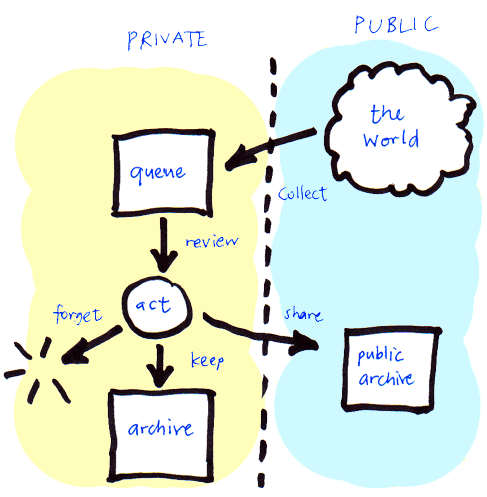
I want a universal “later” button that lets me add any resource to a single feed and then lets me sort and filter later in a way that’s appropriate to that device.

Here’s a more advanced scenario to illustrate how it might work:

  • In a tweet someone mentions a video of a good conference talk. I add it to my “later feed.” In my car, I open my music player which can see my feed. I filter for videos and select the option to play it back with audio only.

This sort of thing isn’t hard, but it should be much much easier. Plenty of smart people are thinking about this. So tell me: what’s the right vocabulary here? General Systems Theory people call these stocks and flows of information. They’re related to Twitter feeds, Google+ Circle streams and Facebook activity feeds. Until someone tells me the canonical nomenclature, I’m going to refer to it as Latering cool stuff to my Universal Later Feed.

Cheap fusion at Helion

A few months ago I posted a hopeful note about the fusion research going at the National Ignition Facility at Lawrence Livermore Laboratory in California. I was impressed with a speech I’d heard by lab front man Ed Moses. He’s very slick and tells a good story. But since then I’ve spoken to a real honest-to-goodness fusion physicist from MIT who painted a convincing picture that Moses is more snake oil salesman than prophet. The only thing likely to come out of the NIF, he says, is bomb research. Sigh. Get your hopes, and see what happens? Fusion is still 30 years away, as always.

Still, it’s an interesting topic. Most physicists acknowledge that, while we find it difficult to manage now, it should become workable at some point (more than 30 mythical years from now, presumably). There’s no magic to it. So we really should keep plugging away at it.

The other day I was lucky enough to get a tour of the fusion reactor at MIT, and the work they’re doing is impressive. I had no idea you could do so much nuclear fusion in the middle of Cambridge. But the people working there don’t have any illusions about cheap fusion power right around the corner. The big new fusion reactor in France called ITER won’t even start doing serious work until well into the 2020s, and it’s still a science machine (as opposed to something that a utility company can buy).

The real problem seems to be the capital-intensive nature of the work. This has plagued nuclear fission too. When even the smallest experiments cost insane amounts of money, you become extremely cautious. Many good ideas never get tried, because you have to put all your effort behind the one idea that is considered most likely to succeed.

Given all this, I was amazed to read an article in Popular Mechanics about a small company in Seattle called Helion Energy. These guys are doing real fusion research in a small company setting, and they appear to be completely legitimate. What they’re doing now is research, and nobody expects it make any big breakthroughs anytime soon, but it’s very encouraging to know that all our bets don’t have to be big.

The era of the irrepressible teacher

Blogs were supposed to be the medium that empowered citizen journalism. Much digital ink was spilled pushing this idea back and forth:

“You bloggers are self-absorbed and undisciplined!”
“Oh yeah? Well you journalists are arrogant and out of touch with the real world.”

It was all pretty silly. I can see how a journalist might feel threatened these days, but whatever is destroying journalism as a career, I promise you it’s not bloggers.

I think when we look back on this era, it will be clear that the most important category of amateurs unleashed by the web wasn’t wannabe journalists but wannabe teachers. You probably know the story of Salman Khan and his startup academy. He’s an extreme example of a gifted teacher who started teaching over the web in his spare time. He’s doing it full time now, and he’s making a huge difference in the world. Khan has done a lot to capitalize on the merits of the web, as opposed to simply repackaging the instruction you’d see at an institution.

I keep running into these sites now, really high quality instruction provided for free by someone who has the teacher bug. It’s remarkable and encouraging. Want to learn quantum computing? Michael Nielsen has a series called Quantum computing for the determined. He uses a format for which he credits Salman Khan as inspiration.

My favorite new site is Kalid Azad’s BetterExplained. I first came across his quick guide to Git (Git is a software management system). Of more general interest is his Visual, Intuitive Guide to Imaginary Numbers. He launches his discussion by reminding us how weird negative numbers are. And so they are. Good stuff.

Why is Kalid doing this? Because he can’t be stopped! I find it interesting to think of the web not as something that empowers natural teachers, but as something that removes the weights that have been around their shoulders. It’s sobering to think how many great teachers there are that have been thwarted by the pain of teaching as a career path. But that was then. Now is their time. Sit back and enjoy the show.

Getting help from people like me

I want to let you know that I appreciate all the work you do for me. You write Wikipedia articles for me, you buy my crap on eBay, and you solve my computer problems. You’re so good Time made you Person of the Year back in 2006. Remember that? Your mom was so proud!

The big thing I notice in a post-Google world is that when I need help, I almost never get it from the pros. Not from the vendors or the documentation writers. Not from the technical support staff. I get my help from you.

I’ve been saying this for a while, as in this invited piece I wrote for Desktop Engineering last year: MATLAB Central Has Answers to Share. The same principle applies at PatientsLikeMe.com. The big idea is that nobody understands my pain like someone who shares my pain. If someone is paying you to think about my pain, that’s never going to be quite as good.

Here’s a recent example that spurred me into writing about this topic one more time. I was using Word the other day and added a horizontal line by typing <dash-dash-dash-dash-return>. Did you know you could do that? You get this nice line that stretches right across the page. It’s pretty cool… until you want to get rid of the line. You can’t delete it. You can’t backspace over it.

These days I know not to waste time worrying about what to do next. Looking at the Microsoft documentation is a fool’s errand. Don’t bother! Instead I went to Google and typed in these words: I can’t get rid of the annoying horizontal line in Word. The first item solved my problem. Naturally, Microsoft would never refer to the line as “annoying.” But that’s one of the words that led me straight to my solution.

(By the way, it turns out the line is the border of an invisible table.)