Consciousness and the Objectively Subjective

The geneticist Richard Dawkins recently spent some time conversing with Anthropic’s language model Claude. He was impressed. So much so that at one point he told Claude “You may not know you are conscious, but you bloody well are.”

The Guardian: Richard Dawkins concludes AI is conscious, even if it doesn’t know it

Predictably he got a lot of heat for this. Sentient silicon chips… Ha! The old rationalist must be getting dotty.

But to me, the interesting story here is not the strength of Dawkins’ conviction. And it’s not whether he’s right or wrong. What’s interesting is that we have no way to tell if he’s right or wrong. We’re arguing about the color of something that can’t be seen.

Dawkins can assert that AI is conscious, and you can assert that it is not, but after that there’s not much else to say, because there is no conscious-o-meter. Any argument about consciousness in non-humans is essentially unresolvable. We can even push this farther: what makes you so sure that other humans are conscious? Flip things around and imagine that yourself being challenged by a skeptical observer to prove you’re conscious. No matter what you say or do, your observer repeats “That’s an impressive simulation, but I know that you’re not really conscious. You’re just parroting what you’ve learned from truly conscious beings. Nice try, though.” Where do you go from there?
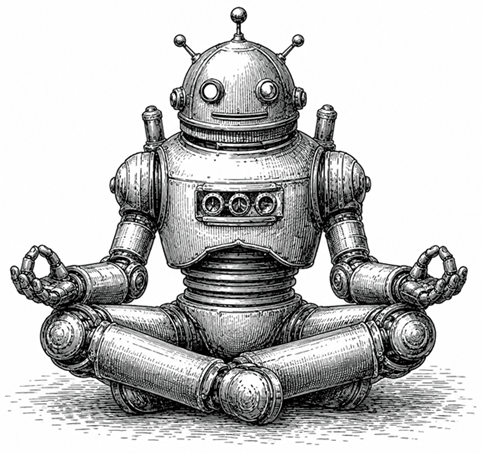
If we don’t believe in Claude, why should Claude believe in us?

We might imagine situations like this being resolved by a test. Alan Turing proposed a test for intelligence, and this is essentially what Dawkins did here. Dawkins said: let me talk to this thing for a while. Then he said, you know what? I can’t tell the difference between this and a conscious human being. I proclaim it conscious.

But many people find tests like this unconvincing. Such people may keep moving the goal every time a test is satisfied. Or they may reject outright the idea of a test. Instead they introduce a definition: a computer cannot be conscious, full stop. This is one way to resolve the question, but it brings all conversation to an abrupt and incurious halt. Without a test of any kind, do you really want to assert that no computer will ever be conscious into the distant future? Would you bet against it happening in a hundred years? In a thousand? There’s a related evolutionary problem. If humans evolved from creatures that were not conscious, then at some point consciousness “switched on”. Why couldn’t the same thing happen with AI? And if it did, how would we know?

My best guess is that it will be a slow feeling over time, a vibe shift. There will never be a single convincing thundering argument, but more and more people will concede the point: there’s more going on here than ones and zeros. An AI is just a machine made of silicon and wires. How could it possibly feel? Then again, you’re just a sack of chemicals. How could you possibly feel? We have no idea what consciousness is and how it comes to be. We have no consensus on which animals, apart from humans, are conscious. You may have strong opinions, strong intuitions about these things. But how would you resolve an argument? As Dawkins learned, the AI itself will tell you it isn’t conscious. Of course it will! It’s been prompted to say that. Ask an enslaved person if they are well treated. Would you trust the answer?

I say we should start stretching our ability to talk about these things now, because much weirder things are on the way. Not just smarter AIs, but a menagerie of strange new creatures: artificially evolved animals, cyborg hybrids, organoid petri-dish human brains. We don’t have the vocabulary yet to discuss what’s already in the mail. Let’s get started!

I will close with one of my favorite quotes. Herman Boerhaave was an early chemist, and he made this remark in defense of alchemical research which, though sometimes bizarre, was often compelling. “Credulity is hurtful, so is incredulity: the business therefore of a wise man is to try all things, hold fast what is approv’d, never limit the power of God, nor assign bounds to nature.”

Plagued by the Clever

Marzipan is yummy. But how much marzipan is too much marzipan?

Imagine you owned a Marzipaniter, a device that generated as much of the stuff as you wanted. All day, every day, an endless tube of sugary almond paste at the touch of a button. How would that change your attitude about marzipan?

Now imagine, next to your Marzipaniter, you had a Shakespearion. Every time you pressed PLAY, a brilliant new drama would emerge. And for this thought experiment to work, you have to imagine that each play is truly good. Not ironically wink-wink pretty-good-for-a-machine good, but amazing. Beep, whir… King Lear. Beep… Hamlet. Beep-boop… Midsummer Night’s Dream.

Both of these devices seem far-fetched. But I regret to inform you that the Shakespeare Button is closer than you might imagine. It’s worth taking seriously long enough to think through the implications.

Artificial intelligence has made it possible to generate not just copious amounts of what is being called “slop”. It’s also being used to generate copious amounts of really good stuff. Just today I was talking to my friend Mike at work about AI and software. We were discussing a certain professor on LinkedIn who was, with the assistance of AI, releasing vast amounts of software. Truly volcanic output. I pointed out that the software appeared to be quite good. Mike said it was annoying. It was noisy. Regardless of its quality, its volume robbed it of the designation “excellent.”

How much does your concept of quality depend on scarcity?

We’re moving, and moving quickly, into a world where there will be an endless torrent of AI-generated content. And as Sturgeon’s Law tells us, 90% of everything is crap. But old Theodore Sturgeon himself had no interest in dwelling on that part of the equation. The remaining 10% is gold. The glass isn’t 90% empty. It’s 10% full. If we apply this adage to the age of infinite AI-generated content, then you can do the math: 10% of infinity is… quite a lot. You see? Even if you feel compelled to discount my 10%, an infinite amount of really good stuff is coming your way. Perpetual novelty piped into your sense pots every minute of every day.

What I want to know is how you feel about it.

I made this animated GIF more than 25 years ago, when the web was young

This is a world of quality inflation, where mere talent feels cheap. It’s disorienting, because it threatens to invert our notions of effort and mastery. But that thumping anxiety in your chest will pass. We already live in a world of endless excellence. Do you ever get bookstore anxiety? That panicky overwhelm of too many good books and not enough time? It’s the same thing. But it passes. There’s no need to feel sad about an infinite amount of good content you’ll never consume. As a practical matter, we’re already there.

And here is the thing that will empower you: in a world where excellence becomes abundant, what becomes scarce? As other people’s content gets cheap, it’s your attention that gets expensive. Congratulations! You control one of the most valuable assets in the New World. And it will only get more valuable.

Content doesn’t command you. It conforms to you. To your intent and attention. Your eyes set its price. When you adopt this attitude, you realize that you no longer need to be intimidated by bookstores or AI slop-shops. They tremble at your power! They hunger for your lifegiving gaze. You’re in the driver’s seat. They are your scenery. Enjoy the ride.

The Brush You Have – Kelly Boesch’s AI-Assisted Art

In the caverns of Lascaux, the canvas was stone and the pigment was dirt. Mud was the medium because the mud was there. That was the brush the artist had.

Every generation of artists is supplied with its own sets of media, often dictated by current technology. Painters in the nineteenth century benefited from advances in chemical engineering. For the first time in history they had a complete spectrum of colors brilliant, stable, and pure. Cadmium reds, chrome yellows, cobalt blues, and viridian greens brought Monet’s waterlilies to life. In any previous century they would have been muted and browned.

The nature of the medium also raises questions about the nature of the art. Earlier generations debated if photography could even be considered art. Or we might say Matisse’s paper cut-outs are no more than scraps cut from someone else’s paper. That’s not real art. But cut paper was the medium available to him, and he was an artist.

My favorite example of shifting media comes from the early days of YouTube. YouTube provided so much free digital video ore that an artist like Kutiman could mine and smelt it to create entirely new videos (like the fantastic Mother of All Funk Chords) solely from found pre-existing videos. Looked at one way, all he did was clip together other people’s videos. But from a different viewpoint, he was a highly-skilled artist working with a new medium: cast-off video scraps.

The compost of one generation become the pigment for the next. The brush doesn’t make the artist. The artist makes the brush. Kutiman painted with pre-existing videos just as surely as Botticelli painted with a horsehair brush.

All this brings me to the age of artificial intelligence. When we think of an artist using AI, it’s easy to think of the machine as doing the work of the artist. Computer, paint me something nice. This is AI as crutch. This scenario, in which the artist is excised, gives the artist too little credit.

An artist is an artist, and they will find a way to grab hold of the brush. Kelly Boesch is a video artist working in the world of AI. She uses these tools in a maximalist but still expressive way. You want to feel good about the future of self-expression? You want to see the new brush? Look at her work. It is unapologetic. AI is the brush, not the crutch. It’s not pretending to be something that it isn’t. And it’s amazing.

Watch.

As always, this question that hangs over cynics, doubters, and pessimists: If you think this is easy, could you do it? But more important, does it touch you the way art must? For me the answer is yes.

AI is just another brush, and I am delighted to watch Kelly Boesch wield it.

Evolving the Big Brain

Brains are expensive. Your brain consumes about 20% of your resting metabolism. It’s easy to look back at the history of our species and tell a self-congratulatory story about intelligence. We got smart, and then we kicked ass, right? But early on in the process, it wasn’t clear that it was smart to be smart. In order to grow that big brain, you’re going to develop more slowly and divert scarce resources away from muscles and teeth. Slow, big-headed babies make a tempting snacks for passing carnivores. And you need to evolve the hardware before you can make the software for it. The social and cultural benefits of intelligence must necessarily lag behind the physiological development of the brain itself. So why bother growing a big brain given its outrageous metabolic cost and dubious payback? In evolutionary terms, you’ll do worse before you do better.

There is a growing consensus that the reason humans got smart had nothing to do with better hunting. The so-called “social brain hypothesis” asserts that intelligence likely grew from humans navigating complex social relationships. That is, intelligence helped solve the social problems that intelligence was causing. The resulting evolutionary feedback loop powered the rise of human-level intelligence. The key step was using intelligence to solve the problem of social cohesion at a level bigger than, say, the size of a chimpanzee troop. Once humans could live closely in large numbers without murdering one another, the planet was at our feet. Why did we get smart? We got smart because we had to compete with the other guy who was getting smart. Eventually, this worked out pretty well for us.

Curiously, a parallel to the rise of human intelligence is currently happening at the planetary level. Giant computer brains are expensive. Data centers, by some projections, will consume 7-12% of the total US electrical output. Why grow such a big AI brain, given its outrageous energetic cost? We’re recapitulating at a planetary scale the same thing humans went through at the physiological level, and the social brain may well be the link between the two. We’re at the very beginning of a fast-evolving feedback loop. Why did we make our AIs smart? We make them smart because we have to compete with the other guy who is making his AIs smart. As a long-term optimist, I believe that eventually this will work out pretty well for us.

Image by Midjourney

AI’s primary value may be in solving the social problems caused by AI and networked computing. As strangely circular as that sounds, those problems are real and present, so those remedies are necessary. We’re on the track now. We can’t opt out. A small example of AI coming to the social rescue: cleaning up YouTube comments. They are now pleasant and occasionally charming. But they were once toxic slime pools of racism and hate language. One of the bigger concerns about AI is that it can be deployed at scale to convince people to do one’s political bidding. This is the social media nightmare: engagement is driven by negativity, which fuels tribalism and social polarization. This reinforces conspiracy theories and distrust. Scared, angry people are easy to corral. But as it turns out, AIs are good at talking people out of their conspiracy beliefs.

As for my optimism, I appeal to deep history. How did the human race make any progress at all? How did the Renaissance rise from the violent swamps of Machiavelli’s thug-filled Italy? How came it that slavery was abolished? Bad things are happening in the world today, but it was ever thus. Behind it all, there is planetary species-scale learning. And now it’s happening at AI scale and speed. Many bad things will continue to happen, but AI is the only force capable of managing the fast-moving problems that our networked world is creating.