Space-bound chimp “thrilled” about launch

Google reached some kind of agreement with the old Life magazine image archive. When I thought about Life, I remembered the coverage they used to give to the space program. I searched for “Mercury” and found our first seven astronauts in their magnificent and somewhat ridiculous silvery suits. Look at those boots! Honest to God, it looks like they’re about to go trick-or-treating. Either that or they’re headed to a fetish-themed club.

The search I did also turned up pictures of our REAL first astronaut: Ham the Astro-Chimp. They might call him Ham the Ham… check out this picture. LIFE: “Ham” mugging after Mercury space flight.. That’s an astronaut who’s not taking himself too seriously. Here’s a little more of the scene. I love the old-school NASA van in the background. It makes me want to put on some Juan García Esquivel music.

Election maps

The recent election, in a good example of counter-causal temporal wind, now seems far, far behind us. In fact, it might be called a hurricane-force temporal gust, blowing the effects of the election far back into last year. This “Hillary 2008” sign was found wedged deep in a palm tree from June 2007.

Now, in the still of the post-election calm, we’re starting to see some fascinating election maps analyzing what just happened. There is, of course, the familiar blue state/red state map in which, as of this writing, Missouri is still listed as undecided (according to the Wikipedia). You Show Me but I won’t show you?

Far more interesting are Mark Newman’s nifty election map equal area cartograms. These go a long way to explaining how those vast tracts of red territory don’t add up to a Republican majority.

Also enlightening is the county-by-county map, not of the voting in 2008, but of the voting differential between 2004 and 2008. I first learned of this from Ben Fry’s blog, but the map is on the NY Times site. What you see is an almost entirely blue map except for a region that is comprised of nearly the entire states of Tennessee and Arkansas, with a good chunk of Oklahoma. That’s the only part of the country that voted substantially more Republican than in the last election. What’s going on here?

Now look at this. On Pin the Tail I first came across this map. It was written up in much better detail by Strange Maps. It’s an overlay of 1860 cotton production and 2008 voting patterns. The alignment is uncanny.

This got me curious about Tennessee and Arkansas again. I went to the U.S. Census Fact Finder and looked up a map of the percent of people who give their race only as white. What you find is that Tennessee and Arkansas, in addition to being relatively poor, represent the southernmost boundary of the 90% contour line of people who describe themselves as strictly white. Which is to say, the whitest part of the Confederacy.

It seems appropriate to quote Faulkner: “The past is never dead, it is not even past.”

Time-Lapse Clouds

Matt Simoneau sits around the corner from me at work, and he made this nifty time-lapse video. He calls it Clouds Outside My Office Window. Well, Matt’s view is my view, so these are also clouds outside my office. Like he owns the clouds! Those are my damn clouds.

Click on through to see the animation. As you can see, life at a software company is pretty dynamic. It gets crazy some days. For example, did you see those cars go flying through?

The story of how Matt got his camera to take these pictures is a good illustration of how communities can put open source code to work. The Canon camera that he used to do this didn’t originally have the time-lapse feature. But amateur code sleuths figured out how to hack into the camera’s firmware and give it new features. If you have a Canon camera, you get to benefit for free. This ends up being very handy for people like kite aerial photographers. Not to mention amateur intervalometric photojournalists like Matt.

The healing power of Slack

Today I happened to watch Randy Pausch’s lecture on time management. It’s in the same breathless spirit as David Allen’s Getting Things Done work. And both of these, after all, are just the newest forms of time management techniques that have been around since Frederick Taylor’s time and motion studies. At their heart, these techniques boil down to something like this: always have a goal, always be doing, always measure your progress against your goal. Waste not.

Inefficiency, or slack, is the sworn enemy of Taylorism and modern scientific management. And we have banished slack so completely that unexpected new problems arise. One example of this is traffic. If you look at the space between cars on a typical highway, you might conclude that it is inefficient. May we not, in the name of maximizing throughput, squeeze out that space? But even if you discount the safety issues associated with tailgating, researchers have discovered that crowding between cars contributes to flow-choking traffic jams. At a critical car density and speed, a simple tap on the brakes can initiate a backward traveling wave that ultimately locks up traffic somewhere upstream.

Here’s a video showing what these waves look like in practice.

How do you calm a traffic jam? Feed it space. Add more slack in the form of restrained acceleration, lower speed limits, and more space between cars.

That’s old news. Here’s something more relevant to our Recent (and Ongoing) Financial Unpleasantness.

Paul Kedrosky writes about where false efficiencies get in the way of market stability. Automatic rebalancing is a financial tool that guarantees a certain balance to a financial portfolio. When it gets out of balance by, say, 3%, automatic buy and sell orders are placed to rebalance things. This works fine when the weather is calm, but when the markets are in turmoil, and when everybody is using the same automatic rebalancing robots, destructive waves can result. What to do? Feed those robots a dose of slack. Turn down the rebalance margins to 6%.

Slack doesn’t get the respect it deserves. “Nothing” isn’t nothing. Emptiness is solid and alive.

And when times get lean, don’t fret. Help yourself to fat slice of empty pie. It helps. Just ask Bob.

A town called Tambo

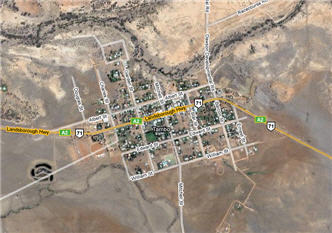
My niece Julia is in Tambo. Tambo is a small town in western Queensland, Australia. How small is it? Well, by my count, 12 or 14 city blocks just about accounts for the whole thing.

Tambo, Queensland

Wikipedia puts the population at 350, so maybe with Julia it’s 351. It is situated on the banks of the Barcoo River, which, as Mark Twain said of the Arno, would be a “very plausible river if they would pump some water into it.” Tourism has replaced the sheep business as a primary source of income. According to About Australia, one of things to admire in Tambo is the Tambo Teddies Workshop where you can “see the sheep skin teddy bears.” An impressive, if sordid, task for sheep to undertake. I don’t wonder that it brings in the crowds.

But there’s nothing wrong with being small, and Tambo looks like a very well-kept place. I know this because I drove around it courtesy of Google Maps Street View, which, astonishingly, has been there and will show you around. Here, for example, is the establishment where Julia works.

If you want to know more about Tambo, read all about it on Julia’s blog.

Helicopter strobing

If you only visited Aspen during ski season, you might be forgiven for thinking the place is snowy all year round. Similarly, a third grader might well imagine his teacher lives at school, since that’s the only place he ever sees her. Any time a periodic observation is synchronized with the event it measures, things get screwy. This movie makes the problem clear.

No matter how surreal it looks, this helicopter isn’t doing anything strange. The rotor turns at a certain rate, and the camera happens to be snapping frames for the movie at exactly the same rate (or a multiple of the same rate, but that complicates the explanation). So the camera is catching the rotor blades at exactly the point as they whirl around. As a result they look like they’re motionless. But if you were on the ground watching, nothing would look amiss.

Here’s another instructive video of a more prosaic system: the wheel of a bike.

A notable application of this kind of synchronization was the Red Baron’s machine gun. In World War I, if you mounted the guns where they were most conveniently operated by the pilot (just over the nose of the plane), you had the unfortunate side effect of shooting off your propeller. The first solution to this problem, introduced in 1914 by Saulmier, was to use armored blades, so bullets did minimal damage when, inevitably, they struck the prop. But the cleverer solution by far was strobing: use an interrupter gear that only lets the machine gun operate when the prop is safely out of the way. Just as with the helicopter video, from the gun’s point of view, the propeller is motionless.

Personal Fabrication for Dummies

You can now get a personal fabricator for $5000 from Desktop Factory. That’s about the price point where LaserWriters started to gain widespread acceptance. Although I’m a big fan of 3-D printing, I don’t actually expect them to appear in most houses anytime soon. I get excited about them because they dramatically accelerate design cycles for anyone building solid objects of any kind.

I found this nifty tutorial to the world of custom manufacture on the Replicator blog: Personal Fabrication for Dummies.

By the way, you can also fabricate objects by shooting lasers into granulated sugar too, if you prefer. Not very practical, but worth a peek.

The History of Rome podcast

If you haven’t yet been convinced to give podcasts a try, here are two good ones that may push you over the edge. I would never sit in front of a computer and listen to a lecture or radio program, but I really enjoy putting podcasts on my iPod and then listening to them while I drive or while I’m folding laundry (or both, if I happen to be driving the laundrymobile). It’s a very satisfying way to learn.

These podcasts are both about matters historical, recent and ancient.

The first is just one very good episode of This American Life. It’s called Another Frightening Show About the Economy and it’s about the collapse of the Wall Street financial system. I saw it recommended lots of places (including Paul Kedrosky’s blog) before I finally listened to it, and I’m glad I did. Very informative.

The more ancient historical matter is the History of Rome podcast. I first heard about this on Alex Palazzo’s molecular biology blog, and once again, it’s a real find. It’s compact, entertaining, and enlightening. I knew the writer and narrator, Mike Duncan, was a genius when he deadpanned that the Roman tactic of bringing down Carthaginian battle elephants with chariots was similar to the one employed by the Rebel Alliance against Imperial Walkers on the ice planet Hoth. Now that’s bringing history alive.

Pictures of the Sun

It’s fun to look at pictures of planets taken by our robotic eyeball extenders. We get to see things that are too darn far away to see with even the biggest earthbound telescope.

But there’s another kind of treat when we look at our own sun with new eyes from here on earth. We’re used to seeing marvelous detail in the moon’s changeless cratered face, but the sun is just a blinding fireball to our eyes.

When I look at a planet, I think “That’s a place.” I can imagine flying over it, or even stepping out of my little tin spaceship onto its surface. But the sun is always just the sun. Not really a place, just a white hole in the sky. My imaginary spaceship never goes there.

New telescopes (and a few space probes) are changing that. The featureless sun is really a charismatic world of curdling fire, boiling magnetic storms, and vast billowing exhalations of solar steam.

These pictures (from the Boston Globe’s Big Picture series) prove that the sun is a place jammed with personality: The Sun – The Big Picture. And if you want to know why they call it “solar wind”, be sure and look at the animation where a strong gust from the sun whips the tail off a comet

Another successful walk

It was a cold and blustery day at Suffolk Downs, but the sky was blue and the walk was a success. We’ve been doing these fundraising walks with Jay since he was first diagnosed in 2001, and they just keep getting bigger. Years ago a nearby park in Cambridge was big enough to host the walk. Now we walk around a horse racetrack with an enormous parking lot out front. It’s a great venue. Those horses have a nice track. Here’s a brief local news clip of what the event looked like: “Greater Boston Walk for Autism” raises over $1 million.

Today there were over 20,000 people walking. This single fact brings obvious good news and bad news. Good news: we’re raising lots of money for autism research. Bad news: autism is a growth market. I’d love to tell you to sell your autism stock, but in truth you should be buying. It’s amazing how many families it affects.

When I ask for people to give money to this cause, I’m painfully aware of how many good causes are out there. You have your favorite charities and I have mine. And if some other evil had touched my life, I would be asking you to help me fight it instead of this one. But this is the one that touched my life. It moves me; I want to move you.

When you live in a house touched by a disability like autism, it’s very easy to turn inward. Most people seem to have it easier than you. There are two mistakes here. The first is thinking that some people get off easy. Every family has troubles, but they are often hidden from view. This leads to the second mistake, which is turning inward, thereby feeling sad and lonely at once. You can’t always stop the sad, but you can stop the lonely. That’s one of the things that’s great about the walk. You achieve a practical goal, raising money, but you also get to look around and say, “My God, look at all these people who have to deal with this.” It gives you sympathy for others, and then, as a kind of bonus, some healing sympathy for yourself.

This is my story. Tell me yours. We have to keep telling each other the stories that matter to us. It’s the only way to get by.

This is a picture of my wife Wendy near the table where she was making inspiration ribbons for the walk. Each one is inscribed with the name of someone with autism.

As a result of her efforts and the rest of our team, including many of you, Jay’s team raised over $7500 and counting this year (it’s not too late to give!).

Thanks.