Duolingo from CMU – Think like a rain forest

The philosopher farmer Wendell Berry once described modern farming like this.

Once plants and animals were raised together on the same farm — which therefore neither produced unmanageable surpluses of manure, to be wasted and to pollute the water supply, nor depended on such quantities of commercial fertilizer. The genius of America farm experts is very well demonstrated here: they can take a solution and divide it neatly into two problems.

Typically, when faced with problems, we try to mitigate and resolve them one at a time. Each solution has a cost and at some point we run out of money. But sometimes you can work magic by reversing the process described by Berry. Take two or more problems and turn them into a single solution.

Here’s an example adapted from a TED talk given by CMU’s “Mr. CAPTCHA” Luis von Ahn.

Problem 1: Mr. X wants to translate a document.
Problem 2: Mr. Y wants to learn a foreign language.

Both Mr. X and Mr. Y are willing to pay for their respective services. But wait! Would it be possible to have Mr. Y learn Lithuanian while simultaneously translating Mr. X’s document for a client in Vilnius? It’s pretty clear it wouldn’t work as stated, but if Mr. X and Mr. Y are replaced by thousands and thousands of people, it just might. In fact, von Ahn swears that it does work, and his team built a site called Duolingo to prove it. Watch the video to see if you’re convinced.

If it works as well as von Ahn believes, the implications are staggering. Two hungry communities can feed each other, because the waste product from one group is the food of the other. And along the way this could eviscerate the translation and language instruction industries.

Don’t think like a farm. Think like a rain forest.

Image search, or Everything is traceable now

TinEye is a service that flips around the normal image search process. Instead of using a word or a phrase, like fleem or crumhorn, to find a list of images, you use an image to fish for other images like it. This turns out to be particularly useful for answering the question “where did they steal that image from?” Rights-holders can use this technique to police their ownership of images, and anti-SOPA activists can use it to bust pro-SOPA politicians for stealing their Twitter background images.

Recently Matt told me that Google is in the game now, and their image search engine, through the magic of Google being Absolutely Huge, will probably crush TinEye in short order. At any rate, I was intrigued, and so later that day when I came across an interesting image in an article I was reading, I thought I’d try a little detective work.

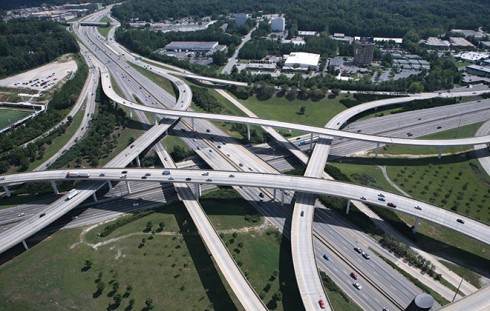
highway

Here’s the article: Branching and merging: the heart of version control. Don’t worry about the article itself. See that stock photograph of a highway interchange? It’s pretty cool. Where did it come from? Where is it in real life? In the Future, by which I mean now, we will be able to answer these questions with a few serene keystrokes. Watch this.

First, grab the URL for the image and do a search.

So this picture is Image 4848603 available from 123RF Stock Photography for a modest fee. And where is it? It tells us it’s from Atlanta. That’s not a lot to go on, but there aren’t that many large freeway interchanges in Atlanta, and since we live in the Future, we can use Google Earth to fly over the metropolitan area. The background shows it’s in a fairly rural area, and after a brief search, thar she blows, cap’n, off the starboard bow!

It’s the I-285/I-85 interchange near Doraville, Georgia.

I found the whole exercise profoundly satisfying. I could use a cigarette right about now.

Real time aurora

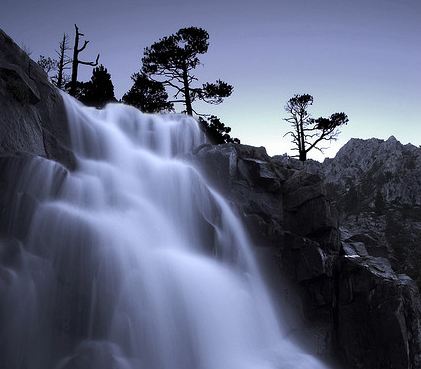
I remember seeing a picture like this in National Geographic when I was a kid. It’s a picture of a waterfall, and a lovely one no doubt, but something strange is going on. Later I learned it was taken with a long exposure so the fast moving water gets this dreamy gauzy veil-like effect. I remember thinking to myself: What in the world is going on here? I’ve never seen a waterfall like that. It’s not a sin for style to trump verisimilitude, but it sure can be confusing if you just want to know what the damn deal is.

Photos and videos of the Northern Lights, the aurora, suffer from the same treatment. There are lots of picture and videos of the aurora, but they are typically brightened and saturated, and the videos are almost always sped up. Or at least I think they are, given that I’ve never actually seen the aurora borealis. What I most want to know is this: what was it really like to be there?

Here is a video that shows you. I like the fact that they show you people and houses in the foreground and then pan around slowly and deliberately. Its the first time I’ve felt like someone was interested in letting me stand next to them, as opposed to expecting applause for their technical skills. Winston Churchill once described a gentleman as someone who knows how to play the bagpipes but refrains. I would say the gentle videographer knows how to use hyperactive jump cuts in the best music-video style… but refrains, choosing instead to offer us a chair and let the heavens speak for themselves.

Dance of the Spirits. Real Time Aurora footage. from Ingenious TV on Vimeo.

[via Steve Crandall]

Biofactories and cowborgs

Clean energy is going to save us. Oh no, wait! Clean energy is going down the tubes. Maybe nuclear energy ia the next big thing after all. Oh, right, except for the earthquake that vaporized all political support for nuclear power. But maybe thorium fission is the magic we’ve been looking for. Or maybe not.

I tell you, these hype cycles are exhausting. It’s enough to make you pretend you don’t care and hope for the best.

When sorting out the hope from the hype, I like to find technically trained people with clear voices, people like Rob Carlson and Tom Murphy. Carlson is on the leading edge of biotechnology and has some encouraging things to say. I enjoyed this piece on The new biofactories. Biotech is promising because it’s granular, scalable, and distributed. Granular, in that it can work in sizes from the humble test tube to a 1000 liter stainless steel brewing tank. So you don’t need a hundred billion dollars just to see if it will work (cough, fusion!). And biotech is scalable in the sense that if it works, you make a lot of product. The fact that it can be distributed means you can make stuff close to where you use it. So not only can you avoid going to the most dangerous part of the world for what you need, you also get to avoid the long trip home from Godforsakenville.

Clearly it would be foolish to say that biotechnology is going to solve our problems, energy-related or otherwise, but it’s coming faster than you think. Read Carlson’s essay and see if you can picture his image of cowborgs mildly sucking on sewage as we milk them for butanol.

Who knows where it’s all headed, but that’s the hype that I’m buying this week.

What malaria looks like

Drew Berry is an animator, and what he animates is something that can’t be seen. He takes the latest research on molecular biology and turns it into movies about how life works. His protagonists, the molecules that constitute our cells, are smaller than the wavelength of the light we use to see. But in a broader and more figurative sense, scientific advances are shining a bright light on vast previously unknown landscapes of biology, and the view is absolutely breathtaking. So while we cannot see the molecules drive us, we do know what they look like.

I’ve collected and admired Berry’s videos for some time, so I was delighted to come across a TED talk in which he discusses and showcases his work. I was surprised to learn that he was originally inspired by none other than David Goodsell, the other guru of biological visualization, and another hero of mine. What’s great about these guys is that they keep up with the science so you know what you’re getting is not a watered-down version. Everybody knows the basics of DNA, but Berry is going to show you the weird whiplash mechanics required to replicate the strand of DNA that’s moving in the “wrong” direction (3:50 in the video below). Every biology student has seen the blobby diagrams that correspond to the phases of mitosis, but Berry is going to show you the teeming construction site view of the microtubule scaffolding that attaches to the chromosomes. Watch those dyneins and kinesins zipping up and down the microtubules like trams in a train yard (8:20 in the video). Finally, you may have some understanding of the life cycle of malaria, but Berry will bring it to life in disturbing detail. Watch as the nasty little parasite smashes the window on a red blood cell, crawls inside, and turns it into a clotted crawling nest of writhing plasmodium babies (12:40 in the video).

I’ll close with Berry’s own words. This is from an article describing his MacArthur Grant award.

My approach is the opposite tack to simplifying the science. Rather than dumbing it down, I set out to show the audience exactly what the scientists are talking about. By building accurate visualisations founded on real scientific data, the animations come alive of their own accord, engage the audience, and go a long way towards explaining what the science is about. The science is rich, detailed and fascinating, and if you can watch it in action you will intuitively get to know how it works.

UPDATE: I just noticed that Apple is featuring Berry’s animations prominently in their recent iBooks textbooks announcement.

Kickstarter, the possibility engine

Kickstarter precipitates novelty and weirdness from the web.

Kickstarter is a site that helps people who need a little capital to reach out to the world and ask for it. It’s a clever idea, but they’ve executed on it so well that it has become a remarkably successful platform for launching small companies. By asking people to support ideas that haven’t been funded yet (like windowfarms or hamburger wrapping paper), Kickstarter builds “pre-communities” for their products. This helps in multiple ways: builders get money, early customers, and word-of-mouth marketers. Consider the alternative. You beg a bank for some money, then make a product, and only then try to market and sell it. It’s all the wrong way around. The bank wants its money back before you even start to attract enough customers.

Kickstarter thus has an alchemical effect, reducing the energy required to start selling niche products, which means products get nichier and weirder. They did a nice review of 2011 featuring some of their favorite videos. If you’re wondering why I keep using the word weird, take a look at the Freaker. They’re not all weird, but this one is. In a good way.

http://www.kickstarter.com/projects/freakerusa/freaker-usamaking-you-and-your-beverage-cooler

Play this game: you are a banker. Zach walks into your office and asks you for $48,500 to support his great new idea, the Freaker. Do you give it to him? In a bland and demanding world, Kickstarter is your friend. Gold is everywhere if we can be bothered to see it.

Pictures of Despots, Part II

As I noted last week, Vladimir Putin is having his share of troubles these days. Now we hear that Kim Jong-Il has moved beyond earthly troubles. As to whether he’s still got problems wherever he is now, I can’t be sure. But I do suspect that the blog Kim Jong-Il Looking At Things is unlikely to be updated anytime soon. At least not with new material.

Old Kim never tried to pose in the heroic mode of Putin, but he sure looks at a lot of interesting stuff. He comes across as the more honest of the two. I suspect Putin doesn’t actually spend all his time wrestling with tigers. But I can believe that Kim Jong-Il really did spend a lot of time, you know, looking at stuff. Stuff like soft drinks and chickens. Here he’s totally cracking up the umbrella guy. And here’s a great shot of him in a Supervillain Lairmobile. Next stop, secret volcano laser control room! Or hell, whichever comes first.

Vladimir Putin, Action Man

Buckaroo Banzai was a physicist, rock star, neurosurgeon, rogue inventor, and presidential advisor. He was also fictitious. A little bit closer to home, Jesse Ventura was a Navy SEAL, professional wrestler, and 38th governor of Minnesota. He even had a political action figure.

Arnold Schwarzenegger, as we all know, was a governor who played action heroes on the big screen, but when it comes to mixing high-octane politics with super-hero hijinks, it’s hard to beat Vladimir Putin.

Putin may be having his political troubles these days, but no autocrat since Benito Mussolini has been quite so handy with a photo-op. Please take the time to flip through these pictures from The Atlantic of Vladimir Putin, Action Man. Which is the best image? Shooting a crossbow at a whale? Driving a tank? Playing the concert piano? So many to choose from! Which one do you like?

Rain forest repair and the moral hazard of hope

The rain forest is shrinking.

Right, you knew that. But did you know this? Google Earth lets you research the topic on your own. Like Superman, you can spin the globe forward and backward in time to see what the yesterworld looked like.

I zoomed in on a region around Ariquemes in Rondônia, Brazil. Once there, I used the “time slider” to change the year in which the pictures were acquired. For this particular part of the world, Google has satellite imagery reaching back to 1975, at which time Ariquemes scarcely existed, and none of the nearby forest had been cleared. Paging forward in time, I saw this.

[This is an animated GIF image with four frames. If you want to see it animate again, click on it or reload the page.]

The forest, there she goes, eh? I resisted the urge to play sad music in the background.

But something big is happening in Brazil right now. Despite our economic troubles up north, Brazil is in the middle of a tremendous boom. That’s more bad news for the forest, right? Not at all. It’s the best possible news. Because what’s happening is people are leaving the impoverished countryside and heading to the city. In many places, subsistence farms are being abandoned.

So there’s this interesting question: if left alone, can the rain forest repair itself? For a long time, we had a ready answer: no. The rain forest is a fiddly machine perched atop poor soil. Smash that machine and you’ve got a parched wasteland that will never bloom again. This is a good story if you like sad-face dystopias, but when you gather real data, a different story emerges. The forest wants to come back if we can just leave it alone (or perhaps help it a little). Here are two encouraging articles.

Some people see a moral hazard in calling out good news like this. Does being hopeful mean we are perforce denying the severity of the problem? That we are abetting the enemies of the earth? The answer must be an emphatic no. The point is not that the situation is good, but that it is not hopeless. Ignoring the problems of deforestation and global warming is harmful, but giving up in despair is worse.

It doesn’t help anyone to make a scary story scarier than it is.