Autism walk fundraiser on October 14th

jay-walk-2007.jpg

Every year around this time, just as the leaves are starting to change color up here in New England, I put on my fundraising hat and try to convince you to give some of your money to help rid the world of a disease that my son has. It helps to have a cute picture handy, but really I want you to think about this as a great big economics problem that’s worth your investment. Taking care of autistic kids like my son Jay is extraordinarily expensive, and one way or another that cost is visited on the economy as a whole. Anything we can do to prevent autism or mitigate its effects will be hugely beneficial, even in the cold calculus of cash.

Of course it will have an incalculable benefit for those parents in the future who might thereby avoid the visit. I regularly hear about parents who have just learned of their child’s diagnosis. It makes my gut ache. The visit is the trip to the specialist on the day your life changes. The visit is when you learn that your child suffers from a severe and lifelong neurological disorder. Listen to me: you don’t want anyone you love to go through the visit. Here is your chance to help.

I close with the letter my wife sent this year. Note the link at the bottom to the website where you can donate online. And for those of you who have already given, a thousand thanks.

Dear Friends and Family,

The 2007 Greater Boston Walk Now for Autism will take place on October 14th. Once again our family will be a part of that Walk and we are asking you to join us in raising critically-needed funds for autism research by making a contribution in support of our Walk. If you live in the Boston area, we also welcome you to join Jay’s Team and thousands of other walkers at Suffolk Downs in East Boston.

We’ll walk in honor of our son Jay, who is eight years old and severely affected by autism. He is nonverbal and has significant cognitive delays and attending difficulties. He requires constant supervision to prevent dangerous behaviors, such as bolting and climbing. Despite these obstacles, Jay is making progress at school in many areas. For example, he is recognizing a few written words now and he is using an augmentative device to make requests.

At home and in the community Jay spends a lot of time in self-stimulatory activity, especially making loud noises and shaking dangling objects up and down. But he smiles a lot, has great eye contact at times, and has gradually learned routines and become more compliant over the years. He is generally better behaved in restaurants and public places than he used to be. Swinging, climbing, and swimming are still Jay’s favorite activities, after stimming. He now has a new bedroom (added to the house this Spring), with a hook in the ceiling so that he can enjoy swinging in both the basement AND his bedroom. His sister Carolyn tries hard to get his attention and he occasionally responds.

We’ll walk for Jay on October 14 because the causes of autism are still unknown and there are no specific medical treatments or cure. We walk because, despite increasing national interest and high prevalence, autism research is one of the lowest funded areas of medical research by both public and private sources. We walk because we hope for a better world for Jay and Carolyn in the future, a world without this devastating disorder.

Whatever you can give will help! I greatly appreciate your support and will let you know how much we raised after the Walk.

Sincerely,

Wendy Gulley

Click here to get to my personal page and make a secure, online donation.
A letter to the American Chestnut Foundation

chestnut.jpg
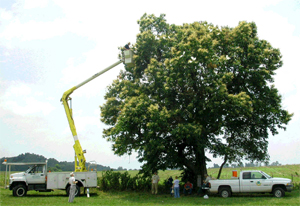
One of the last healthy American chestnut trees

Among the last of a proud breed, this Castanea dentata, or American chestnut, stands alone in a Kentucky field. It is one of the very few mature flowering chestnuts that has so far eluded the fungal disease known as chestnut blight. What you see in the picture is a tree so valuable that it is hand-pollinated by a botanist in a cherry picker. The botanist in the bucket is doing what he can to resurrect the old tree for posterity. I wish him luck.

When it comes to endangered species, the American chestnut is the botanical version of charismatic megafauna. Charismatic megafauna, those large and tragic beautiful animals like lions and gorillas, are the spokesmodels of extinction threat. The Tecopa pupfish can leave the stage unnoticed, but we can’t help but empathize with the plight of the Siberian tiger. Equally tragic and majestic is the mighty American chestnut. Call it charismatic megaflora. At one time it dominated the old-growth forest canopy in the Appalachians. And in a single generation it was gone. Or very nearly so.

The American Chestnut Foundation is dedicated to bringing back a blight-resistant version of the chestnut. As part of their campaign, ACF publications director Jeanne Coleman asked for letters from people who grew up in the shadow of the old chestnuts, people who can testify to what the trees looked like in their prime. My father is one of those people. And he sent Jeanne Coleman a letter. But Jeanne Coleman never wrote back.

So, as a public service on behalf of my father and his trees, I am posting the letter.

American Chestnut Foundation
P. O. Box 4044 Bennington, VT 05201

Dear Ms. Coleman,

In the late 1920’s and the early 1930’s I lived in a village, Crozet, at the foot of the mountains north of Charlottesville, Va. The mountains were beautifully green with great chestnut trees that marked our seasons.

In the autumn we waited for the excitement of the first frost and opening of the bur. Trips up the mountain brought home baskets of chestnuts that had that distinctive sweet firmness that lingers in memory. The fun and the flavor mingled.

This was especially true with the smaller chinquapins. I could collect a pocket full on my way to school and have a days worth of good eating as well as a supply of missiles that bedeviled the girls.

Of course those days preceded anyone’s idea of air conditioning other than a breeze through an open window. I would sleep with my head close to the window and enjoyed the panorama of the mountain. It was a great shock to see a line of brown moving day by day across the mountain. The concept of the blight was difficult for a boy to grasp and it took a considerable period of time for me to understand the inexorable march of destruction I was witnessing. I could not believe our chestnut trees would not come back.

My feelings were mixed in a way that a boy has difficulty expressing. They were a mixture of disbelief and vague grief that persist to this day. Mixed with this of course was that gift of the human spirit, hope.

I celebrate the persistent energy of the American Chestnut Foundation. I anticipate the day when my nostalgia blends into warm pleasure at your success—and the blacksmith can enjoy the shade.

Very truly yours,
Marcus M. Gulley, MD

As a footnote to this letter, I observe that the ACF describes in their FAQ two weevils that attack the chestnut. They are known as the “lesser” and the “greater”. To think, with that setup, that they attempt no joke about the lesser of two weevils… Oh the humanity! First they scorn my father’s letter, and then they forbear to use a perfect weevil-related punchline. Truly they are squandering riches.

What is Final Jeopardy?

Friend of the Star Chamber and regular commenter JMike is the guest author today. He wrote this in an email to me some time ago, and I asked him if I could post it. I’ve been meaning to put it up on the site for a while, and when I saw his recursive Billy Crystal comment on the surprisingly long comment thread kicked off by my JetBlue post, I knew it was time.

This is the way they play Jeopardy in JMike’s imagination. Count all the quotes and make sure it compiles. And watch your step!

Today’s final Jeopardy! category is “Needless Verbal Cleverness” and the answer is:

It is the correct way to phrase the question when the answer is “The opening semi-rhetorical question posed in ‘Atlas Shrugged’ by Ayn Rand.”

Alyssa, you’re in third place with $3000, what is your response?

Who is John Galt?

No, I’m sorry, that is incorrect. And what did you wager? $3000. That puts you at zero.

Our reigning champion, Barney, is in second place with $11500. Barney, what is your response?

What is “Who is John Galt?”

Again, I’m sorry, that is incorrect. And your wager? $11500. There seems to be some unwarranted confidence on the part of our contestants to be needlessly verbally clever, and that puts you down to zero as well.

Carl, you’re in first place with $14000. And your response?

What is “What is ‘Who is John Galt?'”

That is the correct answer. And your wager? $9001. That puts you at $23001 and you are today’s champion.

Thanks for viewing, everyone. Come back tomorrow!

Thanks JMike!

Crash your car! Consumer reports videos

I saw this over at the Popular Science blog: Consumer Reports has crash test videos for every single car ever made in the whole world. Okay, that’s probably an exaggeration, but I bet they have your car. They had mine. There’s something disturbing about watching your car get smashed, particularly if the color matches and the safety rating is poor and you can practically hear the poor crash test dummy’s pretend spinal column snapping like a pretzel stick.

Watch a few of the videos, and you’ll realize how many times Jeff Bartlett had to say the same basic information over and over and over. That guy earned his money the week they put these videos together.

And finally: poor Ford Fusion. So trying. So trying so hard. So only-just-acceptable on the smash-your-occupant rating (okay, to be fair, they got better in model year 2007).

Why is it that there is enough capital to bring creative destruction to the American airline industry (by which I mean new domestic competition like JetBlue and Virgin America), but not to the American automotive industry?

A pleasant ride on JetBlue

I flew to Seattle last week for the Microsoft Symposium on Social Computing. The best price I got for the flight was from JetBlue. I know they hit some turbulence earlier this year, but my experience was very good. I was impressed with a few things. For one, I had never experienced live network TV while flying before. It’s such a simple thing, but it feels absolutely revolutionary: I can change channels… wow. As a bonus, I happened to be in the air during one of the few recent games where the Red Sox beat the Yankees. I’m sure that fact alone made me feel kindly disposed toward the airline.

And once you get used to the fact that food isn’t part of the ticket price, it stops being such a big deal. Quit crying about it! Once you pull those prices apart, the trip gets cheaper and the food gets better.

I liked the fact that the entire plane was set up for coach. I never thought of myself as having a problem with the notion of First Class seating, but it was surprisingly… soothing without those plutocratic bastards and their oh-can-I-get-you-another-drink pre-takeoff mimosas and their insufferable don’t-pee-in-our-potty lavatories and their goddamned Rich Uncle Pennybags top hats.

Another nice touch: when the captain was introducing himself and the crew before the flight, I suddenly realized he was standing in the aisle looking at us. Strike a blow against the gated community! Look your pilot in the eye!

And my conference was excellent, so all in all it was great trip.

Anybody else have any JetBlue stories?

Voyeurism: Photos Recently Uploaded to Blogger

From the Google Operating System blog I came across this: Blogger Play is a site that shows you pictures that have recently been uploaded to Blogger. It’s sort of like looking at the latest pictures on Flickr, but it’s slightly better: if you see a bizarre or intriguing picture, you can almost always work out the story by clicking through to the blog and reading about it. That’s often not possible at Flickr.

These voyeur sites have been around for a long time. They always seduce me. Whenever I come across them I always A) waste a lot of time staring at them and B) feel like I’m staring at synapses in the Great Brain. This is what people all over the world are thinking about right now. That strikes me as being worth a chunk of my time.

X is the new Y, the network diagram

We’ve had a few interesting discussions here about snowclones. Snowclone is the unlovely name given to the notion of phrasal templates, or what might be called do-it-yourself cliché kits. One of the great snowclones of our age is “X is the new black“, a construction that generalizes into “X is the new Y”.

is-the-new.png

Search engines can give us a sense of the vast destructive power of a rampaging snowclone. A search for “is the new black” returns just over a million documents. I propose a Saffir-Simpson style scale for snowclonic power based on Google reach and associated cultural damage. For instance, Category One snowclones are not dangerous and generally reach no further than the speech of unimaginative mouth-breathers and bloggers. Prose and newscast copy are affected in a Category Two outbreak. A Cat Five snowclone can rip the tongues from unwary media figures and warp the cultural institutions of an entire generation.

I mention all this because I came across this dandy visualization today: is the new at thediagram.com. One small corner of which reads: asleep sleep <= sex <= to text.

Note: points will deducted from Gryffindor House for any mentions of our new overlords in the comments.

Another addictive game

Not wasting enough time yet today? I have just the thing for you. Bloxorz is a dangerously addictive game that will exercise your spatial reasoning muscles. Not to mention your procrastination muscles. I have no idea how to pronounce Bloxorz, but then again, I don’t speak hax0r.

The idea is to roll a little brick past various obstacles while preventing it from plummeting, Q*bert style, into empty space. It’s very nicely made. Love the little metal-brick clinky sounds. And I like the fact that there’s absolutely no time pressure.

Let me know how far you get. I haven’t gotten past stage 15 yet.

(This is another quality link that I picked up from collision detection.)

All the pictures from the Hubble Telescope

Many people don’t fully realize that the appeal of amateur astronomy is cerebral rather than a visual. An expensive telescope can afford you some breathtaking views of the moon as well as a nifty view of Jupiter and its satellites. Saturn is a minor thrill, and a few of the larger nebulae also make for fun viewing. But at that point, as far as pure visual spectacle goes, you’re pretty much done. The moon will look the same the next time it’s full. It doesn’t change much. The Orion nebula doesn’t change at all. And it’s a pain in the ass to move that big telescope back into the yard. This is why, on a typical night, so many telescopes gather dust rather than starlight.

If the essential notion of it doesn’t thrill you, then observing variable stars is about the most boring thing imaginable. An enthusiast will get very exercised about the occultation of Regulus by the dark limb of the passing moon. But what are we really talking about here? The star is there, and then it winks out of sight. I can see both sides of this argument. On the one hand, what a majestic event! The inexorable interposition of massive heavenly bodies made plain to our tiny Earthbound eyebones. Oh, the grandeur! The hand of God is surely there. On the other hand: big freaking deal. I’m cold. Why did I stay up for this?

If, however, you had the Hubble Space Telescope at your command, it would be a different story. For a machine like that, the visual thrills never stop. So I was really happy to find a site that does a good job cataloguing all the magnificent pictures taken by Hubble over the years: HubbleSite.

I’ve always found the Hourglass Nebula MyCn18 to be particularly haunting. I’d be willing to bet that freely available pictures like this will do more to recruit more future astronomers than backyard telescopes ever did.

Ignite Boston and bioscreencast.com

I gave a talk at the second O’Reilly Ignite Boston event tonight, and I was lucky enough to meet Hari Jayaram who was also there to present. Hari is a crystallographer at Brandeis with several Protein Data Bank entries under his belt, including the notorious coronavirus nucleocapsid of SARS fame. Along with several other friends, he is busy creating bioscreencast.com. The site was the topic of his talk. Like JoVE and SciVee, bioscreencast aims to remedy the dreadful dearth of practical advice and information faced by working biologists. For example, how do you use BLAST at NCBI to look for homologous proteins? You could waste a lot of time screwing around on the site, or you could just let Hari tell you.

The Navy discovered that kids who spent a lot of time playing flight simulator games were better prepared to learn to fly. I wonder if, in a few years, freshman biology students will arrive on campus knowing all their protocols by heart because they spent so many hours watching bioscreencast.com videos and paging through OpenWetWare.